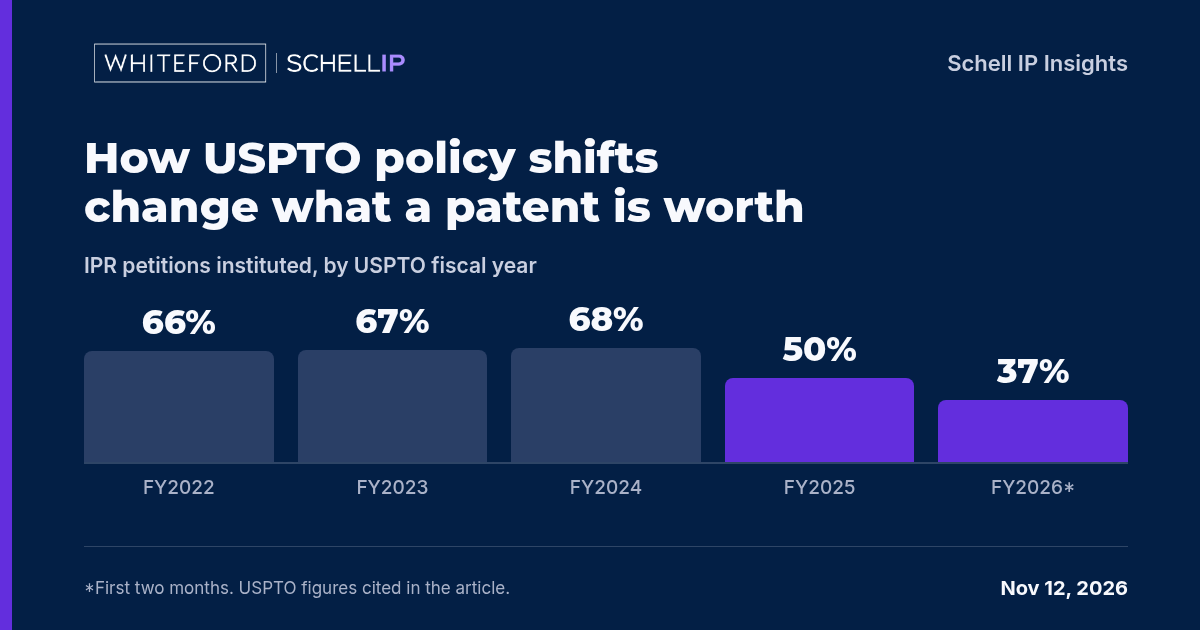
Quick Answer: Much of what makes a U.S. patent easy or hard to challenge is set by Patent Office policy, not by the Patent Act, and that policy has changed direction with each administration since 2014. PTAB institution rates fell from 68 percent of petitions in fiscal 2024 to 37 percent in the first two months of fiscal 2026, without any new statute. Founders, investors and patent owners should build portfolios that hold up in district court, time enforcement and licensing with the policy window in mind, and treat every assessment of patent strength as dated.
Founders and investors often talk about a patent as if its strength were fixed the day it issued. That has never been entirely true, and it is less true now. In my article for JDSupra, I traced how three administrations have pointed the same office in three directions. Here I want to step back from the history and focus on what the pattern means for the people who build, fund, buy and enforce patents.
Two Layers: What Stays Put and What Moves
I find it useful to think about the patent system in two layers. The durable layer is the statute and the Supreme Court. Alice and Mayo still govern eligibility, Amgen still requires a patent to teach the full scope of what it claims, and in district court a patent still carries a presumption of validity that a challenger must overcome by clear and convincing evidence. No Director can change any of that.
The flexible layer is Office practice: how examiners apply eligibility guidance, how the Office treats inventions made with AI tools, and above all whether the Patent Trial and Appeal Board agrees to hear a challenge at all. The Supreme Court has read the institution decision as discretionary and largely unreviewable. A Director who wants to hear fewer challenges can do that, the next Director can reverse it, and there is little a court can say about either choice. Most of this layer moves by memorandum, and a memorandum can be withdrawn as quickly as it was issued.
What the Current Swing Looks Like
The Office’s own statistics show the scale. Institution by petition ran at 66, 67 and 68 percent in fiscal years 2022 through 2024. It dropped to 50 percent in fiscal 2025 and stood at 37 percent for the first two months of fiscal 2026. Measured by patent, the rate went from 74 percent in fiscal 2024 to 54 percent in fiscal 2025 and 46 percent so far in fiscal 2026. Electrical and computer petitions, where most petitions are filed, were instituted 27 percent of the time in those two months, compared with 67 percent for bio/pharma and 59 percent for chemical.
The policy changes behind those numbers include the 2025 rescission of the 2022 procedure that had limited discretionary denials, denials based on the idea that the public’s expectations had settled around an older patent, and, since October 20, 2025, the Director personally deciding whether to institute every inter partes review and post-grant review. Proposed rules would go further, but they are proposals, not final rules. Meanwhile the two bipartisan bills that would actually change the statute, the Patent Eligibility Restoration Act and the PREVAIL Act, have not passed either chamber.
Portfolio Strategy: Build for the Forum You Cannot Avoid
When administrative review is harder to obtain, more validity fights move to district court, where judges apply Alice and Amgen directly and owe the Office’s guidance nothing. That changes what a strong portfolio looks like. Claims that were allowed under favorable eligibility guidance deserve a fresh review against the case law. For any patent that matters commercially, the specification and file history should support the claims on their own terms. I have written before about building a patent portfolio that matters at exit, and policy volatility reinforces the same point: a smaller set of patents that would survive a court challenge is worth more than a large set that depends on a friendly Director.
Claim Drafting and Continuations
Drafting under policy uncertainty means writing to the standard that does not change. In practice that means describing the specific technical improvement in detail, including claim sets of different scope, and not leaning on a reading of examination guidance that may not outlast the Director who issued it.
Continuations are the main tool for adapting. A pending family lets you pursue claims aimed at competitor products as they appear and lets you respond to whatever guidance is in force when those claims are examined. They are not free. The Office has added fees for continuing applications, and Directors can use fees to shape filing behavior, so continuations should be tied to the product roadmap rather than filed by reflex.
Timing Enforcement and Licensing
For patent owners, a period when administrative challenges are hard to bring is a period of greater leverage. The catch is that a discretionary denial does not estop the challenger. Estoppel attaches only after a final written decision, so a petition turned away today on discretionary grounds can come back under a later Director. A favorable window is something to use, not something to count on. A license or settlement signed while the window is open locks in value that a policy reversal cannot take back. And if you receive a discretionary denial, I would describe it to your board as a postponement, not a victory.
IPR Risk Runs Both Ways
Patent owners face lower administrative risk today, but it is not zero and it is not permanent. Older patents may benefit from settled-expectations reasoning, and that reasoning can be withdrawn by memorandum.
For companies accused of infringement, filing a petition is no longer the automatic opening move. The decision now has to weigh the age of the patent, the posture of the litigation, the real chance of a discretionary denial that cannot be appealed, the cost of the petition itself, and the estoppel that follows if review is instituted and the challenger loses. I covered some of this in PTAB discretionary denials: lessons for startup patent strategy.
Diligence for Investors and Acquirers
A statement that a patent is “strong” needs a date attached to it. A validity opinion or freedom-to-operate analysis written against 2024 institution rates answers a different question than the one a buyer is asking now. In investor due diligence, I would add these questions:
- Which policy environment did the validity or freedom-to-operate analysis assume, and when was it written?
- Were the key claims allowed under eligibility guidance that has since changed, and how do they hold up under Alice applied directly?
- Has any patent faced a petition, and if review was denied, was the denial on the merits or discretionary?
- Are continuations pending that let the portfolio adapt to new products or new policy?
- What is the litigation history of each key patent, given that pending proposals would treat previously challenged claims differently if adopted?
Sellers should expect these questions and have answers ready.
Valuing Patents Under Policy Uncertainty
I value patent strength as a range rather than a single number. In one scenario, current policy holds and the proposed rules are adopted, which would make issued patents meaningfully harder to attack outside district court and more valuable to the people who hold them. In the other, a future Director rescinds the memoranda and restores panel institution, and institution rates could move back toward the high 60s as quickly as they fell. That has already happened twice, in 2022 and in 2025. Because institution decisions are unreviewable, there is no court ruling waiting to settle the question.
The durable value of a patent is the part that would hold up in district court under Supreme Court law. The administrative protection on top of that is real, but it should be priced as something that may last only as long as the current policy.
Talk Through Your Portfolio
If you are raising money, buying a company, licensing a patent or facing a petition, it is worth checking which of your assumptions depend on the current Director. Book a consultation and we can review your portfolio against the rules that last and the ones that may not.
Attorney advertising. General information, not legal advice.