Quick Answer: In the patent vs copyright vs trademark comparison, each protects a different kind of asset. A patent protects inventions, meaning how something works or is made. A copyright protects original creative works such as writing, art, music, and software code. A trademark protects brand identifiers such as names, logos, and slogans that distinguish your products in the marketplace. Most growing businesses need more than one: a tech startup might need a patent for its invention, a copyright for its codebase, and a trademark for its brand name, all at the same time. A patent attorney can help you determine which combination of patent vs copyright vs trademark protection actually fits your business.
Inventors and founders often assume that one type of intellectual property protection covers everything they have built. That assumption is one of the most common and most costly mistakes in IP planning. In the patent vs copyright vs trademark comparison, each one protects a fundamentally different kind of asset, and choosing the wrong one, or only pursuing one when you need two or three, can leave significant parts of your business exposed.
This guide breaks down the patent vs copyright vs trademark distinction clearly: what each one covers, how long protection lasts, how to obtain it, and how to figure out which combination fits your situation.
Patent vs Copyright vs Trademark at a Glance
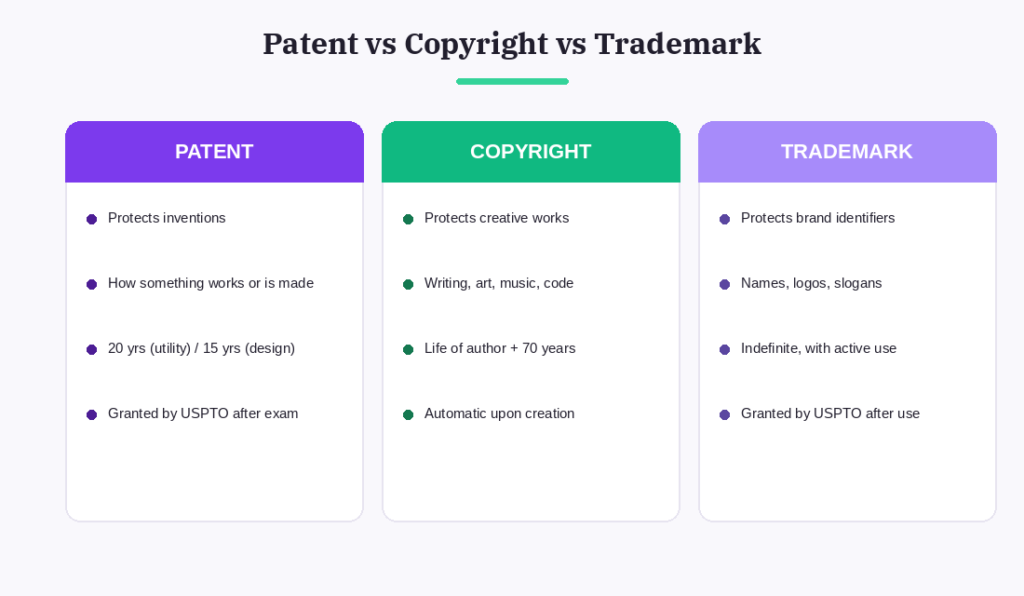
The table above captures the core of the patent vs copyright vs trademark distinction. A patent protects an invention. A copyright protects creative expression as a work of authorship. A trademark protects brand identity and the source identifier of a good or a service. None of the three substitutes for the others, which is precisely why the patent vs copyright vs trademark question trips up so many founders. A patent attorney can work through this picture with you and tell you which of the three applies to your specific situation, and whether you need more than one.
What Does a Patent Protect?
In the patent vs copyright vs trademark framework, a patent is the protection that covers how something works or is made. A patent protects an invention: a new and useful process, machine, manufactured item, composition of matter, or ornamental design, and any new and useful improvement on one.
To qualify, an invention generally needs to be:
- New: not previously patented or publicly disclosed
- Useful: having a practical application
- Non-obvious: not a straightforward variation of existing technology
Utility patents last 20 years from the filing date of the patent application, subject to maintenance fees. Design patents, which protect appearance rather than function, last 15 years from the date of grant with no maintenance fees. Getting a patent requires filing an application with the USPTO and going through a formal examination process. This is the part of the patent vs copyright vs trademark picture where the guidance of a patent attorney makes the biggest practical difference, since the strength of your claims determines what the patent actually protects. For the full filing process, our overview of how to file a patent walks through each step.
What Does a Copyright Protect?
In the patent vs copyright vs trademark comparison, copyright is the protection that covers original works of authorship. This includes books, articles, music, photographs, paintings, films, software code, and other creative content. Copyright is the most automatic of the three: protection exists the moment an original work is fixed in a tangible form, with no application or registration required.
That said, formal registration with the U.S. Copyright Office provides significant legal advantages if you ever need to enforce your rights, including the ability to pursue statutory damages. Copyright lasts for the life of the author plus 70 years in most cases. The critical limitation to understand in the patent vs copyright vs trademark context is that copyright protects expression, not ideas. If you write a detailed manual describing your invention, the copyright protects your specific wording. It does nothing to stop a competitor from building the invention you described. That is exactly the gap a patent fills, which is why patent vs copyright is one of the most important distinctions for inventors to understand.
What Does a Trademark Protect?
In the patent vs copyright vs trademark framework, a trademark is the protection that covers brand identity: the words, names, symbols, logos, and slogans that identify and distinguish your products or services from those of competitors.
Trademark rights can arise through use in commerce alone, but federal registration with the USPTO provides substantially stronger protection, including:
- The right to use the registered trademark symbol
- A legal presumption of nationwide ownership
- The ability to block importation of infringing foreign goods
- A stronger basis for enforcement if a competitor copies your brand
Unlike patents and copyrights, trademark protection can last indefinitely as long as the mark stays in active use and renewals are filed on schedule. A common point of confusion in the patent vs copyright vs trademark discussion is that people try to “patent a name.” A name is a trademark matter, not a patent matter, even if the product the name represents may itself be patentable.
Patent vs Copyright vs Trademark: Do You Need More Than One?
The patent vs copyright vs trademark question is rarely an either-or decision. Most growing businesses need some combination, because their assets span inventions, creative content, and brand identity all at once. Some common examples of how these stack:
- A medical device company might patent the mechanism of its device, copyright its instructional materials and software interface, and trademark its product name and logo
- A software startup might patent a novel technical process, copyright its codebase, and trademark its brand
- A consumer product company might patent a unique functional feature, file a design patent on its distinctive look, trademark its brand, and rely on copyright for its marketing materials
Layering protection this way is standard practice for companies that take IP seriously, and it is not a sign of overspending. Each form of protection covers a different vulnerability, and missing one can leave a gap a competitor can exploit. A patent attorney who understands how patent vs copyright vs trademark protections interact can help you build a coordinated strategy early, before something forces the issue. Our IP strategy roadmap from idea to exit covers how to think about this for growing companies specifically.
How to Decide What You Need in the Patent vs Copyright vs Trademark Picture
Working through the patent vs copyright vs trademark decision for your own situation comes down to a few direct questions:
- Does your product or process work in a new way that no one else has patented? That points toward a patent.
- Have you created original written, visual, audio, or code-based content? That points toward a copyright.
- Do you have a brand name, logo, or slogan that distinguishes your business and that competitors could copy? That points toward a trademark.
- Do you have an invention that also has a distinctive look? Both a utility patent and a design patent may apply.
Most businesses find the answer to more than one of these questions is yes. A patent attorney is usually the most efficient starting point for sorting through the patent vs copyright vs trademark picture, since they can assess what you have built, identify what is patentable, and advise on where other types of protection apply alongside or instead. For a sense of what that guidance looks like in practice, our post on what a patent attorney does is a useful read. If you are weighing whether a patent attorney is the right call for your situation, our take on whether you need a patent attorney addresses that directly.
Common Mistakes Founders Make With Patent vs Copyright vs Trademark
Several mistakes show up repeatedly when founders try to navigate patent vs copyright vs trademark on their own:
- Assuming a copyright on their product documentation or software covers the underlying invention, when it only protects the specific creative expression, not the function
- Trying to patent a brand name or logo, when those are squarely trademark matters
- Registering a trademark but never filing a patent, leaving the actual invention freely copyable
- Relying on a general IP strategy without understanding which of the three types of protection covers which part of the business
- Waiting too long on patents specifically, since public disclosure starts a filing clock that closes permanently if missed
Sorting out patent vs copyright vs trademark correctly the first time avoids every one of these. A patent attorney is often the fastest path to that clarity, even when part of the answer turns out to involve a trademark or copyright rather than a patent. For the specific patent-related timing mistakes that are hardest to recover from, our post on the most common patent timing mistakes is worth reading before you disclose publicly.
Jeff’s Take
The founders who get into trouble are usually the ones who picked one form of protection because it was the one they had heard of, not because it was the one that fit what they built. I have talked to people who registered a trademark on their brand and assumed that meant their invention was protected. In the patent vs copyright vs trademark picture, that is not even close. The trademark protected the name. Anyone could still legally build the thing the name was attached to.
When I look at a new product or business, I am not just asking whether it is patentable. I am asking what the whole protection picture looks like, because in the patent vs copyright vs trademark conversation, the right answer is almost never just one of the three. Mapping this out early, before a competitor forces the question, is far less expensive than figuring it out after something has already gone wrong.
How Schell IP Helps
At Schell IP, we help founders and inventors understand exactly which protections their business needs, starting with a clear read on the patent vs copyright vs trademark question as it applies to your specific situation. Denver patent attorney Jeff Schell brings both legal expertise and real founder experience, so we look at your business the way an investor or acquirer eventually will, asking whether your IP actually protects what makes the company valuable.
We help with:
- Patentability assessments to determine whether your invention qualifies and what type of patent fits
- Strategic IP guidance on how patents fit alongside copyright and trademark in a coordinated protection plan
- Patent application drafting and prosecution for inventions that need protection
- Founder-informed perspective on building IP that supports fundraising and exit, not just legal checkboxes
Book a free consultation to get clarity on what your business actually needs to protect.

Frequently Asked Questions
What is the main difference between a patent, copyright, and trademark?
In the patent vs copyright vs trademark comparison, a patent protects inventions and how they work, a copyright protects original creative works like writing, art, and software code, and a trademark protects brand identifiers like names, logos, and slogans. Each covers a fundamentally different kind of asset.
Can I patent a product name?
No. A product name is protected through trademark registration, not a patent. In the patent vs copyright vs trademark framework, patents cover inventions while trademarks cover brand identifiers. The underlying product the name represents may itself be patentable, but the name is not.
Can copyright protect my invention?
No. Copyright protects the specific creative expression of an idea, such as written instructions or software code, but it does not stop someone from building the invention itself. In the patent vs copyright vs trademark picture, only a patent protects the underlying invention.
Do I need all three: a patent, copyright, and trademark?
Many growing businesses do need more than one. A tech company might need a patent for its core technology, a copyright for its software code, and a trademark for its brand name. A patent attorney can help you determine which combination of patent vs copyright vs trademark protection fits your specific business.
How long does each type of protection last?
A utility patent lasts 20 years from the non-provisional filing date. A design patent lasts 15 years from grant. Copyright lasts for the life of the author plus 70 years in most cases. Trademark protection can last indefinitely with active use and timely renewals.
Which should I get first: a patent, copyright, or trademark?
It depends on what you have and what is most time-sensitive. Patents have strict filing deadlines tied to public disclosure, so in the patent vs copyright vs trademark decision, if you have a patentable invention, that timing often makes the patent most urgent. A patent attorney can help you prioritize based on your specific situation.
Is a logo protected by copyright or trademark?
Potentially both. In the patent vs copyright vs trademark framework, a trademark protects the logo’s function as a brand identifier in commerce, while copyright can protect the original artistic design of the logo. Most businesses rely primarily on trademark protection for their logos.
What happens if I choose the wrong type of protection?
Choosing the wrong protection in the patent vs copyright vs trademark picture, or pursuing only one when you need more, can leave significant parts of your business exposed. Working with a patent attorney early helps avoid this mistake and makes sure the protections you file for actually match the assets worth protecting.
Final Thoughts
The patent vs copyright vs trademark question is not about picking the best one out of three options. It is about understanding that most businesses have inventions, creative works, and brand identities that each need their own form of protection. Getting the patent vs copyright vs trademark picture mapped out clearly and early protects the full value of what you have built, rather than leaving gaps a competitor can exploit.
At Schell IP, we help founders and inventors sort through patent vs copyright vs trademark and build a coordinated strategy that actually protects their business. Whether you need a patent, want to understand how all three fit together, or simply are not sure where to start, the first step is a conversation.
Book a free consultation today to get clarity on what your business needs to protect.