Quick Answer: Want to know how to patent a product? You first need to confirm your invention is new and patentable, decide between a utility patent (how it works) and a design patent (how it looks), file a provisional patent application to secure your priority date, then file a full non-provisional application within 12 months. The USPTO examines your application, may issue Office Actions requiring a response, and if approved, grants the patent. Working with a patent attorney throughout this process is strongly recommended, since the strength of your claims determines how much protection you actually get when you patent a product.
If you have invented something new, protecting it starts with understanding how to patent a product and what the process actually involves. The steps are more accessible than most people assume, but the details matter enormously. A patent filed incorrectly or too late can provide far less protection than you need, or none at all. Getting a patent attorney involved early is the single most reliable way to make sure the patent you end up with actually protects your business.
This guide walks through how to patent a product from the beginning: what qualifies, which type of patent fits your product, the filing process step by step, what it costs, and where professional guidance makes the biggest difference. This guide is meant to provide a common example of the procedure to follow, but every invention and every situation is slightly different and the sequence of steps sometimes likewise varies.
Does Your Product Qualify for a Patent?
Before you patent a product, confirm it actually qualifies. The USPTO grants patents on inventions that meet three criteria:
- New: no one has patented or publicly disclosed it before
- Useful: it has a practical purpose
- Non-obvious: it is not a straightforward variation of something that already exists
Most physical products with a novel feature or function qualify for some form of protection. The honest caveat is that “qualifies” is not always obvious to assess without experience reading prior art and claim scope. A patent attorney can evaluate your product quickly and tell you whether it clears these hurdles, what the realistic scope of protection looks like, and whether there are any red flags worth addressing before you invest in a filing. Skipping this step and filing blind is one of the most common ways inventors end up with a weaker patent than they needed.
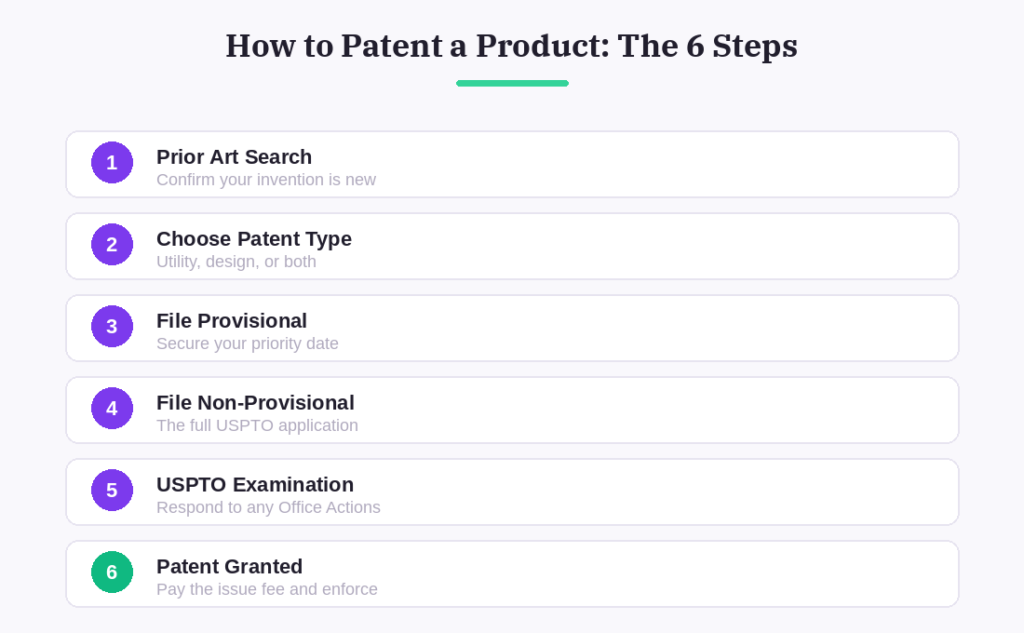
How to Patent a Product Step 1: Do a Prior Art Search
The first practical step to patent a product is a prior art search: a review of existing patents, publications, and products that could affect whether and how you can protect your invention. A prior art search serves two purposes. It tells you whether your product is actually new, and it helps your patent attorney understand how to draft claims that are clearly distinct from what already exists.
You can begin searching on the USPTO’s patent database and Google Patents. Both are free and publicly accessible. The limitation is that a thorough prior art search requires knowing how to interpret what you find, and a missed reference can undermine your entire application later. A patent attorney conducts a professional search with the claim-drafting strategy in mind, not just to check a box but to shape how your application is built from the ground up.
Step 2: Choose the Right Type of Patent for Your Product
When you learn how to patent a product, one of the first decisions is which type of patent fits what you have created:
- A utility patent protects how your product works: its function, mechanism, process, or composition. If the core innovation is the way the product operates, a utility patent is what you need.
- A design patent protects how your product looks: its ornamental shape, surface design, or visual appearance. If competitors could copy the look of your product and hurt your sales, a design patent covers that.
- Both together: many products have a patentable function and a protectable appearance. Filing both gives you the broadest coverage against competitors who might try to design around one type of protection.
The right combination depends on where your innovation actually lives. A patent attorney can assess your product and recommend the approach that gives you the most durable protection relative to your budget. Making the wrong call here affects everything that follows, so this is not a decision to make based on whichever filing is cheaper.
Step 3: File a Provisional Patent Application
For most inventors, a provisional patent application is the right first step when learning how to patent a product. A provisional is not itself a patent, but it does three important things:
- It establishes your official priority date with the USPTO, meaning your invention is legally dated from that filing
- It gives you 12 months to refine your product, raise money, or prepare the full application
- It lets you use the term “patent pending” immediately, which signals to competitors and investors that protection is in process
The 12-month window the provisional creates is firm. If you do not file a full non-provisional application within 12 months, the provisional expires and you lose your priority date entirely. A patent attorney drafts the provisional to be as strong as possible so it fully supports the non-provisional that follows, tracks the 12-month deadline so it cannot be missed, and positions the application for the examination stage ahead.
Step 4: File a Non-Provisional Patent Application
The non-provisional is the full patent application that the USPTO actually examines. When you patent a product through a non-provisional, the application must include:
- A detailed written description of the invention
- Patent drawings that illustrate the invention
- The claims, which are the legal statements that define the boundaries of your protection
The claims are the most consequential part of how you patent a product. Broad, well-drafted claims give you real coverage against competitors. Narrow or poorly drafted claims leave gaps that a competitor can exploit by making small design changes to your product. Drafting claims that are as broad as the prior art allows, and that will survive USPTO examination, is a specialized legal skill. This is the part of the process where working with a patent attorney is not just helpful but directly determines the value of the patent you end up with. Inventors who file non-provisional applications without professional help frequently end up with patents that grant but do not protect what they actually built.
Step 5: Respond to the USPTO Examiner
Once you file, the USPTO assigns an examiner to review your application. The examiner searches prior art and evaluates your claims. In most applications, the examiner issues at least one Office Action, a written response raising rejections or objections. Common grounds include:
- Prior art rejection: the examiner believes an existing patent or publication covers your invention
- Obviousness rejection: the examiner believes your invention is an obvious combination of existing ideas
- Indefiniteness: the claim language is unclear or ambiguous
- Enablement: the written description does not fully explain how to make and use the invention
Receiving an Office Action is normal and does not mean your application has failed. You have the right to respond, argue against the rejection, and amend your claims. How you respond determines whether you come out with broad protection or narrow protection, and it requires understanding patent law and examination strategy. A patent attorney handles Office Action responses as a core part of patent prosecution, and the quality of that response often makes the difference between a strong patent and a significantly weakened one. Patent prosecution can take one to three years depending on the technology area and the examiner’s workload.
Step 6: Your Patent Is Granted. Now What?
When your application is allowed, you pay an issue fee and the patent is granted. At that point you have the exclusive right to make, use, sell, and import your invention for the life of the patent:
- Utility patents: 20 years from the filing date of the non-provisional, subject to maintenance fees at 3.5, 7.5, and 11.5 years
- Design patents: 15 years from the date of grant, with no maintenance fees
A granted patent also gives you the legal basis to enforce your rights. If a competitor copies your product, your options include sending a cease-and-desist letter, negotiating a license, or pursuing litigation. A patent attorney can advise on the most practical enforcement approach for your product and business situation.
How Much Does It Cost to Patent a Product?
When considering how to patent a product, you should also be aware of the cost. The cost to patent a product depends on the type of patent, the complexity of the invention, and whether you work with a patent attorney. As a general framework:
- A provisional patent application is the lowest-cost entry point, with USPTO filing fees that vary by entity size plus attorney fees for drafting
- A non-provisional utility patent involves higher attorney fees for drafting, prosecution, and Office Action responses, plus USPTO examination fees
- A design patent application is generally less expensive than a utility filing, since the specification is shorter and there is a single claim
Because USPTO fees change periodically and attorney fees vary by firm and complexity, the complete patent cost guide for 2026 gives you the most reliable breakdown of what to expect at each stage. A patent attorney can provide a personalized estimate once they understand your specific product.
The Most Important Timing Rule When You Patent a Product
One of the most critical things to understand about how to patent a product is the timing rules around public disclosure. Missing these is one of the most common ways inventors permanently lose patent rights:
- In the US, you generally have 12 months after the first public disclosure, sale, or offer for sale of your product to file a patent application. After that window closes, you may lose your right to a patent entirely.
- Internationally, the rules are stricter. Most other countries require you to file before any public disclosure at all. A trade show demo, crowdfunding launch, or pitch to investors can eliminate your foreign patent rights permanently if you have not filed first.
The safest approach when you patent a product is to file a provisional application before any public disclosure. A patent attorney can review your disclosure history, assess whether any deadlines have been triggered, and advise on the best path forward if you have already disclosed publicly.
How to Patent a Product with a Patent Attorney
You are legally permitted to patent a product without a patent attorney. But understanding whether you should is a different question, and the honest answer is that the quality of the patent you end up with depends almost entirely on decisions that require legal expertise: how the prior art search is interpreted, how the claims are drafted, and how Office Actions are handled.
The inventors who regret not using a patent attorney when they patent a product almost always say the same thing: the patent granted, but it does not actually stop a competitor from copying the product because the claims were too narrow. That outcome is far more common in self-filed applications than most people realize, and it is not recoverable after the fact. A granted patent with weak claims cannot easily be strengthened after the fact.
Working with a patent attorney when you patent a product is not a luxury; it is the most reliable way to ensure the time and money you invest in filing translates into protection that actually defends your market position.
Jeff’s Take: How to Patent a Product
The inventors who come in after trying to patent a product on their own usually fall into the same pattern. They filed, the USPTO granted something, and now they want to know why a competitor seems to be copying the product without infringing the patent. Almost always, the answer is in the claims. The claims were drafted too narrowly, or they described the specific product rather than the underlying innovation, so a competitor can make a small design change and stay outside the protected area.
The goal of patenting a product is not to get a patent. It is to get a patent that actually protects your market position. Those are different things, and the difference usually comes down to a few sentences of claim language that took an experienced attorney to write correctly. Getting that right from the start is considerably less expensive than trying to fix it later, and in most cases you cannot fix it at all once the application is filed.
How to Patent a Product with Schell IP
At Schell IP, we help inventors and product companies learn how to patent a product, then go through the process of patenting a product with the goal of real, enforceable protection, not just a certificate. Denver patent attorney Jeff Schell brings both legal expertise and real experience as a founder and multi-exit entrepreneur, so we look at your product from the perspective of someone who understands what protection actually needs to accomplish for a business.
We help with:
- Prior art searches and patentability assessments so you know what you are working with before you file
- Provisional and non-provisional applications drafted to protect the broadest defensible scope of your invention
- Patent prosecution including Office Action responses that protect the strength of your claims
- Strategic advice on whether a utility patent, design patent, or both makes sense for your product
Book a free consultation to talk through your product and get a clear picture of your options.
Frequently Asked Questions
How do I patent a product?
To patent a product, do a prior art search, choose between a utility patent and a design patent, file a provisional application to secure your priority date, file a full non-provisional application within 12 months, respond to any USPTO Office Actions, and pay the issue fee when your application is allowed. Working with a patent attorney throughout gives you the strongest possible protection at each stage.
How long does it take to patent a product?
It typically takes one to three years from filing a non-provisional application to receiving a granted patent, depending on the technology area and USPTO backlog. Filing a provisional first gives you 12 months to prepare before the full filing clock starts.
How much does it cost to patent a product?
The cost to patent a product varies by patent type, invention complexity, and whether you work with a patent attorney. A provisional application is the lowest-cost starting point, with a full utility patent involving significantly more in combined USPTO and attorney fees. The 2026 patent cost guide has a full breakdown by filing type and entity size.
Do I need a patent attorney to patent a product?
You are not required to use one, but the strength of a patent depends heavily on how claims are drafted and how Office Actions are handled. Self-filed applications frequently result in narrower protection than the inventor realizes. Working with a patent attorney when you patent a product is the most reliable path to protection that actually defends your business.
What is the difference between a utility patent and a design patent for a product?
A utility patent protects how your product works. A design patent protects how it looks. Many products benefit from filing both. A patent attorney can assess your product and recommend the right approach.
Can I say patent pending before my patent is granted?
Yes. Once you file a provisional or non-provisional application with the USPTO, you can use the term “patent pending.” It signals to competitors that protection is in process and establishes your priority date.
What happens if someone copies my product before my patent is granted?
You can mark your product as patent pending as a deterrent. Once the patent is granted, you may be able to pursue damages going back to the publication date of the application in some circumstances. A patent attorney can advise on the right enforcement strategy for your product and situation.
What if I already publicly disclosed my product?
In the US, you generally have 12 months from the date of first public disclosure to file a patent application. After that window, you may lose your right to a patent. Internationally, most countries require filing before any public disclosure. If you have already disclosed, speak with a patent attorney as soon as possible to assess your options before the deadline passes.
Final Thoughts: How to Patent a Product
Learning how to patent a product is the first step toward real protection for your invention. The process is accessible, but the strength of the patent you end up with depends on decisions made at every stage, from the prior art search through the claims, prosecution, and grant. The inventors who come out with meaningful protection are the ones who worked with a patent attorney from the start, not because filing is too complicated to understand, but because drafting claims and handling examination are specialized skills that directly determine what the patent actually covers.
At Schell IP, we help inventors and product companies know how to patent a product with clear strategy and strong, enforceable claims. Whether you are just starting out or have a prototype ready to protect, the first step is a conversation.
Book a free consultation today to discuss your product and map out your path to protection.