Quick Answer: You need a patent infringement attorney when someone is using your patented invention without permission, when you have received a cease and desist letter asserting a patent against you, or when you believe your product may be infringing an existing patent. The earlier you involve an attorney, the more options you have. Here is what to expect from the process.
Patent infringement disputes are among the most high-stakes situations a business owner or inventor can face. Whether you are the patent holder trying to stop a competitor, or a company that has received a cease and desist letter, the decisions you make in the first days and weeks matter significantly. This guide covers when to hire a patent infringement attorney, what the engagement looks like from start to finish, and what realistic outcomes look like based on real case experience.
What a Patent Infringement Attorney Does
A patent infringement attorney handles the legal work on both sides of a patent dispute: representing patent holders who want to enforce their rights, and defending companies or individuals accused of infringement.
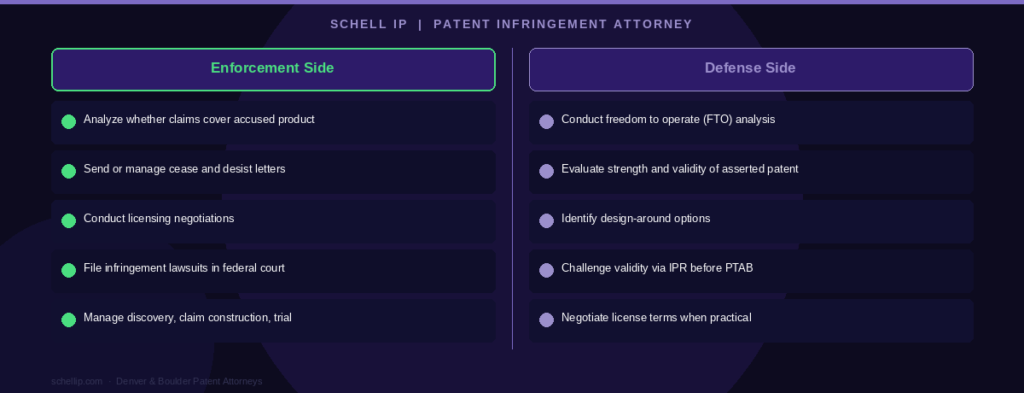
On the enforcement side, a patent infringement attorney:
- Analyzes whether your patent claims cover the accused product or process
- Sends or responds to cease and desist letters
- Conducts licensing negotiations on your behalf
- Files infringement lawsuits in federal district court when necessary
- Manages discovery, expert witnesses, claim construction, and trial
On the defense side, a patent infringement attorney:
- Conducts a freedom to operate analysis to assess your actual exposure
- Evaluates the strength and validity of the patent being asserted against you
- Identifies design-around options that eliminate infringement without stopping your business
- Challenges patent validity through inter partes review (IPR) before the USPTO or as a defense in litigation
- Negotiates license terms when licensing is the most practical path
The skill set required is different from a general business attorney or even most intellectual property attorneys. Patent infringement work requires both a legal license and technical expertise in the relevant field, deep familiarity with USPTO examination practice, and experience navigating federal court proceedings. Understanding what a patent attorney does and how that differs from general legal counsel is a useful starting point before engaging one.
When to Hire a Patent Infringement Attorney
You have discovered a competitor copying your patented invention
If you hold a patent and you believe a competitor is making, using, selling, or importing a product that falls within your patent claims, the first step is not sending a letter yourself. It is getting a legal analysis that confirms your claims actually cover what the competitor is doing, and that your patent is valid and enforceable.
Sending a cease and desist letter based on weak analysis, or asserting a patent that turns out to be invalid, can create legal exposure of its own. A patent infringement attorney evaluates the situation before any action is taken and advises on whether enforcement is worth pursuing and what approach makes sense.
You have received a cease and desist letter
A cease and desist letter asserting patent infringement is not a lawsuit, but it demands a serious response. Ignoring it can be used as evidence of willful infringement, which under 35 U.S.C. § 284 allows courts to award enhanced damages of up to three times the actual damages. The standard for willfulness turns in part on whether you knew about the patent and continued anyway. The basics of patent infringement matter here: the claim that you did not know about the patent is not a defense to infringement, but it can affect the damages calculation.
Do not respond to a cease and desist letter without legal counsel, and do not ignore it. Contact a patent infringement attorney immediately to evaluate the claim, assess the patent’s strength, and determine your realistic options before you do anything else.
You are launching a product in a patent-heavy space
If you are building a product in a field where patents are actively asserted, a freedom to operate (FTO) analysis before launch is a standard part of responsible product development. An FTO analysis evaluates whether your product or process infringes any valid, enforceable patents in the relevant space. Catching a potential problem before launch gives you time to design around it, obtain a patent license, or challenge the patent, all of which are significantly less expensive before a dispute starts than after.
You are in acquisition or fundraising due diligence
Patent infringement exposure is a material issue in M&A and venture capital due diligence. Acquirers and investors will look at whether your product has any known infringement risk and whether you have taken steps to evaluate it. Having a clean FTO opinion, or a documented legal strategy for managing identified risks, puts you in a much stronger position than having no analysis at all, and it is a core part of building an IP strategy that supports a fundraise or exit.
What to Expect When You Hire a Patent Infringement Attorney
The initial consultation
The first conversation with a patent infringement attorney covers the basic facts of the situation: what patent is involved, what product or process is at issue, what has happened so far, and what the timeline looks like. At Schell IP, this conversation is free and gives you a clear picture of the situation before you commit to anything.
Jeff Schell brings a perspective to these conversations that most patent attorneys cannot: he has been through acquisitions and due diligence as a founder, not just as legal counsel. That context shapes how he evaluates infringement disputes in terms of business impact, not just legal risk.
The analysis phase
Before any strategy is recommended, the attorney conducts a substantive analysis. On the enforcement side, this means a claim chart mapping your patent claims to the accused product, an assessment of patent validity and enforceability, and a review of any prior art that a defendant might raise. On the defense side, this means an FTO analysis, a validity assessment of the patent being asserted, and an identification of design-around options.
This analysis is the foundation of everything that follows. Skipping it or rushing it leads to poor strategic decisions.
The strategy conversation
Based on the analysis, the attorney lays out the realistic options and what each one involves in terms of cost, timeline, and likely outcome. For patent holders, the options typically include sending a cease and desist letter, opening licensing negotiations, filing in federal court, or some combination. For defendants, the options typically include negotiating a license, implementing a design-around, challenging validity through inter partes review at the PTAB, or defending in litigation.
There is rarely one right answer, and the right path depends on factors including the strength of the patent, the size of the infringing market, the resources of both parties, and the business relationship between them. A patent infringement attorney who has handled a range of disputes can give you an honest read on what your situation actually warrants.
Resolution
Most patent infringement disputes resolve without going to trial. The most common outcomes are:
- A negotiated license agreement in which the accused infringer pays royalties or a lump sum to continue using the technology
- A settlement agreement in which the dispute is resolved on terms both parties can accept
- A design-around in which the accused product is modified to fall outside the patent claims
- A finding of invalidity that ends the dispute by eliminating the patent’s enforceability
- A consent judgment or injunction when the evidence strongly favors the patent holder
Trial outcomes in patent cases are unpredictable and expensive. Most experienced patent infringement attorneys resolve disputes before reaching that point when the facts and business interests allow it. Understanding direct and indirect patent infringement and how claims are actually read against a product is part of what makes early legal analysis so valuable in shaping a realistic strategy.
How Much Does a Patent Infringement Attorney Cost
Patent infringement work is billed differently depending on the nature and stage of the dispute. The cost ranges below reflect 2026 market rates for experienced patent counsel.
Freedom to operate analysis
This greatly varies depending on the complexity of the technology and the number of patents reviewed, but generally falls within the range of $10,000-$25,000. This is the most common starting point and often the highest-value work in terms of risk reduction per dollar spent.
Cease and desist letter
$2,000 to $5,000 for a well-researched letter with supporting claim analysis, whether sending or responding. Letters drafted without adequate analysis are a false economy.
Licensing negotiation
Highly variable depending on the deal size and complexity. Most attorneys bill hourly for negotiation work, typically at rates between $400 and $700 per hour for experienced patent counsel.
Federal court litigation
Patent litigation is one of the most expensive forms of commercial litigation. Cases that go through trial typically cost $1 million to $5 million or more per side. Many disputes settle before reaching that point, but the potential cost of litigation is a significant factor in every strategic decision.
For most small businesses and startups, the goal is to resolve infringement disputes efficiently and without litigation when possible. That requires early involvement of an attorney and a clear-eyed assessment of what the dispute is actually worth to both parties. The complete patent cost guide covers broader patent-related legal costs that provide useful context when budgeting for an infringement matter.
Common Questions About Patent Infringement Attorneys
The following questions come up consistently in initial consultations at Schell IP.
What if I cannot afford full litigation? Litigation is rarely the first option and often not necessary. A large proportion of infringement disputes resolve through licensing negotiations or cease and desist exchanges that never reach court. An attorney can evaluate whether your situation warrants litigation and what alternatives exist.
What if the patent being asserted against me seems weak? Patent strength is exactly what a validity analysis evaluates. Many patents that are asserted in disputes are vulnerable to challenge on prior art or other grounds. An IPR proceeding can invalidate a weak patent at a fraction of the cost of district court litigation.
What if I already designed around the patent? A design-around that was implemented without a formal legal analysis may or may not actually clear the patent’s claims. Having an attorney confirm that the modified product falls outside the claims is important before you rely on that conclusion.
What if the other party is much larger than me? The size disparity between parties is a real factor but not a reason to avoid getting legal counsel. Many smaller companies and individual inventors prevail in infringement disputes, and some have access to litigation financing that allows them to pursue or defend claims without upfront legal costs.
Jeff’s Take
The infringement disputes that are hardest to resolve well are the ones where a party waited too long to get legal advice. By the time they come in, they have already responded to a cease and desist letter without counsel, or they have sent one themselves without adequate analysis behind it, or they have continued selling a product for months after receiving notice of a patent.
What I tell clients at the outset is that the analysis has to come first. Before we decide anything about strategy, we need to know what the patent actually claims, whether it is valid, and whether the accused product genuinely falls within those claims. That analysis changes the conversation significantly. Some disputes that look serious on the surface turn out to be based on weak patents or claims that do not actually cover what the client is doing. Others that a client assumed were manageable turn out to be more serious than they realized.
The goal in every infringement matter is to get to the right outcome efficiently, whether that is a license, a design-around, a settlement, or a successful challenge to the patent. Litigation is always the last resort, not the starting point. If you are facing an infringement issue and want a straight read on where you stand, book a free consultation at Schell IP and we will start with the analysis.

Frequently Asked Questions
What is a patent infringement attorney?
A patent infringement attorney is a licensed attorney with USPTO patent bar admission who handles patent enforcement and defense work. This includes evaluating infringement claims, conducting freedom to operate analyses, negotiating licenses, and representing clients in USPTO proceedings and federal court litigation.
How do I know if I need a patent infringement attorney?
If you have received a cease and desist letter asserting a patent against your product, you need a patent infringement attorney immediately. If you believe a competitor is copying your patented invention, or if you are launching a product in a space with active patent enforcement, consulting a patent infringement attorney before the situation escalates is the right move.
What is the difference between a patent infringement attorney and a patent attorney?
All patent infringement attorneys are patent attorneys, but not all patent attorneys handle infringement disputes. Patent prosecution attorneys specialize in drafting and filing patent applications. Patent infringement attorneys specialize in enforcement and defense, which involves different skills including claim construction, litigation strategy, and licensing negotiation.
Can I send a cease and desist letter without a patent infringement attorney?
Technically yes, but it carries significant risk. A cease and desist letter that is not backed by a solid claim analysis can be used against you, can expose you to declaratory judgment claims, and can damage a licensing negotiation before it starts. Having an attorney draft and review the letter is strongly recommended.
How long does a patent infringement dispute take to resolve?
Timeline varies significantly. Disputes that resolve through licensing negotiation or cease and desist exchanges can be concluded in weeks to a few months. Inter partes review proceedings at the PTAB typically take 12 to 18 months. Federal court litigation through trial can take 2 to 4 years. Most disputes resolve before reaching trial.
What should I bring to my first meeting with a patent infringement attorney?
Bring any correspondence you have received, including cease and desist letters and any responses you have sent. If you are the patent holder, bring your patent and any information about the accused product. If you are the accused party, bring details about your product and any patent numbers referenced in the correspondence. The more context you can provide, the more useful the initial consultation will be.
Facing a patent infringement dispute or not sure where you stand? Book a free consultation with Jeff Schell at Schell IP. Denver and Boulder-based, serving businesses, startups, and inventors across Colorado and nationally.