
Quick Answer: Most inventors and startup founders that are building products that would benefit from patent protection should work with a patent attorney. A patent attorney writes stronger applications, drafts enforceable claims, manages USPTO deadlines, and helps you avoid mistakes that can cost thousands of dollars or permanently destroy your patent rights. You can legally file on your own, but the process is complex, rejection rates for self-filed patents are high, and weak patents provide little real protection. If your invention has commercial value, hiring a patent attorney is one of the smartest investments you can make.
This is one of the most common questions inventors and founders ask. The answer depends on your invention, your budget, and how much risk you are willing to take. This guide walks you through the key factors so you can make an informed decision about whether to hire a patent attorney or go it alone.
When You Should Hire a Patent Attorney
Not every invention needs a patent, and not every patent requires an attorney. But in most real-world situations, working with a patent attorney is the difference between getting meaningful protection and wasting your filing fees.
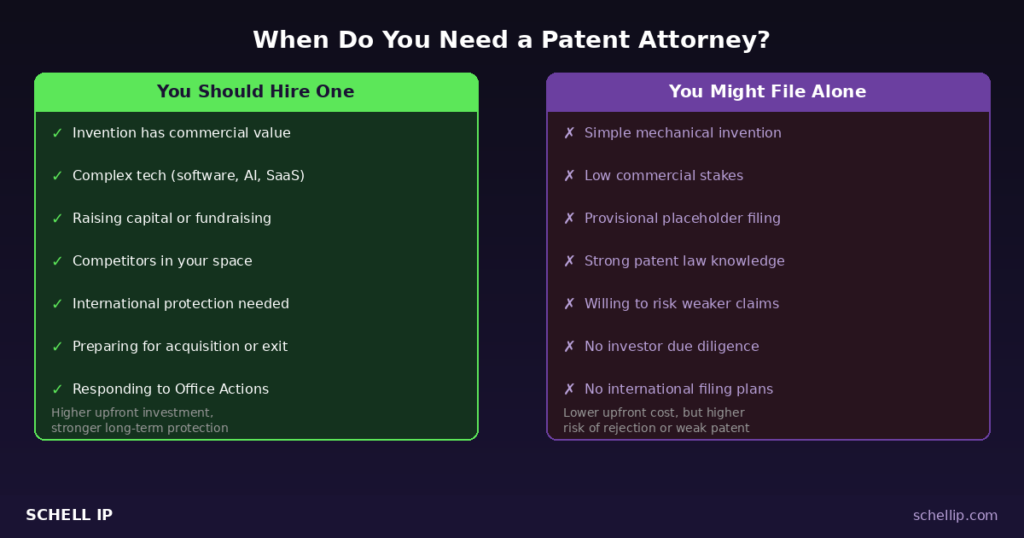
You should strongly consider hiring a patent attorney if:
- Your invention has commercial value and you plan to sell, license, or build a business around it
- Your invention is technically complex, especially in fields like software, AI, or SaaS
- You are raising capital and investors will ask about your IP protection
- You need to respond to a USPTO Office Action
- Competitors are already operating in your space
- You are considering international patent protection
- You are preparing for an acquisition or exit
At Schell IP, Denver patent attorney Jeff Schell has helped dozens of startups and technology companies develop patent strategies that support fundraising, strengthen competitive positioning, and increase acquisition value. That kind of strategic guidance is what separates a good patent from a valuable one.
When You Might Not Need a Patent Attorney
There are situations where hiring a patent attorney may not be necessary. If your invention is simple, you have experience with patent law, and the commercial stakes are low, you may be able to file on your own.
You might consider filing without an attorney (though we generally would not advise this) if:
- You are filing a provisional patent application as a temporary placeholder while you test an idea
- Your invention is mechanically simple with limited prior art
- You have a strong technical background and are willing to invest significant time learning USPTO rules
Even in these cases, be aware of the risks. A poorly written provisional patent application can fail to support your later non-provisional filing, leaving you without the priority date you thought you had. And a granted patent with weak claims may give you a false sense of security while competitors design around your protection.
What Happens If You File Without a Patent Lawyer
The USPTO allows individuals to file patent applications without an attorney. This is called a “pro se” filing. But the fact that you can file alone does not mean you should.
The patent application process requires detailed technical descriptions, precise legal claims, formal drawings, and strict compliance with USPTO formatting rules. Self-filed applications are rejected at significantly higher rates than attorney-filed applications.
The most common problems with self-filed patents include:
- Claims written too broadly (rejected by the USPTO) or too narrowly (easy for competitors to design around)
- Missing technical details that lead to incomplete applications
- No prior art search, leading to applications that duplicate existing patents
- Disclosing the invention publicly before filing, which can permanently bar protection
- Missing critical deadlines for Office Action responses or maintenance fees
A rejected or weak patent usually costs more to fix than hiring a patent attorney from the start. And some mistakes, like missing a statutory deadline or public disclosure before filing, cannot be fixed at all.
How a Patent Lawyer Strengthens Your Application
A patent attorney brings legal and technical expertise to every part of the process. Here is what that looks like in practice.
Prior art searches. Before filing, a patent attorney searches existing patents, published applications, and technical literature to confirm your invention is novel. Many inventors do a quick Google search and assume their idea is original. A professional search covers:
- U.S. and international patent databases
- Technical publications and academic literature
- Expired patents that still count as prior art
- Pending applications that have not yet been published
Claim drafting. Claims are the most important part of your patent. They define what you legally own. A patent lawyer writes claims that are broad enough to block competitors but specific enough to survive USPTO examination. They also include dependent claims that provide fallback protection if an independent claim is challenged.
Office Action responses. Most patent applications receive at least one Office Action from the USPTO. These are formal requests for changes, clarification, or legal arguments. A patent attorney knows how to respond effectively without weakening your claims. This experience can mean the difference between approval and rejection.
Strategic filing decisions. A patent attorney helps you decide what to patent, when to file, and how to structure your applications to support your business. This includes advising on provisional vs. non-provisional filings, continuation applications, and international filing strategies.
Patent Attorney vs. Patent Agent
Both patent attorneys and patent agents are licensed by the USPTO to file patent applications. The key difference is that a patent attorney is also a licensed lawyer.
This means a patent attorney can:
- Represent you in court for patent infringement disputes
- Provide legal advice on licensing, contracts, and IP strategy
- Advise on broader business and legal issues related to your invention
- Handle enforcement and defense if your patent is challenged
A patent agent can draft and file applications but cannot provide broader legal counsel. For straightforward filings with low litigation risk, a patent agent may be sufficient. For anything involving enforcement, licensing, investor due diligence, or business strategy, a patent attorney is the better choice.
How to Choose the Right Patent Attorney
Not all patent attorneys are the same. The right one for your invention depends on several factors:
Technical expertise. A patent lawyer who understands your technology writes better claims and descriptions. If you are building a software product, you need an attorney who understands software patent law and the Alice eligibility standard.
Client experience. An attorney who works regularly with startups and early-stage founders will understand budget constraints, investor expectations, and how to prioritize filings.
Strategic thinking. The best patent lawyers treat patents as business assets, not just legal filings. They help you build a patent strategy that supports fundraising, growth, and long-term competitive advantage.
Clear communication. Your attorney should explain the process in plain language. You should understand what you are filing, why, and what it protects.

Frequently Asked Questions
Do I need a patent attorney to file a patent?
No, the USPTO allows you to file on your own. But most self-filed patents are rejected or granted with weak claims that provide little real protection. A patent attorney significantly improves your chances of getting a strong, enforceable patent.
How much does a patent attorney cost?
Patent attorney fees generally range from $3,000–$6,000 for a provisional patent application and $5,000–$8,000+ for a non-provisional utility patent application. These are general ranges and may vary based on your specific project.
When should I talk to a patent attorney?
As early as possible. Ideally before you share your invention publicly, pitch to investors, or launch your product. Public disclosure before filing can permanently destroy your patent rights in many countries.
What is the difference between a patent attorney and a patent agent?
Both can file patent applications with the USPTO. A patent attorney is also a licensed lawyer who can provide legal advice, handle litigation, negotiate licensing agreements, and represent you in court. A patent agent can only assist with USPTO filings.
Can I file a provisional patent without a lawyer?
You can, but be careful. A provisional patent application must contain enough technical detail to support your later non-provisional filing. If it is too vague, you may lose the priority date you were counting on.
Is a patent attorney worth it for a startup?
Yes. Startups that file strong patents early are better positioned for fundraising, acquisition, and competitive defense. A patent lawyer helps you file strategically so your limited budget produces the strongest possible protection.
Get Expert Patent Attorney Guidance
If you are deciding whether to hire a patent lawyer, the answer usually comes down to one question: does your invention have real value to your business? If it does, working with an experienced patent attorney is one of the best investments you can make.
At Schell IP, Denver patent attorney Jeff Schell works with inventors and startup founders to build patent strategies that protect real business value. Jeff has helped companies across software, AI, and technology develop IP portfolios that support fundraising rounds, strengthen competitive positioning, and increase acquisition outcomes.
Whether you are filing your first provisional patent or building a comprehensive IP portfolio, we provide transparent pricing and expert guidance.
Book a free consultation with Schell IP today to discuss your invention and get a clear cost estimate.