
Golden, Colorado’s Rendezvous Robotics just raised a $20 million seed round led by MaC Venture Capital and Toyota Ventures. The company builds spacecraft that assemble themselves in orbit, and its technology started as research at MIT. For any founder thinking about patent strategy for Colorado startups, this deal is worth a close look.
What Rendezvous Robotics announced
Rendezvous announced the round on October 28, 2026, and ColoradoBiz covered it the next day. The key facts:
- $20 million seed round, oversubscribed, and the company’s first priced financing.
- Lead investors: MaC Venture Capital and Toyota Ventures.
- Other investors: the University of Michigan Endowment, Astera, Industrious Ventures, Humbition and NextView Ventures, plus existing investors Aurelia Foundry, ATX Venture Partners and Mana Ventures.
- Use of funds: next-generation spacecraft development, flight demonstrations and hiring.
- Headquarters: Golden, Colorado.
The technology: spacecraft built from tiles
Most spacecraft are designed around what fits inside a rocket fairing. That limit forces tradeoffs in power, compute, antenna size and heat dissipation before launch. Rendezvous takes a different path. Its spacecraft launch as compact, independent modules called tiles. In orbit, the tiles maneuver, align and connect into larger structures, and they can reconfigure later for new missions.
The company plans a low-Earth-orbit demonstration on a reserved rideshare no earlier than April 2028. Seven independent tiles will join into one spacecraft, separate, and then assemble again in a different configuration, with no outside robotic help. Before that, a parabolic flight campaign in November 2026 will test electromagnetic actuation and mobility in microgravity.
“For decades, the way we build spacecraft has been shaped by what we can fit inside a rocket. We’re challenging that constraint,” said Dr. Ariel Ekblaw, co-founder and board chair of Rendezvous Robotics, in the company’s announcement.
From an MIT lab to orbit

Rendezvous builds on nearly a decade of research that began with TESSERAE, a modular self-assembly system Ekblaw invented at MIT. Work continued through the Aurelia Institute, which she founded. Earlier versions flew on Blue Origin’s New Shepard rocket and on two missions to the International Space Station. A final ISS demonstration of fifth-generation TESSERAE technology is set for December 2026, when 32 tiles will try to assemble into a three-dimensional structure.
That lab-to-company path is the part every deep tech founder should study. A university origin is a strength. It also raises IP questions that investors will ask about before they write a check.
Why IP matters in a deep tech seed round
Investors in hard tech fund years of engineering before revenue shows up. What protects that bet is ownership: clear rights to the core technology, and a growing set of patents on what the team builds next. When the founding idea came from a university lab, diligence focuses on a few questions. Who owns the original invention? What does the company’s license cover? What has the company invented on its own since then?
Founders who can answer those questions cleanly move through diligence faster. Founders who can’t often spend the round’s early months fixing paperwork instead of building.
IP takeaways for Colorado founders
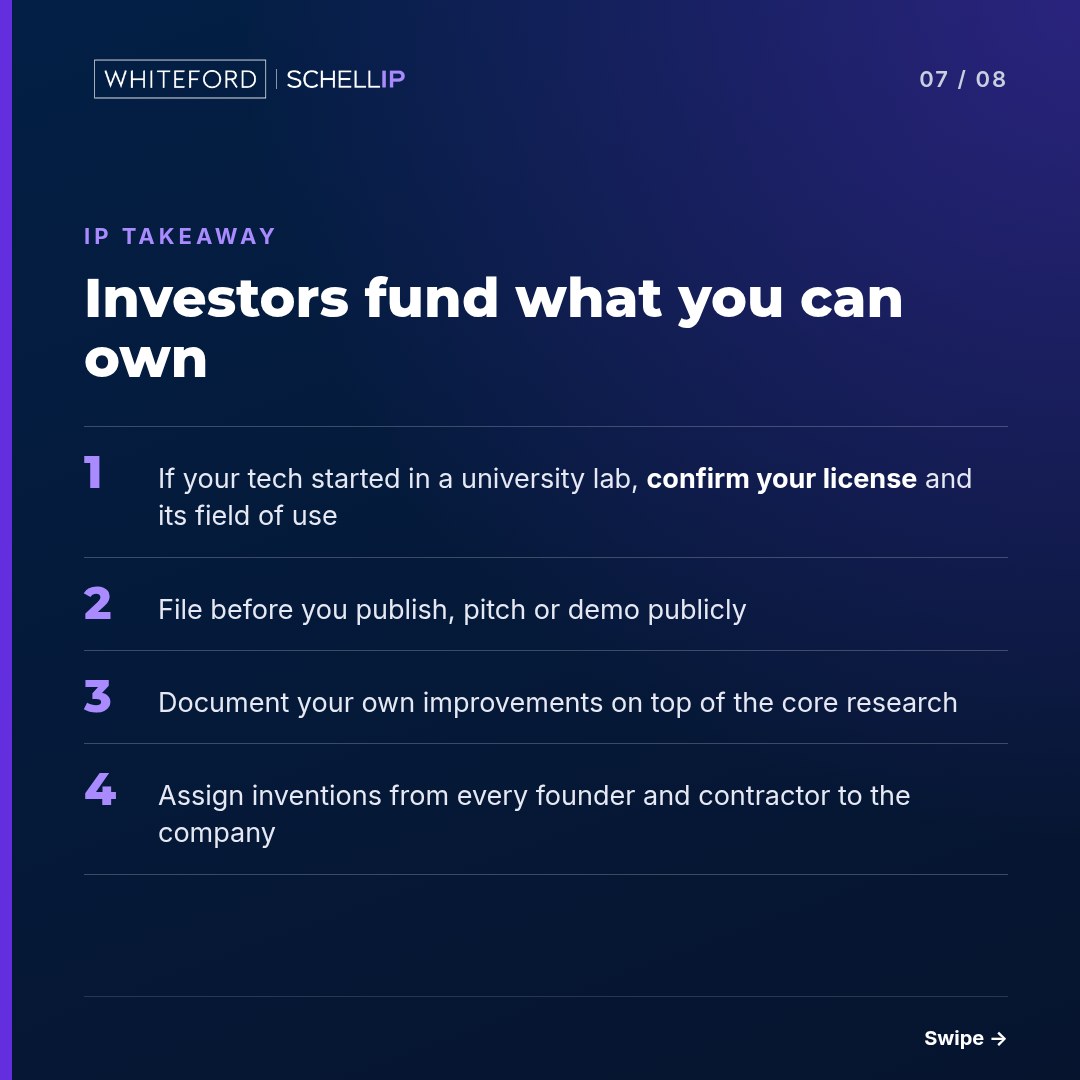
Investors fund what you can own. Here are four steps that apply whether you’re building spacecraft in Golden or software in Denver.
1. Confirm your university license and its field of use
If your technology started in a university lab, the university usually owns the original patents, and your company holds a license. Read it closely. Check whether it is exclusive, which fields of use it covers, which territories, and what happens to improvements. A license limited to one field can block the pivot your investors are counting on. Fix gaps before the round, not during it.
2. File before you publish, pitch or demo
Papers, conference talks, public demos and pitch decks shared without an NDA can all count as public disclosures. The U.S. gives inventors a limited grace period after their own disclosure, but most other countries do not. If you want patent rights abroad, file first. A provisional application is often a fast, low-cost way to lock in a filing date before a big reveal.
3. Document your own improvements
The licensed research is the starting point. The value investors want to see grows from what your team invents on top of it: new hardware, control software, manufacturing methods, system designs. Keep dated engineering records, hold regular invention reviews, and file on the improvements that matter commercially. Tie those filings to your product roadmap so the portfolio tracks where the business is going.
4. Get invention assignments from every founder and contractor
Every founder, employee and contractor who touches the technology should sign an agreement that assigns inventions to the company. Missing assignments are one of the most common diligence problems, and they are much harder to fix after someone leaves. Check your contractor agreements too. Many standard templates leave ownership unclear.
What this means for Colorado’s startup scene
Colorado already has a deep aerospace base, and a $20 million seed round for a Golden company adds to it. Strong research, serious investors and a local team make a powerful mix. The founders who capture the most value from that mix treat IP as part of the build plan from day one. If you’re a founder or inventor turning research into a company, start with the four steps above.
FAQ
What is Rendezvous Robotics?
Rendezvous Robotics is a Golden, Colorado company that builds modular spacecraft designed to assemble, expand and reconfigure in orbit. Its technology builds on TESSERAE research that began at MIT.
Who led Rendezvous Robotics’ $20 million seed round?
MaC Venture Capital and Toyota Ventures led the round, according to the company’s October 28, 2026 announcement.
Does my startup need patents before raising a seed round?
Not always, but deep tech investors want to see a plan. At minimum, that means clean ownership of your core technology, filings on key inventions before public disclosure, and signed invention assignments from your team.
What should I check in a university license?
Check exclusivity, field of use, territory, rights to improvements, sublicensing rights, and the payment and diligence milestones you must meet to keep the license.
When should I file a provisional patent application?
Before any public disclosure you can’t control, such as a paper, conference talk, public demo or pitch without an NDA. Filing first preserves your options in the U.S. and abroad.
Talk to a Colorado patent attorney
Building something in Colorado? Jeff Schell helps founders and inventors build patent strategies that match their products and their fundraising plans. Book a consultation or call (720) 419-1296.
