Quick Answer: Patent pending means a patent application has been filed with the USPTO but has not yet been granted. Patent pending status does not give the inventor legal power to stop others from copying the invention. That power begins only when the patent is granted. While an application is pending, the term works mainly as public notice and as a deterrent to competitors.
The phrase patent pending shows up on toys, tools, and gadgets everywhere. It looks important and it sounds like protection. But many inventors never stop to ask what patent pending status actually does for them, and the answer is more nuanced than the label suggests. The sections below explain what patent pending means, what it protects, what it does not, and how an inventor gets it the right way.
What is a patent?
Before explaining patent pending, it helps to define a patent. A patent is a legal grant that gives its owner the exclusive right to make, use, or sell an invention, as defined by the patent’s claims.
Put simply, the owner of a patent on a new kind of toaster can stop anyone else from making or selling that toaster without permission. Inventors obtain a patent by filing an application with the United States Patent and Trademark Office (USPTO), usually with the help of a licensed patent attorney.
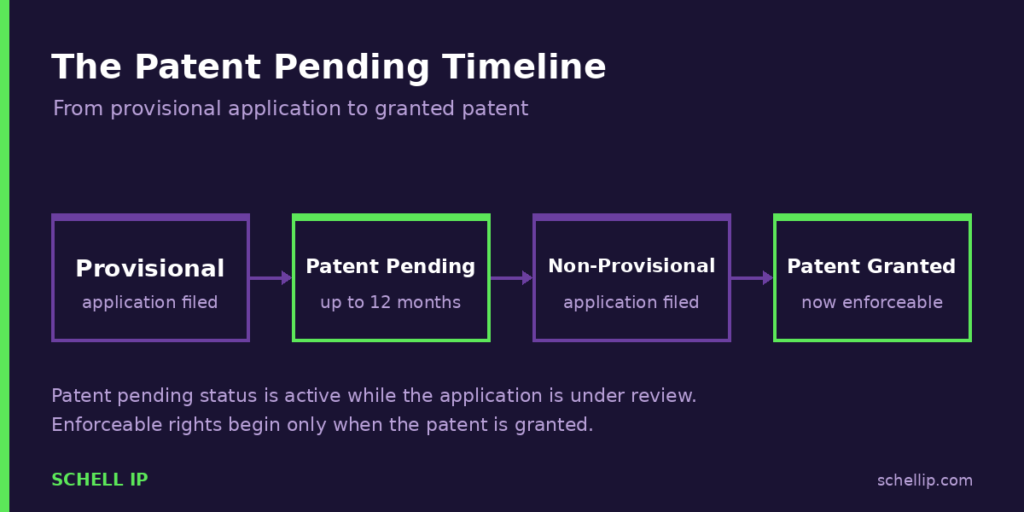
There are two kinds of applications. A provisional application locks in an early filing date and gives the inventor 12 months to file a non-provisional application. The non-provisional application is the one that can become a granted patent once the USPTO reviews and approves it. Both filings give the invention patent pending status.
What does patent pending actually mean?
Patent pending means an application has been filed and the USPTO has not yet made a decision. It functions like a coming-soon sign for a patent.
A useful comparison is a chef with a promising new dish who puts a “new dish coming soon” sign in the window. The sign signals intent, but the dish is not on the menu yet. Patent pending works the same way: it announces that protection is on the way, but the protection is not in force yet.
The most important point to understand is that patent pending does not give an inventor the legal right to stop anyone from copying the invention. That right begins only once the patent is granted. Until then, patent pending is a notice, not a shield. For more on that distinction, see “Does ‘patent is pending’ offer legal protection?”.
If patent pending does not stop copycats, why does it matter?
Patent pending status earns its value in ways that have nothing to do with a courtroom:
- It acts as a deterrent. Competitors who see patent pending know a granted patent may be coming, and that copying the invention now could create problems for them later.
- It can strengthen a future infringement claim. If a competitor copies the invention and the patent is later granted, the patent pending marking helps show the competitor was on notice. More on enforcement appears in the basics of patent infringement.
- It serves as a marketing signal. To customers, patent pending communicates that a product is new, novel, and tied to one source.
- It adds value in a sale or funding round, where intellectual property often plays a major role.
How long does patent pending last?
The length of patent pending status depends on the application type and the USPTO’s backlog. A provisional application provides patent pending status for up to 12 months, during which the inventor must file a non-provisional application or lose the priority date. Examination of a non-provisional application can then take one to three years, and the invention keeps patent pending status until the patent is granted or rejected. For a fuller timeline, see how long it takes to get a patent.
Using patent pending correctly
One rule matters above the rest: a product should not be marked patent pending unless an application has actually been filed. Falsely claiming patent pending status can carry penalties under U.S. law (35 U.S.C. §292). The term should be used only when it is true, the product should be marked clearly, and the marking should be updated once the patent is granted.
What to do while a patent is pending
Because patent pending does not provide enforceable rights, the steps taken during this window matter:
- Keep detailed records of the invention’s development, including sketches, prototypes, dates, and notes.
- Use non-disclosure agreements before sharing details with partners, manufacturers, or investors.
- Understand the market so potential copycats can be spotted early. A provisional patent application is often the right first step.
Patent pending vs. a granted patent
Patent pending and a granted patent are frequently confused. Patent pending means the application is in process and carries no enforceable rights. A granted patent means the USPTO has approved the invention and the owner holds exclusive rights that can be enforced. One is a promise, and the other is power. The goal of the entire process is moving an invention from patent pending to granted.
Jeff’s Take
In my years working with inventors, I’ve seen patent pending get misunderstood in both directions. Some founders treat it like a force field and stop worrying about competitors the moment they file. Others dismiss it as meaningless because it can’t be enforced. Both are wrong.
Here’s how I explain it to my clients. Patent pending is leverage, not a lock. It won’t stop a determined competitor on its own, but it changes the calculation for anyone thinking about copying you, it signals seriousness to investors and customers, and it preserves your priority date while you figure out your next move. The inventors who get the most out of patent pending are the ones who treat that 12-month window as a head start, not a finish line. They use the time to refine the product, line up their non-provisional filing, and build the records that make enforcement straightforward later. The phrase on the label matters far less than what you do during the months it buys you.

Frequently Asked Questions
Does patent pending mean my invention is protected?
Not in an enforceable sense. Patent pending means an application is filed but not yet granted. An inventor cannot sue for infringement until the patent issues. Until then, patent pending serves as public notice and a deterrent.
How do I get patent pending status?
An invention gets patent pending status the moment a provisional or non-provisional patent application is filed with the USPTO. Filing a provisional application is the fastest and most cost-effective way to claim patent pending status.
How long does patent pending last?
A provisional application provides up to 12 months of patent pending status. If a non-provisional application is filed, patent pending status continues through examination, which often takes one to three years.
Can someone steal my idea while it is patent pending?
A competitor can copy the invention while it is patent pending, because rights cannot be enforced until the patent is granted. Doing so is risky for them, because once the patent issues the owner may be able to act against ongoing infringement. Marking the product patent pending and using NDAs reduces the risk.
How much does it cost to get patent pending?
Filing a provisional application is relatively inexpensive, and the larger costs come with the non-provisional application and examination. The 2026 patent cost guide gives a full breakdown.
Talk to a patent attorney
The patent process rewards getting the details right. An experienced patent attorney helps an inventor choose the right application, draft claims that hold up, and avoid the mistakes that commonly sink first-time filers. Inventors unsure whether they need one can start with “Do I need a patent attorney?”.
Schell IP, based in Boulder, Colorado, has secured hundreds of patents and helped clients raise or generate over $50 million. Inventors who have questions about patent pending status or their next step can schedule a free consultation. There is no cost to set up a call.