Quick Answer: A provisional patent application is a placeholder filing that secures an early filing date and gives you 12 months to prepare a full application. A non-provisional patent application is the examinable filing that gets reviewed by the USPTO and can result in an issued patent. Most inventors file a provisional first to lock in their priority date, then follow up with a non-provisional within 12 months. The right choice between a provisional vs non-provisional patent depends on how developed your invention is, your budget, and your timeline.
One of the first decisions inventors face is whether to file a provisional or non-provisional patent application. Both are part of the U.S. patent system, but they serve different purposes and come with different costs, timelines, and levels of protection.
Understanding the difference between a provisional vs non-provisional patent is critical before you invest time and money into the patent application process. Filing the wrong type at the wrong time can cost you money, delay protection, or leave your invention exposed.
This guide explains what each type of application does, how they compare, and how to decide which one is right for your situation.
What Is a Provisional Patent Application?
A provisional patent application is a temporary filing with the USPTO that establishes an early filing date for your invention. It does not get examined, it does not result in an issued patent, and it expires after 12 months.
What a provisional patent application does provide is a priority date and the right to use the term “patent pending.” This matters because the U.S. patent system is first-to-file, meaning the earliest filing date wins if two people file for similar inventions.
A provisional patent application includes a written description of the invention, any relevant drawings or diagrams, and the required USPTO filing fee. It does not require formal patent claims, which makes it simpler and less expensive to prepare.
Provisional patent applications typically cost $3,000 to $6,000 when filed with a patent attorney. Costs may vary based on complexity.
What Is a Non-Provisional Patent Application?
A non-provisional patent application is the formal filing that the USPTO actually examines. If approved, it results in an issued patent that protects your invention for up to 20 years from the filing date.
A non-provisional patent application requires a complete written description of the invention, formal patent claims that define exactly what is protected, drawings (if needed to understand the invention), an abstract, and the required USPTO filing, search, and examination fees.
The patent claims are the most critical part. They define the legal boundaries of your patent and determine what competitors can and cannot do. Writing strong claims requires both legal expertise and technical understanding.
Non-provisional patent applications typically cost $5,000 to $8,000 or more to prepare and file, depending on the complexity of the invention. You can find a detailed cost breakdown in our complete patent cost guide. These costs are general ranges and may vary based on your specific project.
Provisional vs Non-Provisional Patent: Key Differences
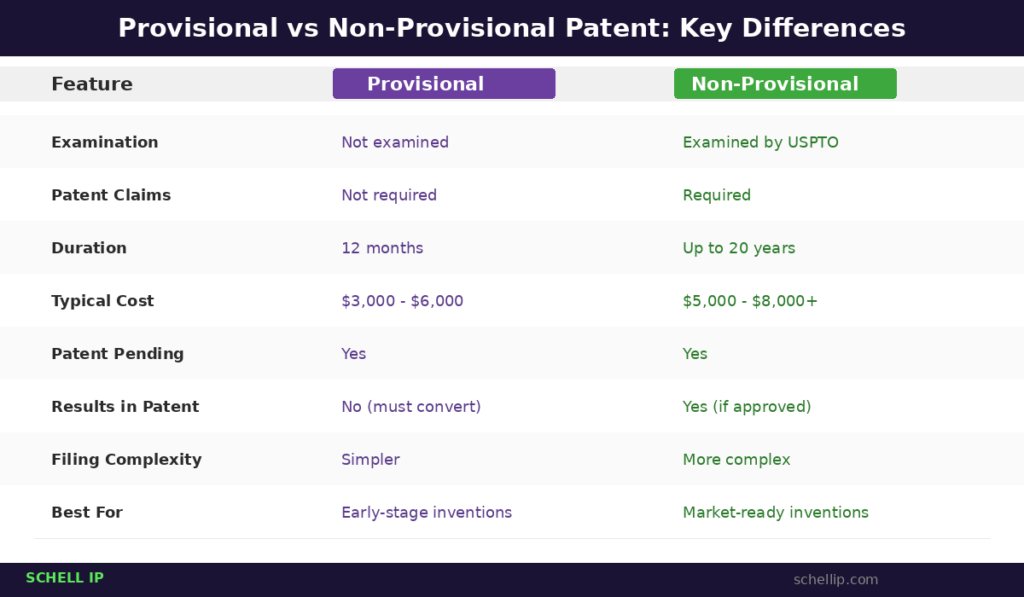
The core difference between a provisional vs non-provisional patent is that a provisional application is a placeholder and a non-provisional application is the real filing. Here is how they compare across the factors that matter most:
USPTO examination: A provisional patent application is not examined. A non-provisional patent application is reviewed by a patent examiner who determines whether your invention meets the requirements for a patent.
Patent claims: A provisional does not require claims. A non-provisional requires formal claims that define the scope of your protection.
Duration: A provisional expires after 12 months. A non-provisional, if approved, provides protection for up to 20 years from the filing date.
Cost: Provisionals are less expensive ($3,000 to $6,000 typical). Non-provisionals cost more ($5,000 to $8,000+) because they require more detailed documentation and claims.
Patent pending status: Both types allow you to use the term “patent pending” on your product or marketing.
Outcome: A provisional cannot become a patent on its own. You must file a non-provisional within 12 months, or the provisional expires and you lose your priority date.
When Should You File a Provisional Patent Application?
A provisional patent application makes sense when you need to establish a filing date quickly but are not ready for a full application. Common situations include:
- You are still developing or refining your invention and need more time before filing a complete application
- You are preparing to pitch investors or partners and want “patent pending” status before sharing your idea
- You are planning a product launch or demo and need to file before public disclosure
- You want to secure an early priority date while managing cash flow
- You are building a startup and need to show IP protection is underway for fundraising
The key risk with a provisional is that it must be followed by a non-provisional filing within 12 months. If you miss that deadline, you lose the priority date and the provisional expires as if it were never filed.
When Should You File a Non-Provisional Patent Application?
A non-provisional patent application is the right choice when your invention is fully developed and you are ready for formal examination. This typically applies when:
- Your invention is complete and you can describe it in full technical detail
- You already filed a provisional and are approaching the 12-month conversion deadline
- Your product is market-ready and you need enforceable protection
- You want to begin the USPTO examination process and move toward an issued patent
You can also file a non-provisional directly without a provisional first. This is sometimes the better path if your invention is already well-documented and you want to start examination sooner rather than later.
Common Mistakes With Provisional and Non-Provisional Patent Filings
The provisional vs non-provisional patent decision seems straightforward, but inventors frequently make mistakes that weaken or destroy their patent rights:
- Filing a provisional that is too thin. A provisional must describe your invention in enough detail to support the later non-provisional filing. If the provisional is vague or incomplete, it may not actually protect your priority date.
- Missing the 12-month deadline. If you file a provisional and do not follow up with a non-provisional or PCT application within 12 months, you lose the priority date entirely.
- Disclosing publicly before filing anything. Sharing your invention at a trade show, on a website, or with investors before filing can limit or eliminate your patent rights in many countries.
- Writing non-provisional claims without professional help. Claims define the legal scope of your patent. Poorly written claims can result in a patent that is granted but unenforceable.
- Treating a provisional as permanent protection. A provisional does not protect your invention on its own. It only preserves your filing date while you prepare the full application.
How Provisional and Non-Provisional Patents Work Together
For most inventors, the provisional vs non-provisional patent question is not either/or. The typical path is to file a provisional first, then convert to a non-provisional within 12 months.
This approach gives you the best of both options. The provisional locks in your priority date at lower cost and gives you time to develop the invention, test the market, raise funding, or refine your claims. The non-provisional then provides the formal examination and long-term protection.
The process typically follows this path: file a provisional patent application, use the 12-month window to refine the invention and prepare documentation, file a non-provisional patent application (or a PCT application for international protection), respond to USPTO Office Actions during the examination process, and receive an issued patent if the application is approved.
At Schell IP, we help inventors plan this sequence strategically so the provisional supports the non-provisional filing and both align with the business timeline.
Frequently Asked Questions
What is the difference between a provisional and non-provisional patent?
A provisional patent application is a temporary filing that secures a priority date and lasts 12 months. A non-provisional patent application is the formal filing that gets examined by the USPTO and can result in an issued patent lasting up to 20 years.
Does a provisional patent protect my invention?
A provisional patent application does not provide enforceable patent rights. It establishes a priority date and allows you to use “patent pending” status. You must file a non-provisional application within 12 months to obtain actual patent protection.
Can I skip the provisional and file a non-provisional patent directly?
Yes. If your invention is fully developed and well-documented, you can file a non-provisional patent application without filing a provisional first. This starts the examination process immediately.
How much does it cost to file a provisional vs non-provisional patent?
Provisional patent applications typically cost $3,000 to $6,000, and non-provisional patent applications typically cost $5,000 to $8,000 or more. These are general ranges that include attorney fees and USPTO filing fees. Costs may vary based on the complexity of your invention.
What happens if I miss the 12-month provisional patent deadline?
If you do not file a non-provisional or PCT application within 12 months of your provisional filing date, the provisional expires. You lose the priority date and cannot recover it. Any public disclosures made during that period could also prevent you from filing in the future.
Should I hire a patent attorney for a provisional patent application?
It is strongly recommended. A provisional must contain enough detail to support the later non-provisional filing. If the provisional is too thin, it may not actually preserve your priority date. A patent attorney ensures the provisional is written to support your long-term filing strategy.

Get Help Choosing the Right Patent Filing
Choosing between a provisional vs non-provisional patent depends on where you are in the development process, your budget, and your timeline. The right decision now protects your invention and sets up a stronger filing later.
At Schell IP, Denver patent attorney Jeff Schell works with inventors and startups to determine the best filing strategy for their situation and budget.
Book a free consultation with Schell IP today to discuss your invention and determine whether a provisional or non-provisional patent application is right for you.