Quick Answer: Patent maintenance fees are payments required by the USPTO to keep a utility patent in force after it is granted. Patent maintenance fees are due three times: at 3.5, 7.5, and 11.5 years after the grant date. The fees increase at each stage, and large entities pay the full amount while small entities receive a 60% reduction and micro entities an 80% reduction. If you miss a patent maintenance fee, there is a six-month grace period with a surcharge, after which the patent expires and enters the public domain. Design and plant patents do not require maintenance fees, only utility patents do.
Getting a patent granted is a milestone, but it is not the finish line. To keep that patent enforceable for its full term, you have to pay patent maintenance fees to the USPTO at set intervals. Miss them, and the patent you spent years and thousands of dollars securing can lapse and become free for anyone to use. Understanding patent maintenance fees, when they are due, what they cost, and what happens if you miss one, is essential to protecting the value of your patent.
This guide explains how patent maintenance fees work, the exact deadlines, the costs by entity size, what happens if a payment is missed, and how to make sure you never lose a patent to a missed fee. For the bigger picture on patent costs, our complete patent cost guide for 2026 covers filing through grant.
What Are Patent Maintenance Fees?
Patent maintenance fees are recurring payments owed to the United States Patent and Trademark Office to keep a granted utility patent in force. They exist because a patent is not a one-time purchase. The government grants you the exclusive right to your invention, but it asks you to periodically confirm that the patent is still worth maintaining by paying patent maintenance fees over its life.
Importantly, patent maintenance fees apply only to utility patents, the kind that protect how an invention works. Design patents and plant patents do not require patent maintenance fees at all. So if you hold a design patent, this obligation does not apply to you, though the cost tradeoff is worth understanding, which our design patent application guide explains.
The obligation to pay patent maintenance fees begins only after the patent is granted, not during the application process. Once your utility patent issues, the maintenance clock starts.
When Are Patent Maintenance Fees Due?
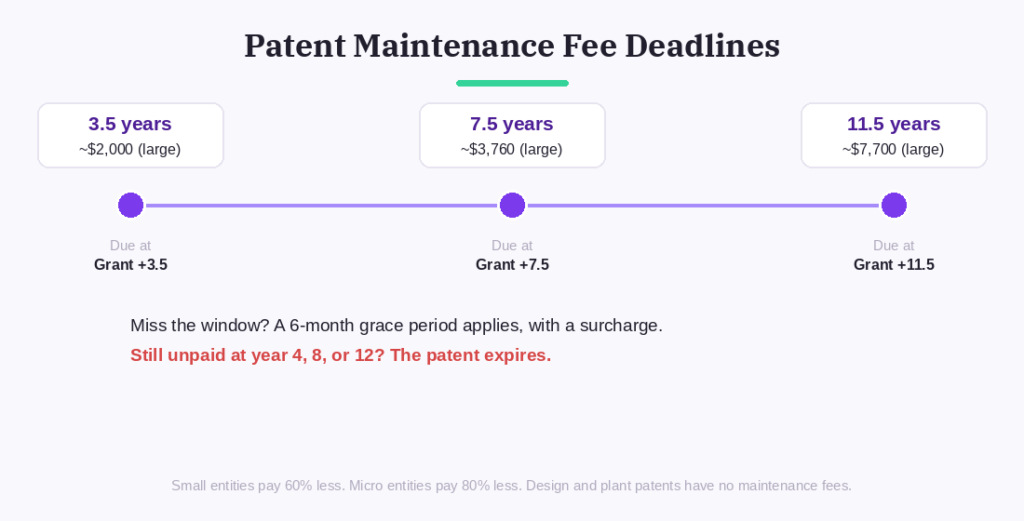
Patent maintenance fees are due at three points measured from the grant date of the patent:
- 3.5 years after grant
- 7.5 years after grant
- 11.5 years after grant
Each patent maintenance fee has a payment window. You can pay without a surcharge during the six-month window leading up to each deadline (at 3 to 3.5 years, 7 to 7.5 years, and 11 to 11.5 years after issue). You cannot pay early, and there is no annual fee in between, which is a common point of confusion. After these three payments, no further patent maintenance fees are owed for the rest of the patent’s 20-year term.
If you miss a window, there is a six-month grace period during which you can still pay the patent maintenance fee plus a surcharge. Only after the grace period closes does the patent actually lapse. Because the consequences of a misstep here are permanent, many owners have a patent attorney confirm their deadlines and windows rather than tracking them alone.
How Much Are Patent Maintenance Fees?
The cost of patent maintenance fees depends on two things: which of the three deadlines you are paying, and your entity size. The fees escalate sharply at each stage, by design, to encourage owners to actively decide whether a patent is still worth keeping.
As of 2026, the USPTO large-entity patent maintenance fees are approximately:
- 3.5 years: around $2,000
- 7.5 years: around $3,760
- 11.5 years: around $7,700
These amounts are reduced based on entity status. Small entities pay 60% less than the large-entity rate, and micro entities pay 80% less. So a micro entity pays roughly one-fifth of the large-entity patent maintenance fees at each stage. Because the USPTO adjusts these figures periodically, you should always confirm the current amounts on the USPTO fee schedule before budgeting.
Over the full life of a patent, total patent maintenance fees range from roughly $3,000 for a micro entity to around $13,000 for a large entity. That makes maintenance a meaningful part of the true lifetime cost of owning a patent, and a number worth planning for from the day your patent is granted. A patent attorney can help you fold these costs into your budget early, and our overview of what is included in a patent service explains how ongoing maintenance fits into working with a firm.
What Happens If You Miss a Patent Maintenance Fee?
Missing a patent maintenance fee is one of the most avoidable ways to lose a valuable patent, and it happens more often than most inventors expect. Here is the sequence.
If you do not pay within the standard window, the patent enters a six-month grace period. You can still pay the patent maintenance fee during this time, but you must add a surcharge. If you still have not paid by the end of the grace period, the patent expires. At that point the invention enters the public domain and anyone is free to use it. The patent rights become unenforceable.
There is a limited safety net. If a patent expires because a maintenance fee was not paid, you can petition the USPTO to reinstate it, but only if the delay was unintentional, and you must pay the missed patent maintenance fee plus a petition fee. Reinstatement is not guaranteed, and petitions filed more than two years after expiration require additional justification. Because the petition process is technical and the stakes are high, this is a situation where consulting a patent attorney quickly can make the difference. The far better approach, though, is never to miss the deadline in the first place.
Patent Maintenance Fees by Entity Size
Your entity status directly determines what you pay, so it is worth knowing where you fall:
- Large entity: pays the full patent maintenance fees with no reduction. This generally applies to larger companies.
- Small entity: receives a 60% reduction. Most independent inventors and small businesses qualify.
- Micro entity: receives an 80% reduction. To qualify, you generally must meet income limits and have been named on a limited number of prior applications.
Claiming the wrong entity status can create problems later, including the need for deficiency payments to correct underpaid patent maintenance fees. If you are unsure which category applies to you, this is exactly the kind of question a patent attorney can answer quickly. If you are weighing whether professional help is worth it at all, our take on whether you need a patent attorney is a useful read.
A Word of Caution: Maintenance Fee Scams
One practical warning worth knowing: the USPTO publicly cautions that many private companies, unaffiliated with the government, send official-looking solicitations to patent owners about patent maintenance fees. These notices often mimic government correspondence and charge inflated amounts to “handle” your payment. Legitimate patent maintenance fees are paid directly to the USPTO or managed through your patent attorney. If you receive a maintenance fee notice that you did not expect, verify it with the USPTO or your patent attorney before paying anything. One of the quieter benefits of hiring a patent attorney is that these solicitations get filtered out before they ever reach you.
How to Make Sure You Never Miss a Patent Maintenance Fee
Because the deadlines span nearly twelve years, the biggest risk with patent maintenance fees is simply forgetting. A payment due 11.5 years after grant is easy to lose track of, especially as companies grow, move, or change hands. A few practices help:
Keep your correspondence and fee address current with the USPTO so reminder notices reach you. Build the three maintenance deadlines into a docketing system or calendar the moment your patent is granted, and remember that these payments stretch across the patent’s full life, which we cover in how long patents last. Budget for patent maintenance fees as part of the lifetime cost of the patent rather than treating them as surprise expenses. And consider having your patent attorney track and manage the deadlines, which is a common service that removes the risk of a missed payment entirely.
Jeff’s Take
I have seen inventors lose genuinely valuable patents over a missed maintenance fee, and it is painful every time, because it is completely avoidable. Someone spends years and real money getting a patent granted, then a reminder goes to an old address, the deadline slips, and the grace period closes. The invention falls into the public domain and a competitor is free to use it.
The thing I tell clients is to treat patent maintenance fees as part of the cost of the patent from day one, not as a separate surprise years later. Decide early whether a patent is worth maintaining, and if it is, put the deadlines somewhere they cannot be forgotten. The escalating fee structure is actually the USPTO nudging you to make that decision deliberately at each stage. There is no shame in letting a patent lapse on purpose if it no longer protects anything valuable. What you want to avoid is losing one by accident.
How Schell IP Helps
At Schell IP, we help patent owners protect the value of what they have already secured. Denver patent attorney Jeff Schell and our team track maintenance deadlines, advise on entity status to make sure you are not overpaying, and help you decide which patents in a portfolio are worth maintaining as your business evolves.
We help inventors and companies by:
- Tracking patent maintenance fee deadlines so a payment never slips through the cracks
- Confirming the correct entity status so you pay the lowest patent maintenance fees you qualify for
- Advising on portfolio strategy to decide which patents are worth maintaining and which to let lapse
Book a free consultation to make sure your patents stay protected and your maintenance strategy is sound.

Frequently Asked Questions
What are patent maintenance fees?
Patent maintenance fees are payments required by the USPTO to keep a granted utility patent in force. They are due at 3.5, 7.5, and 11.5 years after the patent’s grant date.
How much are patent maintenance fees?
As of 2026, large-entity patent maintenance fees are approximately $2,000 at 3.5 years, $3,760 at 7.5 years, and $7,700 at 11.5 years. Small entities pay 60% less and micro entities pay 80% less. Always confirm current amounts on the USPTO fee schedule.
When are patent maintenance fees due?
Patent maintenance fees are due at 3.5, 7.5, and 11.5 years after the patent is granted. Each has a six-month payment window before the deadline, and you cannot pay early. There are no annual fees in between.
What happens if I don’t pay a patent maintenance fee?
If you miss the payment window, you have a six-month grace period to pay with a surcharge. If you still do not pay, the patent expires and enters the public domain. You may petition to reinstate it only if the delay was unintentional.
Do all patents require maintenance fees?
No. Only utility patents require patent maintenance fees. Design patents and plant patents do not require any maintenance fees.
Can I reinstate a patent that expired for a missed maintenance fee?
Possibly. You can petition the USPTO to reinstate an expired patent if the delay in payment was unintentional. You must pay the missed patent maintenance fee plus a petition fee, and reinstatement is not guaranteed, especially more than two years after expiration.
How are patent maintenance fees reduced for small inventors?
Entity status determines the discount. Small entities receive a 60% reduction on patent maintenance fees, and micro entities receive an 80% reduction. Most independent inventors qualify for one of these categories.
Are unsolicited patent maintenance fee notices legitimate?
Often they are not. The USPTO warns that many private companies send official-looking maintenance fee solicitations that charge inflated amounts. Legitimate patent maintenance fees are paid directly to the USPTO or through your patent attorney. Verify any unexpected notice before paying.
Final Thoughts
Patent maintenance fees are the price of keeping a patent alive, and missing one is among the most avoidable ways to lose valuable protection. The rules are straightforward once you know them: three payments at 3.5, 7.5, and 11.5 years, reduced for small and micro entities, with a short grace period before the patent lapses for good. The key is to plan for patent maintenance fees from the day your patent is granted and to make sure the deadlines are tracked.
At Schell IP, we help patent owners stay protected by managing maintenance deadlines, confirming entity status, and advising on which patents are worth maintaining. Whether you hold one patent or a growing portfolio, we make sure a missed fee never costs you your rights.
Book a free consultation today to review your patents and build a maintenance strategy that protects their value.