Quick Answer: Yes, AI can draft a patent application, but the problem is how. When I tested AI patent drafting tools, they produced a complete application in minutes, and the result looked better than it was. Beneath the confident, official-sounding language were the kinds of gaps a founder doesn’t catch until they become expensive: claims aimed at the wrong target, technical description too generic to satisfy patent law, details the AI invented, and confidentiality exposure created before anything was ever filed. AI patent drafting can assist the work, but it cannot replace patent strategy, meaning the judgment about what to claim, what to keep secret, and how the patent serves your business. That judgment is what you are actually paying a patent attorney for.
I’m Jeff Schell, a patent attorney, multi-exit founder, and startup adviser with Schell IP and Whiteford, and this is not an anti-AI argument. I use AI in my own practice where it makes sense, and most of the startups I advise use it everywhere: product, marketing, engineering, legal operations. So when founders ask whether AI can handle their patent application, they deserve a real answer based on what the tools actually produce, not a reflexive no from someone protecting billable hours. That’s why I ran the test. What follows is what I found, organized into the five problems that showed up consistently, and then an honest accounting of where these tools genuinely earn their keep.
What AI Patent Drafting Gets Right
The tools generated a title, abstract, background, figures description, detailed description, and sample claims faster than most attorneys could open a template, and for a founder who has just seen what a patent normally costs, that output is seductive. It looks like the expensive part of patenting has been automated away.
The trap is in what a patent application is actually for. It isn’t a writing deliverable; it’s a legal instrument whose value depends on support, claim scope, prior art awareness, ownership, and alignment with where the business is going. Judged as prose, the AI drafts were fine. Judged as instruments, they failed in five consistent ways, and each failure shares an unpleasant property: it stays invisible until an examiner, an investor’s diligence team, or opposing counsel finds it for you.
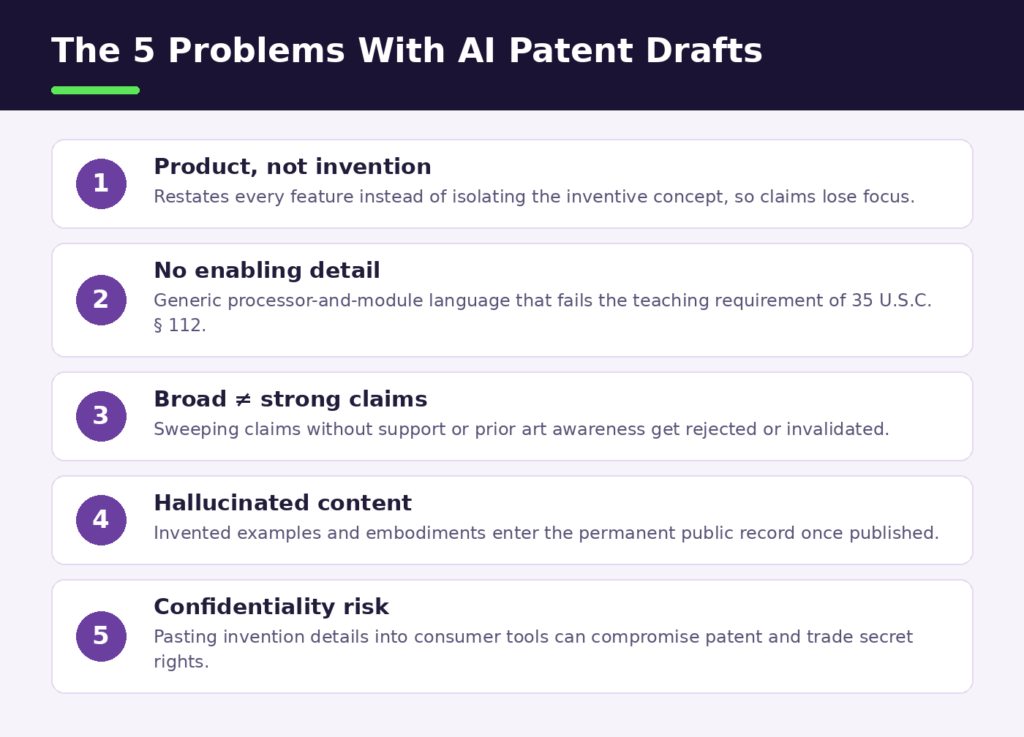
Problem 1: AI Patent Drafting Describes Your Product, Not Your Invention
A patent doesn’t protect your product. It protects an inventive concept, and identifying that concept is the foundational judgment of the entire application. A product might contain dozens of features, but only a handful are typically new, fewer still are legally defensible, and fewer again are the ones a competitor would need to copy or an investor would pay for. The application has to be built around those, with everything else in a supporting role.
The tools I tested skipped that judgment entirely. They restated the product idea, comprehensively and evenly, treating every feature as equally important. The result reads well and claims poorly, because claims that aim at everything protect nothing in particular. This filtering is precisely what a good inventor interview accomplishes; at Schell IP and Whiteford, we spend that first working session separating what is genuinely new from what is merely yours, because everything downstream depends on getting that distinction right.
Problem 2: Patent-Sounding Language Is Not Enabling Detail
Patent law requires an application to teach the invention in enough detail that a person skilled in the field could actually build it. That’s the enablement requirement of 35 U.S.C. § 112, and it regularly sinks applications that read impressively but teach nothing.
The AI drafts were a case study in the difference. They filled page after page with generic statements about processors, memory, networks, modules, and machine learning: language that sounds patent-like and supports nothing. If your invention lives in a specific data transformation, a control loop, a model architecture, a security step, or a training workflow, the application must describe that mechanism with real specificity, and the AI will only capture it if the founder already knows which details matter and feeds them in with care. Most founders don’t, through no fault of their own; knowing which technical details carry legal weight is the craft. So the draft comes out hollow exactly where it needs to be dense, and nothing about it looks wrong until an examiner tests it. Software and AI inventions carry an additional layer of this risk around subject-matter eligibility, which we’ve unpacked in our guide to whether you can patent an algorithm.
Problem 3: Broad-Sounding Claims Are Not Strong Claims
Founders reading an AI draft tend to love the claims, because they sound sweeping. That reaction is understandable and backwards. A claim’s breadth is only worth what the specification can support and the prior art will allow; a broad claim without support gets rejected under § 112, and a broad claim that reads on existing technology gets rejected over prior art or, worse, granted and then invalidated when you try to enforce it.
Strong claims are engineered, not generated. They’re drafted with simultaneous attention to patentability, enforceability, design-arounds, and commercial value, which requires knowing the invention, the competitive landscape, and the legal requirements all at once. A generic drafting tool has access to none of that context, so it cannot know which claim elements create leverage and which are decoration. We keep a running list of the do’s and don’ts of drafting patent claims, and the AI output managed to hit nearly every don’t.
Problem 4: AI Patent Drafts Make Things Up
Hallucination is an annoyance in most AI use cases. In a patent application it is a liability, because the application becomes part of the public record when it publishes, and every statement in it is one your company has to live with. The drafts I tested invented examples, assumed performance characteristics, and described embodiments no one had built. An application that claims more than the invention actually does, or discloses details that are inaccurate or inconsistent with your real roadmap, creates problems that range from examination trouble to credibility damage in diligence or litigation.
The discipline a written application demands is the opposite of what generative tools are optimized for. They’re built to produce plausible, complete-sounding text; a patent application needs every sentence to be deliberately chosen and true. This is one of several failure modes we analyzed in our companion piece on the risks of using AI and ChatGPT to draft a patent application; consider that post the theory and this one the field test.
Problem 5: The Tool Itself May Be a Disclosure Problem
Before any drafting happens, there’s a threshold question most founders skip: what happens to the invention details you paste into the tool? Consumer AI products vary enormously in their terms, retention policies, training practices, and enterprise controls, and those differences carry legal consequences. A tool that retains prompts or trains on inputs may have compromised your invention’s secrecy before you’ve filed anything, which can undermine your ability to protect it as either a patent or a trade secret. That choice between patent and trade secret should be a deliberate strategic decision, not something a chat window’s terms of service quietly made for you.
For startups, this is bigger than patents. The same data-handling questions touch trade secrets, customer data, vendor contracts, board governance, and outside counsel practices, so AI legal risk arrives not as one issue but as a stack of them, and questions like whether an AI invention can be patented at all sit in that same stack.
Where AI Patent Drafting Tools Actually Help
None of this adds up to “keep AI away from patent work.” It adds up to putting AI in the right layer of the process. The drafting and strategy layer requires judgment the tools don’t have; the preparation layer underneath it mostly requires organization, and there the tools are genuinely good:
- Organizing invention ideas before anything gets formalized, so the raw material arrives structured instead of scattered across documents, whiteboards, and Slack threads.
- Generating questions for an inventor interview, which makes the human conversation sharper because the obvious ground has already been mapped.
- Summarizing product features and comparing versions of technical documents, the tedious work that consumes attorney hours without adding any judgment to the result.
- Brainstorming potential embodiments, alternative versions of the invention that might deserve coverage in the application and are easy to overlook when you’re close to the product.
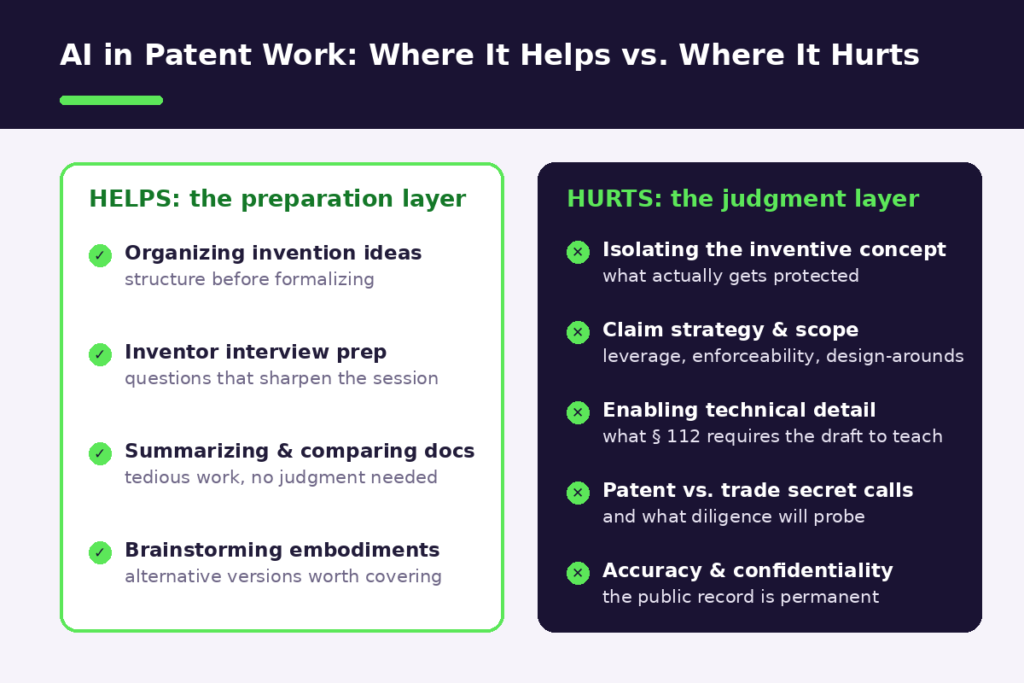
The dividing line is judgment. What is the inventive concept? What should be claimed now versus held back as a trade secret? Where will the prior art fight be? What will investors probe in diligence, and what will a buyer care about three years from now? What assignments and contracts are needed so the company actually owns the invention? Those are legal and business questions, and no draft, however polished, answers them for you. AI should assist a patent strategy, not replace it.
Jeff’s Take: How I’d Tell a Founder to Use AI Patent Drafting This Week
My practical advice comes down to three don’ts and one do.
Don’t paste confidential invention details into a tool until you understand its data terms and have appropriate controls in place. Don’t mistake a polished draft for a filable one; polish is precisely what these tools fake best. And don’t let a tool set your claim strategy, because it knows nothing about your prior art, your competitors, or your exit plan.
Do use AI to arrive prepared. A clear technical memo, a product architecture summary, known alternatives, competitive notes, and an inventor timeline make the legal work dramatically more efficient, which shifts your budget from information-gathering to actual strategy. I’ve sat on both sides of this table, as the founder paying the legal bill and as the attorney sending it, and the clients who show up prepared consistently get more patent for their money. Helping you show up prepared is the job these tools are actually qualified for.
Frequently Asked Questions About AI Patent Drafting
Can AI write a patent application?
AI can generate every section of a patent application in minutes, including claims. Whether that application actually meets patent office requirement or protects your invention is a different question: tested drafts showed unfocused claims, generic language lacking enabling detail, invented embodiments, and confidentiality risks.
Is AI patent drafting safe for confidential inventions?
Only if you understand the tool’s data terms and controls. Consumer AI tools may retain prompts or use inputs for training, which can create trade secret and disclosure risk before you’ve filed anything.
Will the USPTO reject an AI-drafted patent application?
The USPTO doesn’t reject applications for being AI-drafted; it rejects applications that fail the legal requirements. And worse, your patent application generated via AI might not be rejected, it just might not fully protect what you need it to. AI drafts commonly struggle with exactly those requirements: enabling detail, supported claims, and accurate disclosure.
What is AI actually useful for in the patent process?
Preparation. Organizing invention ideas, generating inventor interview questions, summarizing product features, comparing technical documents, and brainstorming embodiments. It’s a strong assistant to patent strategy and a poor substitute for it.
Can AI be listed as the inventor on a patent?
No. A human must be named as the inventor, and the invention needs to be more than simply “using AI to do X.” The claims must describe something specific and novel.
This post is general information and is not legal advice about your particular invention, AI tool, or filing decision.
If Your Startup Runs on AI, Your Legal Strategy Should Account for It
If your startup is using AI and needs a patent, trade secret, and outside general counsel strategy that will survive diligence, book a free consultation with Schell IP and Whiteford. We’ll look at what’s protectable, what should stay secret, and what a buyer or investor will ask about before they wire anything.