Quick Answer: Can you patent an algorithm? You cannot patent an algorithm on its own. Under U.S. patent law, algorithms are treated as abstract ideas and are not eligible for patent protection in isolation. However, if your algorithm is applied to solve a specific technical problem or improve a real-world process, that application may be patentable. The key is demonstrating a concrete, practical use: not just the logic itself.
If you’ve built software, an AI model, or a technical system that relies on a proprietary algorithm, this question matters. Whether you can patent it depends on how your invention is framed, not just what it does.
This guide walks through the legal framework for algorithm patents in the U.S., what makes an algorithm-based invention eligible, and when it makes sense to work with a software patent attorney to evaluate your options.
The Short Answer: Algorithms Alone Are Not Patentable
U.S. patent law excludes three categories from patent eligibility: laws of nature, natural phenomena, and abstract ideas. Algorithms fall into that third category.
The Supreme Court made this explicit in Alice Corp. v. CLS Bank International (2014). The ruling established that implementing an abstract idea on a computer, without more, does not make it patentable. This decision significantly tightened the standard for software and algorithm patents and remains the controlling framework today.
But there is an important nuance. The Alice decision did not eliminate software patents or algorithm-based patents. It established a two-step test to determine whether an invention goes beyond an abstract idea. That test is what determines whether your algorithm-based invention qualifies. The USPTO’s official subject matter eligibility guidance explains how examiners apply this framework across all technology areas, including software.
Can You Patent an Algorithm? The Alice Method
When evaluating whether an algorithm-based invention is patentable, the USPTO applies the Alice/Mayo two-step test.
Step 1: Is the Claim Directed to an Abstract Idea?
The examiner first determines whether your patent claim is directed to an abstract idea. A sorting algorithm, a mathematical formula, or a method of organizing data would typically qualify as abstract. If the answer is yes, the claim moves to step two.
Step 2: Does the Claim Include an Inventive Concept?
The examiner looks for something more: an inventive concept that transforms the abstract idea into a patent-eligible application. The claim must do more than apply the algorithm in a generic way on conventional hardware.
Inventions that have passed this test tend to share a few characteristics:
- They solve a specific technical problem, not just a business or organizational one
- They improve how a computer or system functions, not just what the computer is used for
- They are tied to a particular machine or process in a meaningful, non-generic way
If your algorithm enables faster data processing, improves image recognition accuracy in a defined context, or solves a specific cybersecurity vulnerability, those applications have a much stronger path to patentability than a general-purpose method that happens to run on a computer.
Understanding this framework is one reason it’s worth consulting a patent attorney before investing in an application. A software patent attorney can assess where your invention stands relative to this test before you file.
What Can Be Patented When an Algorithm Is Involved
The question isn’t just whether you can patent an algorithm. It’s whether the invention built around that algorithm meets the legal standard. In practice, algorithm-based inventions are often patentable when they involve:
- A technical process improvement: An algorithm that reduces processing time or memory usage in a specific, measurable way
- A machine or system: A specific device or system architecture where the algorithm is integral to how the hardware functions
- A transformation: A process that transforms data from one form to another in a technically meaningful way, beyond simply displaying or storing it differently
- A novel software application: Software that solves a concrete technical problem in a new way, beyond what standard methods achieve
This is why patenting software and patenting an app is often achievable even when the underlying logic is algorithmic. The application is what gets patented, not the math.
Software Patent Eligibility: Common Examples
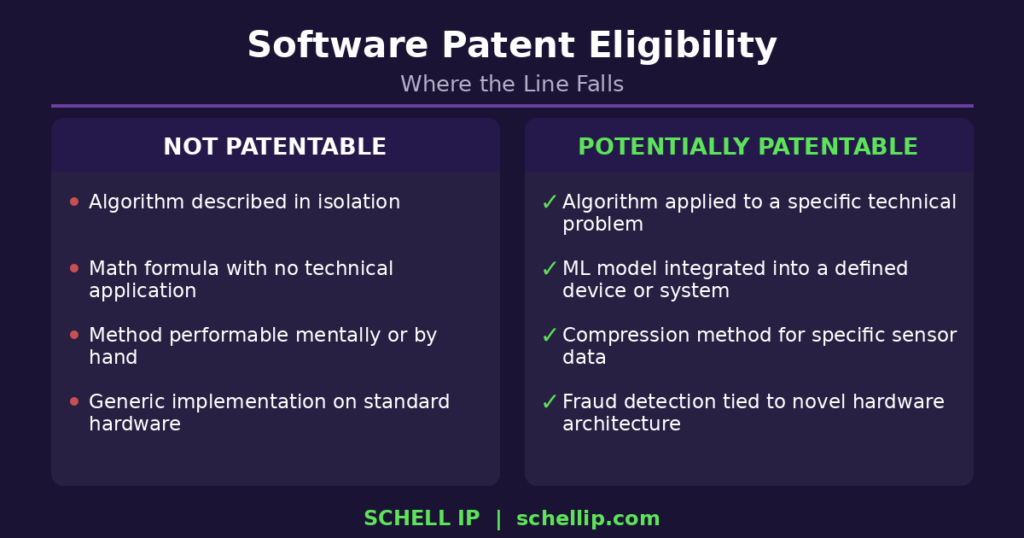
Software patent eligibility turns on specifics. Here is where the line tends to fall:
Likely Not Patentable
- A sorting algorithm described in isolation
- A mathematical method for calculating risk, with no specific technical application
- A general method of organizing information that could be done by hand or mentally
Likely Patentable
- A compression algorithm applied to a specific type of sensor data that improves transmission speed on low-bandwidth networks
- A machine learning model integrated into a medical device that improves diagnostic accuracy in a defined clinical setting
- A fraud detection algorithm that operates on a specific hardware architecture in a way that reduces false positives measurably
The more technically specific and concrete the claim, the stronger the case. Vague, broad claims that describe the algorithm at a high level without tying it to a real application are far more likely to be rejected. A patent attorney can help you identify which elements of your system are worth claiming before you file.
Can You Patent an App or Software Product?
Yes, in many cases. The same principles apply. An app that performs a novel technical function may be patentable if the underlying implementation goes beyond what a generic computer does by default. A new way to display information or organize tasks typically is not enough.
The distinction matters: a to-do list app is not patentable because the function is abstract and the execution is generic. An app that uses a novel method to predict user behavior in real time and adjust its interface to reduce errors in a specific context has a technical story to tell.
If you’re developing software and want to understand what’s protectable, the benefits of hiring a software patent attorney early in that process are significant. Getting claims framed correctly from the start is far more efficient than trying to retrofit a patent strategy after the product is built.
AI Inventions and Algorithm Patents
AI and machine learning models raise the same questions at scale. The algorithm itself, including the model architecture, the training method, and the loss function, is abstract. What can be patented is the specific application: how the model is deployed, what technical problem it solves, and how its output is used in a real system.
The USPTO has issued a 2024 guidance update on AI patent subject matter eligibility that directly addresses how the Alice/Mayo framework applies to AI inventions. The standard is the same: show a technical application, not just a technical idea.
If you’re working in AI and considering patent protection, Schell IP works with AI-focused inventors to evaluate what elements of an AI-based system are protectable and how to position claims for eligibility. See the AI patent attorney page for more on how Schell IP approaches AI inventions.
The Patent Application Process for Algorithm-Based Inventions
Filing a patent for an algorithm-based invention follows the same general process as any utility patent, but the drafting stage is particularly important. How claims are written determines eligibility, not just novelty.
The core steps:
- Prior art search: Confirm the invention is novel and identify the competitive landscape
- Claims drafting: Frame claims around the technical application, not the algorithm in isolation
- Filing: Submit a provisional or non-provisional application to the USPTO
- Examination: A patent examiner reviews the application; Section 101 rejections are common for software-based inventions
- Office Action responses: Amend or argue claims in response to examiner rejections. This stage is where experienced counsel makes a material difference
A Section 101 rejection is not the end of the road. Many algorithm-based patents succeed after Office Action responses that clarify the technical application. Understanding how long it takes to get a patent helps set realistic expectations. The process typically runs 2 to 3 years for utility patents.
When to Consult a Patent Attorney
Not every algorithm-based invention needs a patent. Trade secrets, copyrights, and contractual protections are worth considering. But if the invention is novel, technically specific, and central to your competitive advantage, patent protection may be worth pursuing.
This is a determination that’s difficult to make without legal guidance. The Alice framework involves nuanced claim-by-claim analysis, and the difference between an eligible and ineligible claim often comes down to how the invention is described, not just what it does. Consulting a software patent attorney before filing saves time and significantly reduces the risk of a preventable rejection.
Schell IP works with software developers, startups, and tech companies in Colorado and beyond. Schedule a consultation to discuss whether your algorithm-based invention is a strong patent candidate.

Frequently Asked Questions
Can you patent an algorithm in the United States?
Not on its own. Algorithms are classified as abstract ideas under U.S. patent law and are not eligible for protection in isolation. However, if the algorithm is applied to solve a specific technical problem or is integral to a novel technical system, the invention as a whole may qualify for patent protection under the Alice/Mayo framework. A patent attorney can help you assess whether your specific invention meets that standard.
What is the Alice test, and how does it affect software patents?
The Alice test is a two-step framework the USPTO uses to evaluate patent eligibility for software and algorithm-based inventions. Step one asks whether the claim is directed to an abstract idea. Step two asks whether the claim includes an inventive concept that transforms the abstract idea into a specific, practical application. Inventions that fail step two are rejected under 35 U.S.C. Section 101. The USPTO’s subject matter eligibility guidance provides the full framework examiners use.
Can you patent software?
Yes, software can be patented when it implements a novel technical process, improves how a computer system functions, or solves a concrete technical problem in a non-obvious way. Generic software that performs abstract tasks on standard hardware is typically not eligible. Consulting a software patent attorney early helps ensure your application is framed for eligibility from the start.
Can you patent an app?
An app may be patentable if the underlying method or system involves a novel technical contribution beyond the interface itself. The key is demonstrating that the app does something technically new. If you’re unsure whether your app qualifies, a patent attorney consultation is the fastest way to get a clear answer.
How do I know if my algorithm-based invention is patentable?
The most reliable way is to consult with a patent attorney who handles software patents. A prior art search and a preliminary Section 101 analysis can help you assess eligibility before investing in a full application. Factors that strengthen a case include technical specificity, a defined problem-solution pairing, and claims that go beyond generic implementation.
What happens if I get a Section 101 rejection?
A Section 101 rejection means the examiner found the claims directed to ineligible subject matter, most commonly an abstract idea without sufficient inventive concept. This is common in software and algorithm-based applications and does not mean the patent is dead. An experienced attorney can respond by amending claims or arguing that the invention satisfies the Alice framework. Many software patents are granted after one or more rounds of Office Action responses.