Quick Answer: The full patent timeline in 2026 typically runs about 24 to 36+ months from the day you file a non-provisional application to the day your patent is granted. If you expedite the process, the patent office has a program to reach a final decision on your patent application within 12 months if you pay a fee. If you start with a provisional application, add up to 12 months on the front end. The first office action alone takes an average of about 20 months to arrive, and applications that need extended examination can stretch past three and a half years. If you need a decision faster, the USPTO’s Track One program targets a final decision within 12 months for an extra fee.
Those are the averages. What the averages hide is that the patent timeline isn’t really one clock, it’s a series of stages, and the places where inventors lose months (or lose their patent rights entirely) are almost never the long waits everyone worries about. The rest of this guide walks through the patent timeline one stage at a time, so you know what’s happening, what’s normal, and where the real risks sit.
The Patent Timeline at a Glance
Before we break down each stage, here is the full patent timeline from idea to granted patent, with realistic 2026 durations. Total time from a non-provisional filing to grant typically lands between 24 and 36 months. Here is an exemplary timeline:
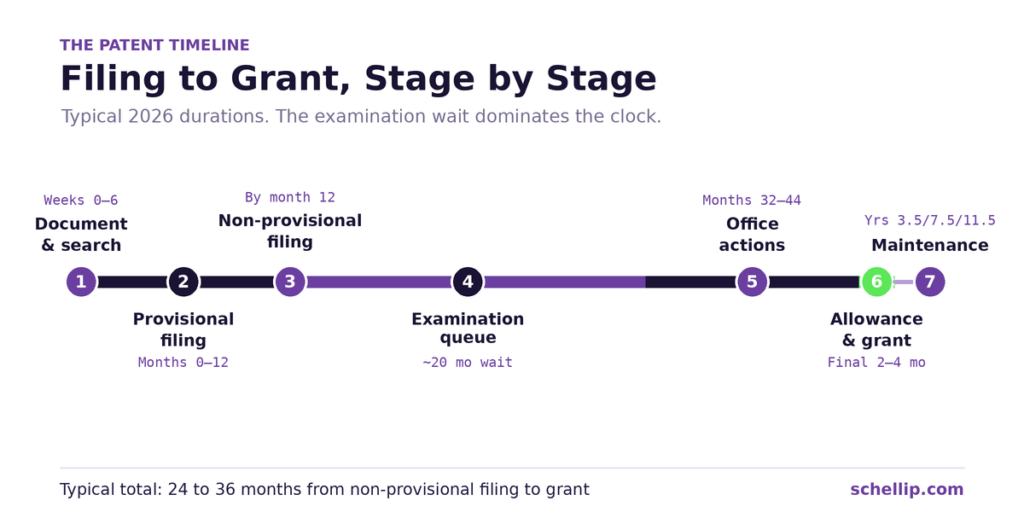
The patent timeline runs through seven stages:
- Stage 1, document and search (weeks 0 to 6): capture the invention in detail and run a prior art search.
- Stage 2, provisional filing (months 0 to 12): an optional placeholder application that locks in your filing date.
- Stage 3, non-provisional filing (by month 12): the formal application examiners actually review.
- Stage 4, examination queue (roughly months 12 to 32): the application waits its turn, about 20 months on average.
- Stage 5, office actions (months 32 to 44, give or take): the examiner rejects or objects, and you respond.
- Stage 6, allowance and grant (final 2 to 4 months): you pay the issue fee and the patent grants.
- Stage 7, maintenance (years 3.5, 7.5, and 11.5): fees due to keep a granted patent alive.
Now let’s walk through the patent timeline stage by stage, because the averages above hide the decisions that determine whether your application moves smoothly or stalls for years.
Stage 1: Before You File (Weeks 0 to 6)
The patent timeline starts earlier than most inventors realize. The clock on your rights begins the moment you disclose your invention to anyone, not the day you file. Budget two to six weeks up front for two things: documenting the invention in as much detail as possible, and running a prior art search to confirm it’s actually unique. This is the one stretch of the patent timeline where going slower is genuinely faster, because what you capture here determines what you can claim later. At Schell IP, this is also where we think through alternative uses and future versions of the invention, so the application is drafted as broadly as the invention allows.
One warning that shapes the entire timeline. The United States gives you a 12-month grace period to file after your first public disclosure, and in our attorneys’ experience that grace period is a dangerous trap. If someone sees your disclosure, tweaks your concept, and files their own application first, they may end up with the earlier filing date and block you from ever getting a patent. File before you disclose to investors, manufacturers, trade show audiences, or crowdfunding backers. We cover these disclosure traps in detail in our guide to critical patent timing mistakes.
Stage 2: The Provisional Application (Months 0 to 12)
Most inventors start the patent timeline with a provisional patent application. A provisional is a placeholder: it is never examined and can never become a patent by itself, but it establishes your priority date with the USPTO and gives you patent pending status for 12 months while you refine the invention, test the market, or raise money.
Two things about this stage matter enormously for your patent timeline:
- The 12-month conversion deadline is unforgiving. You have exactly 12 months from your provisional filing date to file the non-provisional. In our practice, this is the single most commonly missed deadline in all of patent law, and missing it means losing the priority date your provisional was filed to protect.
- A rushed provisional can quietly cost you that priority date. A provisional only holds your date for what it actually discloses. This is what happened in Novozymes A/S v. DuPont Nutrition Biosciences, a 2013 Federal Circuit decision: an enzyme patent lost its claim to an earlier priority date because the original filing described the invention only in broad terms and didn’t adequately support the specific claims that were later asserted. The lesson for the timeline is simple: a provisional is a real patent application, and treating it as a throwaway placeholder can undo the very protection it was filed to secure.
You can also skip the provisional entirely and file a non-provisional first. That shaves up to a year off the total patent timeline, and it’s often the right call when the product is finished and disclosure is imminent.
Stage 3: Filing the Non-Provisional (Month 12, or Month 0 If You Skip the Provisional)
The non-provisional is the formal application that a patent examiner actually reviews, and it is the only application that can become an enforceable patent. Once it’s filed, your place in the examination queue is set, and so is something more important: the quality ceiling of your entire patent.
This is the point in the patent timeline that inventors control completely and appreciate least. There are good patent applications and bad ones. A bad one (rushed, thin on technical detail, missing key variations of the product) doesn’t just risk rejection. It can fail to support your priority claim, invite invalidation if you ever try to enforce the patent, and even let a competitor patent a tweaked version of your own product over you. Everything that happens in stages 4 through 6 is built on what you file here, which is why the filing itself, not the waiting, is where the timeline is really won or lost. If you want the how-to for this stage, our guide to filing a patent covers the mechanics step by step.
Stage 4: The Waiting Period (Roughly Months 12 to 32)
After filing, your application enters the USPTO’s queue, and this is the longest single stretch of the patent timeline. As of 2026, the average wait from filing to first office action is around 20 months, and the USPTO is working through a backlog of roughly 780,000 unexamined applications. Wait times vary meaningfully by technology: software and biotech applications tend to sit on the long end, while mechanical and consumer-product applications often move faster. You can check current figures on the USPTO’s patents pendency dashboard.
During this wait you are patent pending, which means your filing date is locked in and you can mark your product accordingly. What you can’t yet do is sue anyone for infringement. If that gap matters for your business, the acceleration options later in this guide exist precisely for this stretch of the timeline.
Stage 5: Office Actions (Months 32 to 44, Give or Take)
When the examiner finally picks up your application, you will very likely receive an office action: a formal response detailing which of your claims have been accepted, rejected, or objected to. Don’t panic when it arrives. Office actions are extremely common, the majority of applications get at least one, and a rejection is the start of a negotiation, not the end of your application.
The response cycle works like this: you typically have three months to respond (extendable to six with fees), the examiner then reviews your response and either allows the claims, issues another office action, or issues a final office action. If prosecution continues past a final office action, a Request for Continued Examination (RCE) reopens the process, and applications that go through an RCE average around 44 months of total pendency. Each round adds months to the timeline, which is why the quality of your responses, and of the original application they’re built on, matters so much. In our experience, no attorney can fully rescue an office action response if the underlying application was weak to begin with, which loops right back to the filing decisions in stage 3.
Stage 6: Allowance and Grant (The Final 2 to 4 Months)
When the examiner allows your claims, you’ll receive a Notice of Allowance, pay the issue fee, and the patent formally grants a few weeks later. Across all utility applications, total pendency in 2026 averages about 26 months, with most smooth prosecutions landing in that 24 to 36 month range. Design patents move faster through the timeline, typically 18 to 24 months total.
Stage 7: After the Grant (Years 3.5, 7.5, and 11.5)
Reaching a granted patent isn’t the end of the timeline. Utility patents require maintenance fees at 3.5, 7.5, and 11.5 years after grant, and missing one can abandon the patent entirely. The USPTO does not forgive these deadlines, and patent history is full of cautionary tales about filings that arrived a single day late, in one well-documented instance triggering more than a decade of litigation over a blockbuster drug patent (the Angiomax patent term extension dispute). Any patent attorney worth hiring runs a backed-up docketing system for exactly this reason; at Schell IP, deadline tracking is part of what you’re paying for. Our full guide to patent maintenance fees covers the amounts and grace windows.
How to Speed Up the Patent Timeline
If two to three years doesn’t work for your business, you have real options to compress the timeline:
- Track One prioritized examination. The USPTO’s Track One program targets a final decision (allowance, final rejection, or appeal) within about 12 months of the request being granted. You pay a prioritization fee on top of the normal filing fees (recently in the range of roughly $1,700 to $1,800 for a small entity, and the USPTO adjusts fees regularly, so check the current schedule). For a startup heading into a fundraise or a product launch, cutting the wait from two-plus years to under one is often worth every dollar.
- Petition to make special based on age. If an inventor is 65 or older, the USPTO will expedite examination on petition, at no extra government fee. It’s one of the most underused ways to shorten the timeline.
- File a clean, complete application the first time. The cheapest acceleration strategy is avoiding extra examination rounds entirely. Every office action cycle you prevent saves three to twelve months off the back end of the timeline.
Jeff’s Take
I’ve been practicing patent law for over fifteen years, and here’s what I’ve learned about the patent timeline: the stages everyone worries about are not the stages that actually hurt people. Nobody loses their patent rights because the USPTO took 20 months to send a first office action. That wait is annoying, but it’s survivable, and your priority date is protected the whole time.
Where people actually lose their rights is at the deadlines and decisions buried inside the timeline. The 12-month deadline to convert a provisional into a non-provisional is, in my experience, the most commonly missed deadline in all of patent law. The 12-month grace period after a public disclosure lulls inventors into waiting, right up until a competitor or a crowdfunding campaign turns that disclosure into prior art against them. And a rushed, thin application quietly poisons every later stage of this timeline in ways I often can’t fix after the fact.
This isn’t hypothetical, and it isn’t limited to inventors working out of a garage. In Helsinn v. Teva, a case that went all the way to the Supreme Court in 2019, a pharmaceutical company lost patent protection because it had put its invention on sale under a commercial agreement more than a year before filing, even though the details of the invention stayed confidential. One deal, signed too early, and the on-sale bar wiped out the patent. If a company with that many lawyers can get caught by the timeline, so can a founder wearing six hats.
So my honest advice on the patent timeline is this: stop optimizing for the parts you can’t control, and get serious about the parts you can. File early, before any disclosure if at all possible. File a complete, well-drafted application. And put every deadline into a tracked docketing system, ideally your attorney’s, because the patent office will not forgive a miss, even by one day.
Patent Timeline FAQ
How long does it take to get a patent in 2026?
Most utility patents take 24 to 36 months from non-provisional filing to grant, with the average first office action arriving around 20 months after filing. Design patents are faster, typically 18 to 24 months. Applications that require extended examination through an RCE average around 44 months. For a closer look at what drives these numbers, see our companion guide, How Long Does It Take to Get a Patent?
Can I speed up my patent timeline?
Yes. The USPTO’s Track One program targets a final decision within about 12 months for an additional fee, and inventors aged 65 or older can petition to have examination expedited at no extra government cost. Filing a complete, well-drafted application also prevents the extra office action rounds that add the most unplanned time to the timeline.
What happens if I miss the 12-month provisional deadline?
If you don’t file a non-provisional application within 12 months of your provisional filing, the provisional expires and you lose the priority date it established. Any disclosures made in the meantime can then count as prior art against a later application. This is the most commonly missed deadline in patent law, so calendar it the day you file the provisional.
Does “patent pending” protect me while I wait?
Patent pending means your application is on file and your priority date is locked in, and you can mark your product accordingly, which deters copycats. It does not let you sue for infringement; that right only comes with the granted patent. Both provisional and non-provisional applications establish patent pending status.
When does the patent timeline actually start?
Practically, it starts before you file. The moment you publicly disclose your invention, deadlines begin running against you. The safest timeline starts with documentation and a patent search, then a filing before any disclosure to investors, manufacturers, or the public.
Ready to Map Your Patent Timeline?

The biggest variable in your patent timeline isn’t the USPTO’s backlog. It’s the quality and timing of what you file, and those are decided in the first few weeks, not the last few months. If you’re weighing when to file, whether to start with a provisional, or whether Track One fits your launch schedule, the team at Schell IP is ready to help you map it out. Book a free consultation and we’ll walk through your timeline together, with no cost and no pressure to move forward.