Quick Answer: A cross licensing patent deal is an agreement where two companies each grant the other permission to use their patents, usually to settle a dispute, avoid one, or clear the freedom to build in a crowded technical field. Instead of paying cash for a one-way license, each side trades access to its own patents, so both can operate without suing each other. Big technology companies have used cross-licensing for decades to keep their products out of court. Most startups have never heard of it, which is a missed opportunity, because a strong patent portfolio can become a bargaining chip long before it ever becomes a lawsuit.
The rest of this guide explains how cross-licensing actually works, the difference between using it defensively and offensively, when it makes sense for a startup, and what to watch out for before you sign one.
What Is a Cross-License, Really?
Think of a normal patent license as a one-way street: one company owns a patent, another company wants to use the technology it covers, so the second company pays the first for permission. Money flows one direction, rights flow the other, which is how most patent licensing works.
A cross-license turns that street into a two-way exchange. Company A holds patents that Company B needs, and Company B holds patents that Company A needs, so instead of writing checks back and forth, they grant each other the rights they need. Sometimes money still changes hands to balance out a difference in the value of each portfolio, but the core of the deal is the mutual grant. Each company walks away free to build products that would otherwise infringe the other’s patents.
This matters most in fields where a single product can touch hundreds or thousands of patents held by many different owners. A modern smartphone, a piece of networking equipment, or a complex piece of software can read on patents scattered across an entire industry, which is why licensing in standards-heavy fields like 5G and IoT gets so complicated. When everyone potentially infringes everyone else, suing your way through the tangle is slow and expensive. A cross licensing patent arrangement is how sophisticated companies cut through it: they agree to leave each other alone and get back to competing on product instead of in the courtroom.
Cross Licensing Patents and the “Patent Thicket”
There’s a name for that tangle of overlapping patents: a patent thicket. In densely patented areas like semiconductors, telecommunications, and increasingly AI and software, so many patents overlap that it becomes nearly impossible to ship a product without arguably infringing something somebody owns. The USPTO and academic researchers have studied how these thickets can slow down innovation, because the risk of litigation hangs over every new product.
A cross licensing patent strategy is one of the main tools companies use to navigate a thicket. Rather than negotiate a separate license with every patent holder, or gamble that nobody will sue, competitors agree to broad mutual grants that cover whole categories of their patents. For a founder, the takeaway is simpler than the economics: in a crowded field, your own patents are not just protection against being copied. They are the currency you use to buy your way out of everyone else’s thicket.
Defensive vs. Offensive: Two Ways to Use a Cross Licensing Patent Strategy
Companies use cross-licensing in two very different ways, and understanding which one you’re in changes how you negotiate.
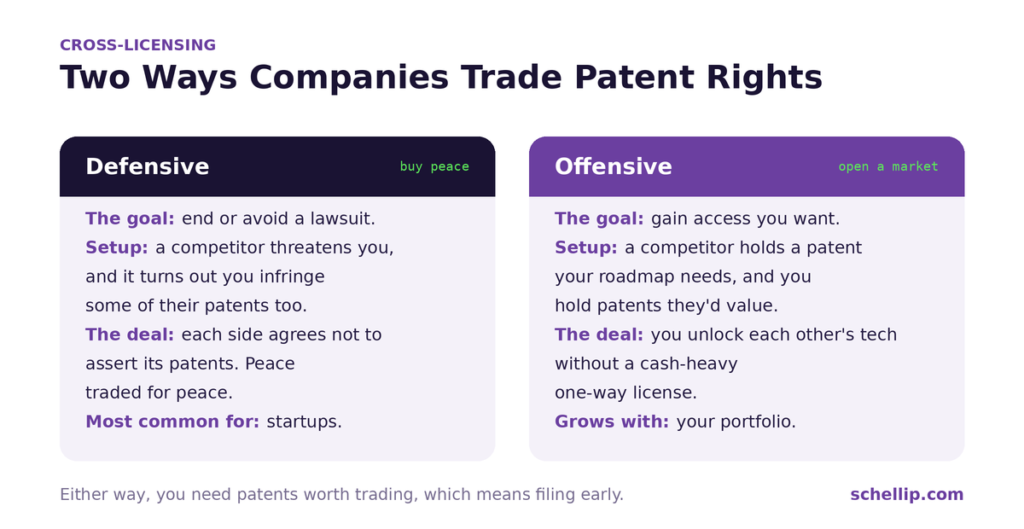
- Defensive cross-licensing is about buying peace. This is the most common form, especially for startups. A larger competitor threatens to sue you for infringing its patents, and you discover that its products infringe some of yours. Instead of a costly lawsuit neither side really wants, you cross-license: each company agrees not to assert its patents against the other. You give up the ability to sue them, they give up the ability to sue you, and both companies get back to business. The stronger your portfolio, the more leverage you have to reach a balanced deal rather than a lopsided one.
- Offensive cross-licensing is about opening a market. Here you’re not under threat; you want something the other company has. Maybe a competitor holds a foundational patent you need to build your next product, and you hold patents they’d like access to. A cross-license lets each of you unlock the other’s technology without a cash-heavy one-way license. This is less common for early startups, but it becomes powerful as your portfolio grows and other players start wanting what you own.
The line between the two isn’t always clean, and a single negotiation can carry elements of both. What matters is knowing your own position going in: are you trading to make a threat go away, or trading to gain access you don’t currently have? At Schell IP, that assessment is one of the first things we work through with a founder, because it determines whether you’re negotiating from strength or from exposure.
When Does a Cross Licensing Patent Strategy Make Sense for a Startup?
Cross-licensing isn’t right for every company, and for a very early startup with no patents yet, it usually isn’t on the table at all. It tends to make sense in a few specific situations:
- You operate in a densely patented field. If you’re building in semiconductors, telecom, networking, or increasingly in AI and software, you’re likely wading into a patent thicket whether you realize it or not. Building a portfolio that can be cross-licensed is part of operating safely in those spaces.
- A bigger competitor has noticed you. Growth attracts attention, and attention sometimes arrives as a demand letter. If you already hold patents of your own when that letter comes, you have something to trade. If you don’t, your only options are to pay or to fight, both of which are expensive. This is the single best argument for protecting your invention early, well before you think you need to.
- You need access to technology someone else controls. When a competitor holds a patent that sits squarely in your product roadmap, a cross-license can be the cleanest way to get access, especially if you hold patents they’d value in return.
The common thread across all three is that cross-licensing only works if you have patents worth trading. That’s the part founders miss. The strategy that saves you later is built years earlier, in the unglamorous work of filing applications before you’re forced to.
What to Watch Out for Before You Sign
A cross-license is a real legal agreement with long-term consequences, and the details matter enormously. A few things we always look at closely:
- Scope. Does the grant cover only the patents that exist today, or future patents too? Does it cover only current products, or product lines you haven’t launched yet? A grant that’s broader than you intended can hand a competitor rights to technology you haven’t even built.
- Sublicensing and transfer. What happens if the other company gets acquired? Can the rights you granted pass to a new owner, possibly a much larger competitor? These clauses decide who you might really be in bed with three years from now.
- Field-of-use limits. A well-drafted cross-license can be limited to specific fields or markets, so you’re not granting away more than the situation requires. Getting these boundaries right is where experienced patent counsel earns its keep.
The point isn’t to make cross-licensing sound frightening. It’s a routine, powerful tool. But it’s also a place where a rushed agreement can quietly give away far more than you realized, which is exactly why it belongs in the hands of someone who negotiates these deals for a living.
Jeff’s Take
I hope you never have to sue anyone. Lawsuits are expensive and distracting, and I tell clients that honestly. But here’s the hard truth I’ve learned guiding hundreds of startups, as a patent attorney, as a venture partner, and as a founder myself: if you don’t have the right legal ammunition, you’re an easy target. So why do I push founders to get patents if I don’t want them suing people? Because you need a shield.
In the AI era, the odds you get sued go up, not down. And the ground has shifted in the patent holder’s favor. Recent policy changes at the USPTO and recent changes to the law have put patent holders in their strongest position in at least twenty-five years, which means a competitor holding patents is stronger today than they were even six months ago. When one of them comes after you, or when a patent troll targets you, you can’t fight back with money alone. The strongest response is your own patents, because they let you say: if you sue me, I’ll counter-sue you.
Here’s where the cross licensing patent strategy comes in, and it’s the part founders miss. That counter-suit threat is the leverage, not the finish line. Once both sides realize they each infringe the other, nobody actually wants to spend years and millions destroying each other in court. So the standoff resolves into a deal: you grant each other the rights you need and agree to leave each other alone. That deal is the cross-license. The threat is what gets the other company to the table; the cross-license is what everyone signs to walk away. And you only have that leverage if you filed early enough to have patents worth counter-suing with.
So my honest advice for 2026: in a hyper-competitive tech market, your patents aren’t just a “no trespassing” sign. They’re the leverage that turns “how much do we owe you” into “let’s trade and move on.” Without them, you’re showing up to a gunfight with a knife. The founders who reach that better outcome are almost always the ones who treated their patents as a defensive shield and filed early, before anyone was paying attention.

Cross-Licensing FAQ
What is a patent cross-license?
A patent cross-license is an agreement in which two companies grant each other permission to use their respective patents. Instead of one company paying another for a one-way license, each side trades access to its own patents, allowing both to operate without infringing on the other. Money sometimes changes hands to balance a difference in portfolio value, but the heart of the deal is the mutual grant.
What’s the difference between defensive and offensive cross-licensing?
Defensive cross-licensing is used to avoid or settle a dispute: two companies that could each sue the other agree not to, trading peace for peace. Offensive cross-licensing is used to gain access to technology you want, where each company unlocks the other’s patents without a cash-heavy one-way license. Defensive deals are far more common for startups.
Is cross-licensing only for big tech companies?
No, though large companies have used it the longest. Any company that holds patents in a crowded technical field can use cross-licensing, and startups increasingly need it as they grow into industries dense with overlapping patents. The catch is that you need patents worth trading, which is why filing early matters so much.
What is a patent thicket?
A patent thicket is a dense web of overlapping patents in a technical area, so tangled that it’s difficult to build a product without arguably infringing patents owned by many different companies. Semiconductors, telecommunications, and increasingly AI and software are known for thickets. Cross-licensing is one of the main strategies companies use to operate safely inside one.
When should a startup start thinking about cross-licensing?
Practically, the groundwork starts the moment you begin building something defensible in a crowded field, because cross-licensing only works if you already hold patents worth trading. Waiting until a competitor threatens you is usually too late to file. The startups with leverage are the ones that filed early, before they needed it.
Ready to Build Leverage Before You Need It?
Cross-licensing only works if you have something to trade, and that something gets built years before the threatening letter ever arrives. If you’re building in a competitive technical field and want to understand what a defensible patent position looks like for your company, the team at Schell IP can help you think it through. Book a free consultation and we’ll talk through your strategy, with no cost and no pressure to move forward.