Quick Answer: Defensive patents are patents filed not necessarily to bring a patent infringement lawsuit against competitors, but to help protect your company in the case it is sued. In 2026, with patent holders in a stronger legal position than they have been in 25 years, building a portfolio of defensive patents is one of the most important things a tech founder can do. Without them, you are showing up to a gunfight with a knife.
I hope you never have to sue anyone.
Seriously. Lawsuits are expensive and distracting. But if you don’t have the right legal ammunition, you might become an easy target for one.
I’m Jeff Schell. I’m a patent attorney, a venture partner, and an entrepreneur who has guided hundreds of startups through the legal minefield. I’ve built and exited my own companies, so I know this terrain from both sides of the table.
So why do I tell my clients to get defensive patents if I don’t want them to sue anyone?
The answer is simple: you need a shield.
The Legal Landscape Has Changed, and the Risk Is Real
In the AI era, getting sued is not a remote possibility. It is increasingly likely.
Recent policy changes at the USPTO and new case law have put patent holders in a stronger position than they have been in at least 25 years. The short version: courts are enforcing software and AI patents again, while simultaneously making them more difficult to challenge, and competitors who hold patents are in a significantly better position than they were even six months ago. If a competitor comes after you, or a patent troll targets you, the threat is real in a way it simply was not a few years ago.
You cannot fight that threat with just money.
What Are Defensive Patents?
Defensive patents are patents you file with the primary goal of protecting your company from patent infringement lawsuits, rather than to assert them offensively against competitors.
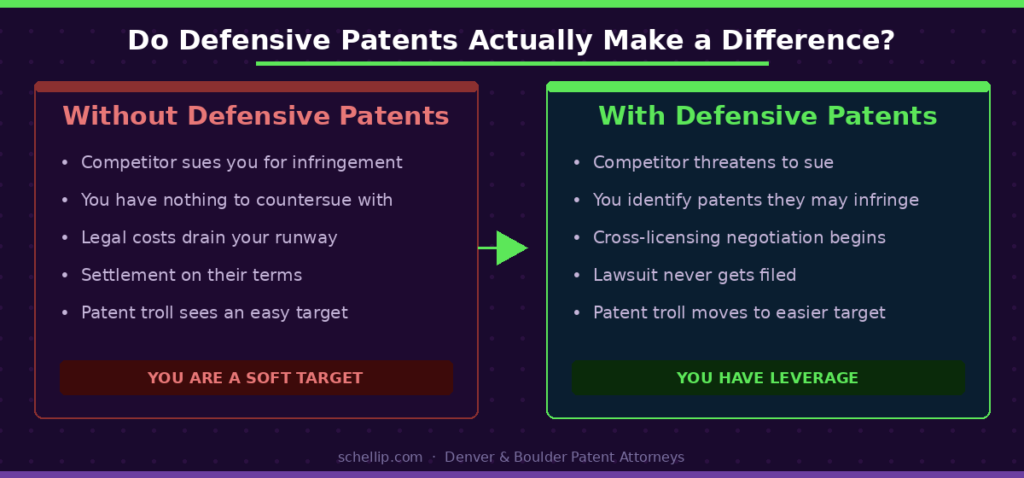
The logic is straightforward. If a competitor or patent troll threatens to sue you and you have your own portfolio of defensive patents, you have something to fight back with. This completely changes the negotiation dynamic. Instead of a one-sided legal threat, you now have the ability to countersue.
This strategy is sometimes called cross-licensing: essentially telling the other party, “If you sue me, I will countersue you.” It is one of the most effective ways to get someone considering a patent infringement lawsuit against you to simply walk away.
Jeff’s Take
I’ve seen this play out many times with startup founders. They come to me thinking patents are about offense, about suing someone who copied their idea. And yes, that can be one use.
But the more immediate value for most early-stage companies is defensive. Having a portfolio of defensive patents changes how a competitor calculates the risk of coming after you. It turns you from a soft target into someone who can hit back.
In the current environment, where patent holders are in a stronger position than they have been in decades, showing up without defensive patents is a genuine strategic mistake.
It’s not a question of if someone will come after you in a competitive tech market. It’s a question of when, and whether you’ll have anything to defend yourself with when they do.
Patent Trolls Are a Real Threat to Tech Startups
Patent trolls, formally known as non-practicing entities, are companies that acquire patents not to build products but to sue or threaten to sue companies that are actually building things.
They sometimes target startups specifically because startups often lack the resources for prolonged litigation. The calculation is that you will settle rather than fight, and the settlement demand is calibrated to be less than the cost of defending yourself.
Defensive patents disrupt that calculation entirely. A patent troll threatening a company with no IP portfolio is in a very different position than one threatening a company with meaningful defensive patents it can assert right back.
How Defensive Patents Create Leverage in Every Direction
Beyond stopping lawsuits, defensive patents create business value that compounds over time.
For fundraising, investors increasingly expect to see defensible IP, particularly in AI and software. A portfolio of defensive patents signals that you own something proprietary and that competitors cannot simply copy your way to market share. It reduces perceived risk for the investor. If you’re building in AI specifically, our post on IP strategy in the digital AI age covers how the IP landscape is shifting for software companies.
For acquisitions, acquirers perform detailed IP due diligence. Defensive patents increase your valuation and reduce friction in the deal process. Many acquisitions are driven at least in part by the target’s IP portfolio. At the patent strategy for startups level, building that portfolio early is almost always the right move.
For licensing, even defensive patents can generate revenue through patent licensing agreements with companies that want to use your technology legitimately. What starts as a shield can become a revenue stream.
Defensive Patents in the Cross-Licensing Negotiation
Cross-licensing is the formal version of the defensive patent strategy. Two companies agree to license each other’s patents, often as part of resolving or preventing litigation.
In practice: a larger competitor threatens to sue you for infringing one of their patents. You respond by identifying defensive patents in your own portfolio that their products potentially infringe. Suddenly, the lawsuit is not one-sided. They now face the same exposure they were trying to create for you. Most of the time, the lawsuit simply does not happen.
This strategy only works if your defensive patents are real, specific, and well-drafted. Vague or overly broad patents will not create the deterrent you need, which is why working with an experienced software patent attorney from the beginning matters so much.
Without Defensive Patents, You Are a Soft Target
The hyper-competitive tech market in 2026 is not forgiving of companies that skip IP strategy.
Your competitors are filing patents. The legal environment now strongly favors patent holders. Courts are letting cases reach juries. Triple damages are available for willful infringement. And patent trolls are actively targeting companies that look like easy prey.
With a portfolio of defensive patents, you change the entire risk calculation for anyone thinking about coming after you. Sometimes the only way to avoid a fight is to make clear that you are prepared for one.
How to Start Building Your Defensive Patent Portfolio
You do not need dozens of patents to create meaningful protection. Even a small, well-targeted portfolio can shift the dynamic significantly.
A provisional patent application establishes your priority date quickly while you continue development, and filing provisionals early and often is one of the most cost-effective ways to build defensive coverage. From there, focus on your core technology, the specific technical improvements that are hardest for competitors to work around and most central to your competitive advantage.
Think about what a competitor or troll might come after you for. Your defensive patent portfolio should cover the areas of your technology where you have the most exposure, not just the features you are most proud of. For a full breakdown of what this costs at each stage, the 2026 patent cost guide covers everything from provisional filings through full prosecution.

Frequently Asked Questions
What are defensive patents?
Defensive patents are patents filed primarily to protect a company from patent infringement lawsuits rather than to sue competitors. They create leverage in disputes by giving the patent holder the ability to countersue, which often deters litigation entirely.
What is cross-licensing and how does it relate to defensive patents?
Cross-licensing is an agreement between two companies to license each other’s patents, often used to resolve or prevent patent disputes. Defensive patents are what make cross-licensing possible. When a competitor threatens to sue you for patent infringement, your own portfolio gives you the ability to threaten a counterclaim, which typically leads both parties to walk away or reach a licensing arrangement instead.
What is a patent troll?
A patent troll, or non-practicing entity, is a company that acquires patents for the purpose of suing businesses that are actually building products. They target companies without strong defensive patent portfolios because those companies are more likely to settle than fight.
Do I need a lot of patents to have defensive protection?
No. Even a small, well-targeted portfolio covering your core technology can shift the litigation calculus significantly. Quality and specificity matter more than quantity.
How much does it cost to build a defensive patent portfolio?
Most early-stage companies start with one to three provisional patent applications and add non-provisional filings as the business grows. The 2026 patent cost guide has detailed pricing at each stage.
How do I know what to patent for defensive purposes?
Start with your core technology, the innovations that are hardest to work around and most central to your competitive advantage. A free consultation with Schell IP is the fastest way to identify what is patentable and where your portfolio has gaps.