Last Updated: August 13, 2026
Quick Answer: AI patent litigation has shifted decisively in favor of patent owners. Beginning in 2024 and cementing through 2025, the USPTO and federal courts changed the standard for software and AI-implemented inventions, making it significantly harder for large companies to steal patented technology without consequence. Courts are now enforcing AI patents that demonstrate a clear technological improvement, such as reducing memory usage, training models faster, or detecting anomalies with less data. If you hold a patent or are building technology worth protecting, this is one of the most important legal developments in years.
For a long time, the dirty little secret in Silicon Valley was this: patents don’t matter because you can’t enforce them.
I’m Jeff Schell. I’m a venture partner with an international venture capital firm and a patent attorney. I track federal circuit patent court decisions daily so you don’t have to. And I’m here to tell you that secret is dead.
Here’s what changed, why it matters, and what you should do about it now.
What “Efficient Infringement” Meant and Why It Worked
To understand the current state of AI patent litigation, you need to understand where we’ve been.
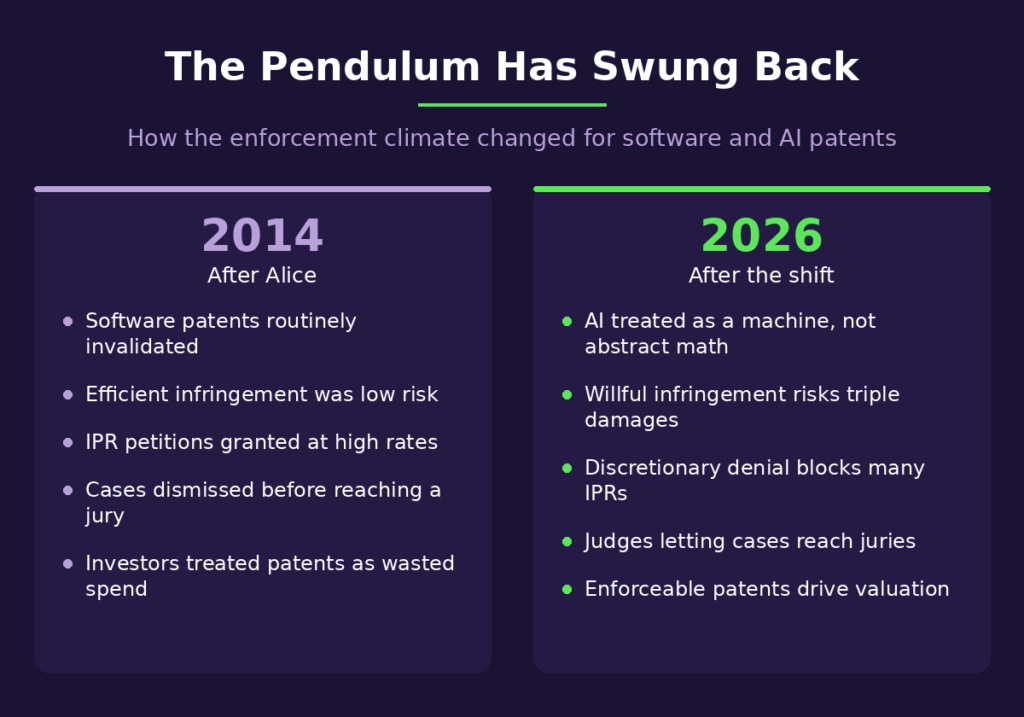
In 2014, the Supreme Court’s decision in Alice Corp. v. CLS Bank decimated software patents. The ruling effectively made it illegal to patent abstract ideas implemented on a computer, and courts began throwing out software patents at an alarming rate. If your invention was software-implemented, even if it was genuinely novel, the odds of winning a patent lawsuit dropped dramatically.
For investors and founders, weak software patents became a red flag in due diligence. They signaled wasted capital and poor patent strategy, and many venture capitalists told founders not to bother with patents at all. That advice made sense at the time. It no longer does.
What Changed: The Pendulum Has Swung Back Hard
Starting in 2024 and cementing through 2025, both the USPTO and the federal courts revised the standard for patents involving software-implemented inventions. The shift is fundamental, not cosmetic.
Courts now recognize AI as a specific machine tool, not just abstract math. This distinction is critical. Under the old standard, many AI and software inventions were dismissed as too abstract to patent. Today, judges are evaluating these inventions differently, recognizing that a specific AI model, a defined training method, or a novel data architecture is a concrete technical improvement, not a mathematical abstraction.
Recent AI patent litigation has resulted in courts upholding patents covering:
- Data structure improvements
- User interface mechanics
- Specific methods of training artificial intelligence
These are precisely the categories of invention courts were dismissing a decade ago. The same types of patents big tech once felt comfortable ignoring are now holding up in court. For a closer look at the legal standards driving this shift, the USPTO’s published guidance on AI and software patentability is worth reviewing alongside recent Federal Circuit decisions.
What Qualifies as a Patentable AI Invention in 2026
The key phrase the courts have settled on is technological improvement. If your AI system improves how the underlying technology works, not just the business outcome it produces, it can qualify for enforceable patent protection. Courts are asking a specific question: does this invention make the computer itself work better?
Your AI may qualify for patent protection, and survive AI patent litigation, if it delivers a concrete technological improvement. Examples include:
- Reducing memory usage during inference or training
- Training a model faster with fewer computational resources
- Detecting anomalies or making predictions using significantly less data
- Improving the accuracy, speed, or efficiency of a computer system in a measurable way
- Novel architectures for how software systems coordinate, communicate, or process data
What does not qualify: using AI to organize, sort, or categorize data, even if it does so faster than a human, typically does not meet the bar. Courts view this as automating a conventional process, not improving the technology itself. This is the distinction that determines software patent eligibility and what holds up in AI patent litigation.
That distinction creates two very different outcomes depending on the type of company you’re building. For deep tech startups with genuine AI innovation, this shift is a massive opportunity: a strong patent portfolio becomes a competitive moat, a bargaining chip in licensing negotiations, and a value driver in acquisition due diligence. For wrapper startups, companies that build a layer of UI or workflow on top of existing AI models without meaningful technical innovation, this is a warning. Without patentable technology, your competitive position is fragile, and a larger company can replicate what you have built without legal consequence.
Jeff’s Take
I’ve been practicing patent law and sitting on the investor side of the table for a long time, and what’s happening right now in AI patent litigation is genuinely unusual. The legal environment for software and AI patents is the most favorable it has been since before Alice. But here’s what I want founders to understand: this does not mean any software patent is suddenly valuable. What changed is that a well-drafted patent, one that clearly describes a specific technical improvement to a specific technical problem, now has real teeth. The patents that were always poorly written are still weak. The difference is that the good ones can now actually be enforced, which changes the entire strategic calculus around how and when to file.
Discretionary Denial: The New Shield for Patent Owners
One of the most consequential and least discussed changes in AI patent litigation involves something called discretionary denial.
For years, large companies had a powerful tool beyond district court: the Patent Trial and Appeal Board (PTAB) and its Inter Partes Review (IPR) process. When a startup tried to enforce a patent, a bigger defendant could simply file an IPR petition asking the PTAB to invalidate the patent. This parallel challenge was cheap for the challenger and expensive for the patent owner, and the PTAB granted these petitions at a high rate.
That dynamic has changed significantly. The USPTO Director has reassigned authority over IPR institution decisions and has begun exercising discretionary denial, rejecting petitions from third parties seeking to challenge patent validity, particularly for software and AI-implemented inventions.
For patent holders, this is a structural improvement. A well-drafted patent is now harder to kill through an IPR challenge, and enforcing your rights in district court is less likely to be derailed by a parallel PTAB proceeding. We wrote a detailed breakdown of how these new USPTO interim procedures could boost patent value for small innovators if you want to go deeper on the mechanics.
Why Efficient Infringement Is Now a Dangerous Strategy
Under the old rules, the worst-case scenario for a company that copied your patented technology was a settlement on favorable terms. The infringer’s lawyers knew the patent was vulnerable to challenge and that the court might dismiss the case on eligibility grounds before it ever reached a jury.
Under today’s rules, that calculus has changed completely.
If a company willfully infringes your patent, meaning they knew about your patent and copied your invention anyway, they now face the possibility of triple damages for willful infringement. And unlike in 2015, judges are increasingly allowing AI patent litigation to go to trial rather than dismissing it on eligibility grounds.
The combination of stronger software patent eligibility standards, discretionary denial of IPR petitions, and judges willing to let cases reach juries means efficient infringement is no longer efficient. The risk has shifted back to the infringer.
What This Means If You Hold a Patent
If you have a patent, especially a software or AI patent, your position is fundamentally stronger than it was even two years ago.
You are no longer just a nuisance. You are a threat.
And in business, being a credible threat is sometimes the only way to get a deal done. Whether the outcome you want is a licensing agreement, an investment offer, or an acquisition, you need leverage. A well-drafted, defensible patent is one of the most concrete forms of leverage available to a founder. This is how Silicon Valley has always treated patents: not as legal paperwork but as financial and strategic assets. The difference now is that the legal environment finally supports that view for software and AI companies, not just hardware and biotech.
For a closer look at how this mindset plays out in practice, see our piece on why Silicon Valley looks at patents differently and what that means for founders everywhere.
What This Means If You Haven’t Filed Yet
If you’re building a technology company and haven’t established a patent strategy, the window to act is more valuable than it has been in over a decade. The current AI patent litigation environment rewards founders who file early and file strategically.
That doesn’t mean any patent will do. Vague, broadly written software patents still face scrutiny. The key is filing the right way, with claims that demonstrate a specific technical improvement to a specific technical problem, not simply a business process automated by software. That is the standard that survives Alice, holds up in IPR, and gives you real leverage if AI patent litigation ever becomes necessary.
Strong AI patents start with understanding your technology at a system level. An experienced AI patent attorney will interview your technical team, map how your system processes information, identify the inventive steps, and draft patent claims that are broad enough to block competitors but specific enough to survive the USPTO and the courtroom. Patents written purely for approval, rather than for enforcement or strategic coverage, rarely hold up in AI patent litigation. At Schell IP, every patent is written with the assumption that it will be scrutinized, both by the USPTO and by opposing counsel using sophisticated search tools, with litigation, licensing, and acquisition in mind from day one.
A few things worth knowing as you think about building your IP portfolio:
- A provisional patent application can establish your priority date quickly, typically for $3,000 to $6,000, while you continue development.
- A non-provisional utility patent is what creates the enforceable right. Understanding the full patent filing process helps you make smarter decisions about timing and investment.
- If you’re in software or AI specifically, working with a software patent attorney who understands both the Alice standard and the current enforcement climate is essential.
For a full breakdown of what protecting your innovation costs at each stage, see our 2026 patent cost guide.
How AI Patent Litigation Impacts Fundraising and Acquisition
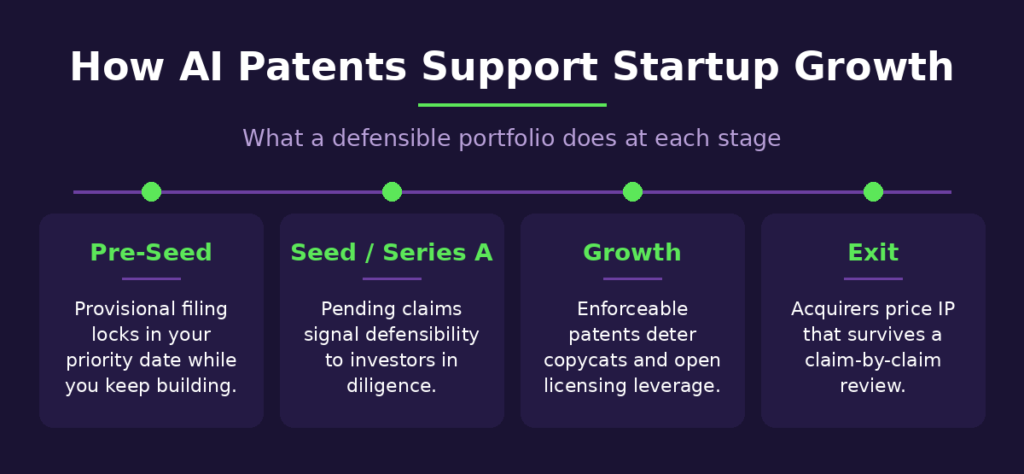
Investors and acquirers are paying closer attention to patent assets than ever. A defensible patent portfolio signals that a startup owns proprietary technology worth protecting. During due diligence, enforceable patents reduce risk for the buyer and increase the startup’s valuation, and in the current enforcement climate, that diligence review increasingly asks not just whether you have patents but whether they would survive litigation. Founders who skip patents entirely may find themselves at a disadvantage when raising their next round or negotiating an exit, particularly in the AI space.
Two Questions That Come Up in Every AI Patent Conversation
Inventorship. When an AI system contributes to an invention, who gets credit? Current U.S. law requires a human inventor; the USPTO has consistently held that only natural persons can be named, and courts have upheld this position in multiple rulings. For founders, the human team directing the AI, defining the problem, selecting the training approach, and interpreting the output are the named inventors. This is not purely academic: if your application does not clearly identify the human inventive contribution, it can be challenged in litigation on inventorship grounds. An experienced AI patent attorney structures applications to clearly document human involvement at each inventive step.
International protection. AI patent litigation does not stop at U.S. borders, and foreign patent laws differ significantly from U.S. standards. The European Patent Office applies a stricter standard for software patent eligibility than the USPTO, while some jurisdictions are more receptive to certain types of AI inventions. For startups with global ambitions, filing through the Patent Cooperation Treaty (PCT) provides a streamlined path to protection in over 150 countries, but each national phase requires careful handling to avoid costly gaps in your portfolio.
The Sheriff Is Back in Town
The Wild West of efficient infringement is over.
The patent system, the same one that felt broken for most of the last decade, has fundamentally reoriented in favor of patent owners. The USPTO is acting like it means business. Courts are letting AI patent litigation reach juries. And AI and software inventions are being recognized as the real technical innovations they are.
If you’re building something worth protecting, now is the time to protect it. And if someone has been copying your technology and counting on the old environment to shield them, that bet is getting riskier by the day.
Make sure you are on the right side of that shift.
Frequently Asked Questions
What is AI patent litigation? AI patent litigation is the legal process of enforcing or defending patents related to artificial intelligence technology. It includes lawsuits over patent infringement, challenges to patent validity, and disputes over the scope of AI-related patent claims.
What is efficient infringement? Efficient infringement is a strategy where a company knowingly copies patented technology, calculating that the cost of litigation is lower than the cost of licensing or building around the patent. It became widespread after the Alice decision made software patents harder to enforce. The rise of AI patent litigation, combined with the threat of triple damages for willful infringement, has made this strategy far riskier.
Are AI patents enforceable in 2026? Yes. Courts are now enforcing AI patents that demonstrate a clear technological improvement, such as reducing memory usage, training models faster, or detecting anomalies with less data. Judges are allowing more of these cases to reach juries rather than dismissing them on eligibility grounds, a significant shift from the post-Alice era.
What is discretionary denial at the USPTO? Discretionary denial refers to the USPTO Director’s authority to reject Inter Partes Review (IPR) petitions before they reach a full hearing. This is particularly significant for software and AI patent holders, who previously faced a high risk of having valid patents invalidated through the PTAB process.
What are triple damages in a patent case? If a court finds that a defendant willfully infringed a patent, meaning they knew about the patent and infringed anyway, the court can award up to three times the actual damages. This exposure is a major reason efficient infringement is no longer a safe strategy for large tech companies.
What makes an AI invention patentable vs. an abstract idea? The dividing line is whether your AI delivers a concrete improvement to the technology itself. Using AI to organize data is likely an abstract idea. Using AI to make a computer system run more efficiently, reduce resources, or improve accuracy is a technological improvement and likely patentable.
Can AI be listed as an inventor on a patent? No. Under current U.S. law, only natural persons can be named as inventors on a patent application. The USPTO and federal courts have consistently upheld this requirement. For AI-assisted inventions, the human team members who directed the inventive process are named as inventors.
Who are the best attorneys for AI patent litigation? The best attorneys for AI patent litigation combine deep technical knowledge of artificial intelligence with experience navigating the USPTO and federal courts. Look for a patent attorney who understands how investors, acquirers, and competitors evaluate AI patents, not just how to file them. At Schell IP, Denver patent attorney Jeff Schell works with AI startups to build patent portfolios designed for enforcement, funding, and acquisition.
What should I do if I already have an AI or software patent? Now is a strong time to evaluate its enforceability and strategic value in light of the current AI patent litigation environment. Speaking with a patent attorney about your current portfolio, including licensing opportunities, infringement risks, and continuation applications, is a smart next step.
If your invention qualifies for protection, or someone is already copying your technology, book a free consultation with Schell IP to assess your position and learn how enforceable AI patents can strengthen your company’s leverage.