Quick Answer: Patents for startups are not just legal protection. They are valuation assets. In 2026, acquirers and investors are not buying your code. They are buying your freedom to operate and your ability to defend market position. Startups with strong patent portfolios command significantly higher exit multiples than those without. If you are building a company you plan to sell or fund, patents are not optional.
Book a free consultation with Schell IP to talk through your patent strategy.
Why Patents for Startups Matter More Than Ever in 2026
I have sold multiple companies. As both a patent attorney and a venture partner who has sat on both sides of the acquisition table, I can tell you the one thing that consistently drives up the price: it is not always revenue. It is your “moat.”
In the last 25 years, I have never seen patents matter more for startup valuation than right now. The reason comes down to one shift that has changed everything: AI makes copying easier than ever before.
If you build a great feature today, a competitor can use AI to clone it in a weekend. The only thing that stops them is intellectual property. Without it, your competitive advantage has an expiration date that is measured in days, not years.
This is why patents for startups have moved from a “nice to have” to a core business strategy. Not because you plan to sue anyone, but because your exit depends on it.
What Acquirers Are Actually Buying in 2026
Most founders think of their company as a product, a team, and a revenue line. Acquirers think about it differently, especially in tech.
When a large company buys a startup in 2026, they are not buying your code. They are rewriting your code anyway. What they are actually acquiring is:
- Freedom to operate: the legal right to build and sell their product without being blocked by a competitor’s patent
- A defensive patent portfolio: IP they can use to protect their market position after the acquisition closes
- A moat: something that prevents competitors from simply copying what they just paid to acquire
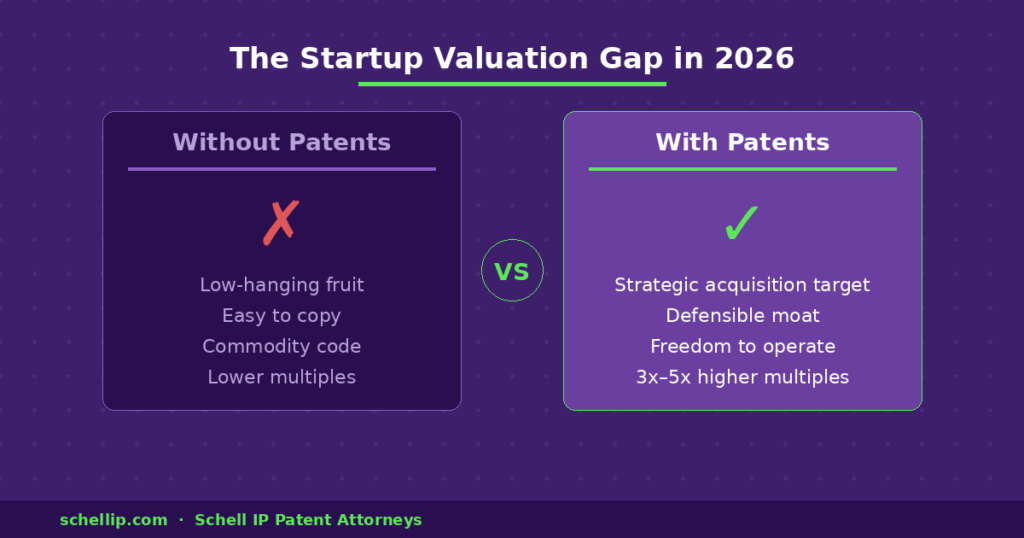
Without patents for startups, you are low-hanging fruit. You are easy to crush, easy to copy, and easy to undercut. With a strong IP portfolio, you become a strategic acquisition target, a company someone needs to buy rather than simply compete with.
The Valuation Gap Is Real
This is not a theoretical argument. When looking at exit multiples in 2026, companies with strong patent portfolios are trading at 3x to 5x higher multiples than companies with equivalent revenue and code but no IP protection.
The reason is straightforward: patents transform a software company into an asset company. If you have a granted patent on the methodology underlying your system, it does not matter whether a competitor can copy your code. If they build something that uses your patented approach, they are infringing. That is a legally enforceable barrier that code alone can never create.
Investors understand this. Venture capitalists are increasingly asking not just “what does this company do?” but “can anyone stop competitors from building the same thing?” A startup with patents answers yes. A startup without them cannot.
When to Think About Patents for Startups
The most common mistake founders make is treating patents as something to worry about later. After product-market fit. After the seed round. After the Series A. By then, it is often too late to establish the priority dates that matter.
Here is the right framework:
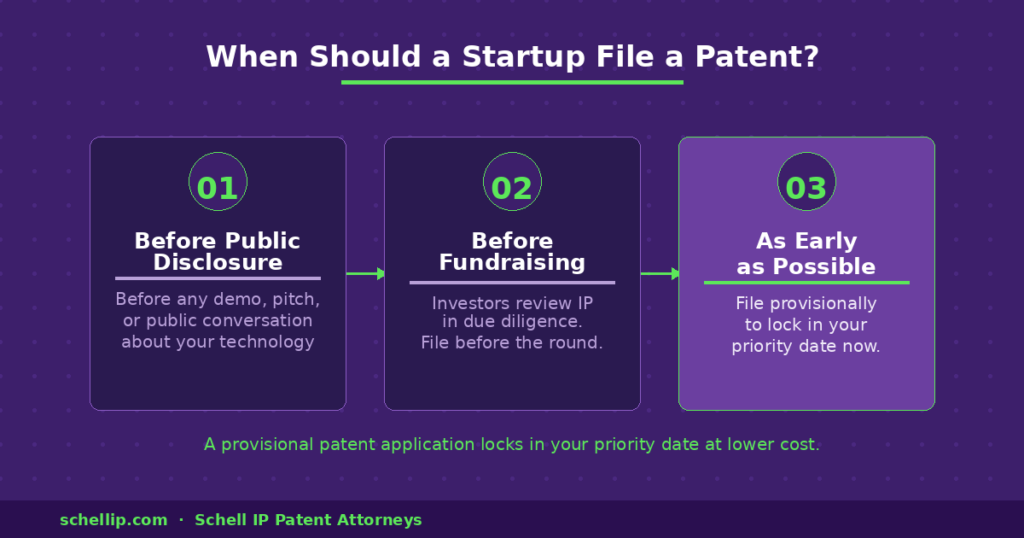
As early as possible: file a provisional patent application. A provisional patent application costs a fraction of a full non-provisional and gives you 12 months of “patent pending” status. The priority date you establish when you file is the date that matters in any future dispute or due diligence process. Filing early is almost always the right call.
Before your first fundraising round. Investors conducting due diligence will ask about your IP. A startup patent attorney can help you identify what is patentable and make sure your application is written to survive scrutiny, not just to get approved, but to actually hold up if challenged.
Before you share your technology publicly. Once you publicly disclose how your technology works, whether through a demo, a pitch deck, a conference talk, or even a ChatGPT conversation that gets indexed, you start a clock. In the US you have a one-year grace period to file. In most other countries, you have no grace period at all. File before you talk publicly whenever possible.
What Makes a Patent Portfolio Valuable to an Acquirer
Not all patents are created equal. A poorly drafted patent can be worse than no patent. It creates a false sense of security and may not hold up in due diligence or litigation. Acquirers and their counsel know how to spot weak patents, and a portfolio full of them can actually hurt your valuation.
What makes patents genuinely valuable in an acquisition context:
- Claims that are broad enough to matter. Narrow claims that only cover one specific implementation are easy to design around. Strong patents cover the underlying methodology, not just one version of it.
- Claims that are specific enough to survive challenge. Overly broad claims get rejected or invalidated. The goal is claims that are as broad as the prior art allows while still being defensible.
- Coverage of your core competitive advantage. The patents that matter are the ones that protect what makes your product difficult to replicate. A patent attorney who understands your business, not just patent law, is essential here.
- A portfolio, not a single patent. One patent is a starting point. A portfolio of two to five patents covering different aspects of your technology creates overlapping protection that is much harder to design around.
Patents for Startups: Common Mistakes to Avoid
Filing yourself or using AI to draft the application. Patent claims are a specialized form of legal writing. Small errors in how claims are drafted can make an otherwise strong patent unenforceable. Most founders who file themselves spend more money fixing the application later than they would have spent working with a patent attorney from the start.
Waiting until you have revenue. The priority date is everything. A competitor who files six months before you can block your patent regardless of who invented it first. File early, even provisionally.
Protecting the wrong things. Not every feature is worth patenting. A good patent strategy for startups focuses on the innovations that are genuinely novel, genuinely defensible, and genuinely core to your competitive advantage.
Ignoring international protection. If you plan to operate or sell internationally, US patents alone may not be enough. Discuss international filing strategy with your attorney early. The deadlines for international filings are tied to your original US filing date.
Jeff’s Take: Patents for Startups
I talk to founders every week who are building genuinely impressive technology and have done almost nothing to protect it. They are focused on growth, which makes sense. But when they eventually get to a term sheet or an acquisition conversation, they discover that the IP gap they ignored for two years is now a negotiating liability.
I have seen it cut both ways. I have seen founders who filed early walk into acquisition conversations with real leverage, the kind that comes from owning something a buyer cannot simply recreate. And I have seen founders who waited walk away from deals at reduced valuations because their due diligence turned up nothing worth protecting.
Stop building features. Start building assets. The exit you are working toward depends on it.
Frequently Asked Questions
What are patents for startups?
Patents for startups are intellectual property protections that give a startup exclusive rights to its core technology, methods, or innovations. In a startup context, patents serve two main purposes: defense against competitors who might copy your product, and valuation, giving investors and acquirers a legally protectable asset that increases what your company is worth.
When should a startup file for a patent?
As early as possible, and ideally before any public disclosure of your technology. A provisional patent application can be filed quickly and inexpensively to establish a priority date. The full non-provisional application can follow within 12 months. Waiting until after fundraising or product launch is one of the most common and costly mistakes startup founders make.
How much do patents cost for startups?
A provisional patent application typically costs $3,000 to $6,000 with an attorney. A full utility non-provisional patent application runs $10,000 to $20,000 or more depending on complexity. See our complete 2026 patent cost guide for a full breakdown.
Do patents actually increase startup valuation?
Yes, significantly. Startups with strong patent portfolios are commanding 3x to 5x higher exit multiples than comparable companies without IP protection. Patents signal to acquirers that your competitive advantage is defensible and that they are buying something they cannot simply build themselves.
What is the difference between a provisional and non-provisional patent?
A provisional patent application establishes your priority date and gives you 12 months of “patent pending” status at lower cost and complexity. A non-provisional application is the full patent filing that goes through examination and, if approved, results in a granted patent. Most startups file provisionally first to lock in the priority date, then convert to non-provisional as they refine the technology.
Can I patent software or an AI system?
Yes, in many cases. The key is demonstrating a technological improvement, specifically how your system processes, analyzes, or transforms information in a novel way. Generic use of AI to organize data is unlikely to be patentable. A specific, novel method for achieving a technical result typically is. Working with an AI patent attorney ensures your application is framed correctly for the current USPTO guidelines.
Ready to talk through your patent strategy? Book a free consultation with Schell IP.