Quick Answer: Yes — even if you never plan to sue anyone. Patents are not just offensive weapons for litigation. In 2026, they are your primary defense against competitors and patent trolls who may come after you. Without a patent, you have no leverage. With one, you can often stop a threat before it ever reaches a courtroom.
Book a free consultation with Schell IP to talk through your patent strategy.
The Real Reason You Need a Patent (It’s Not What You Think)
Most founders assume patents are for companies that want to sue someone. They are not planning any lawsuits, so they figure they can wait. That is the wrong way to think about it.
Not having a patent does not keep you out of court. It just means you show up without any ammunition when someone comes after you.
When founders ask “do I need a patent,” they are usually thinking about offense — filing so they can stop a competitor from copying them, or license their technology for royalties. Those are legitimate reasons to file. But they are not the most important reason in 2026.
The most important reason right now is defense.
In the AI era, your likelihood of getting sued or threatened is higher than at any point in the last two decades. Recent policy changes at the USPTO and new case law have made patent holders significantly stronger than they were even a few years ago. Competitors with patents are in a better position than they were six months ago. Patent trolls — companies that exist solely to buy patents and sue businesses — are more active than ever.
If you do not have patents, you have no leverage when any of these scenarios hit you.
What Cross-Licensing Is and Why It Works
When a competitor or patent troll comes after you, money alone will not save you. Legal defense is expensive. Injunctions can shut down your product. And the distraction from an active lawsuit can cripple a startup’s momentum at exactly the wrong moment.
One of the most effective defenses is fighting back with your own patents, a strategy called cross-licensing.
Here is how it works: when someone threatens to sue you for patent infringement, you respond by pointing to your own portfolio and saying, effectively, “If you sue me, I will countersue you.” The threat of mutual destruction creates a strong incentive for both parties to walk away and keep building instead of burning money in court.
Cross-licensing only works if you actually have patents. But when you do, it is one of the most reliable ways to make a would-be plaintiff reconsider. A startup with even a modest patent portfolio is a far less attractive litigation target than one with nothing to counter with.
Why the 2026 Patent Landscape Has Raised the Stakes
Several things have converged to make patent protection more important now than it has been in at least 25 years:
- USPTO policy shifts. Recent changes to how the USPTO examines and grants patents — including new guidance on AI inventorship and software patentability — have expanded what is protectable and made granted patents harder to invalidate through post-grant review.
- Stronger enforcement in the courts. Federal Circuit rulings have made it meaningfully harder for defendants to challenge patent validity in Inter Partes Review (IPR) proceedings. A well-drafted patent is more likely to hold up when you need it.
- AI makes copying faster. A competitor can now build around your unpatented technology faster than ever. If your competitive advantage is not protected, it has a shorter shelf life than it ever did. This is one of the core risks we discuss with founders who ask whether using AI tools to draft their own applications is a good idea.
- Patent trolls are more active. Early-stage companies are frequently targeted precisely because they lack the resources and IP portfolio to fight back.
Do I Need a Patent? A Practical Framework for Founders
You do not need a massive portfolio to have leverage. Even two or three well-drafted patents covering your core technology can meaningfully change your position. Here is how to think about it:
1. Identify your core defensible innovations. What does your product do that competitors cannot easily design around? These are your highest-priority filing candidates. A patent attorney can help you identify which innovations are patentable and which are better protected as trade secrets.
2. File early, even provisionally. A provisional patent application costs significantly less than a full non-provisional and gives you 12 months of “patent pending” status while you refine your product and raise your next round. The priority date you establish on day one is the date that matters if anyone ever challenges your ownership of the idea.
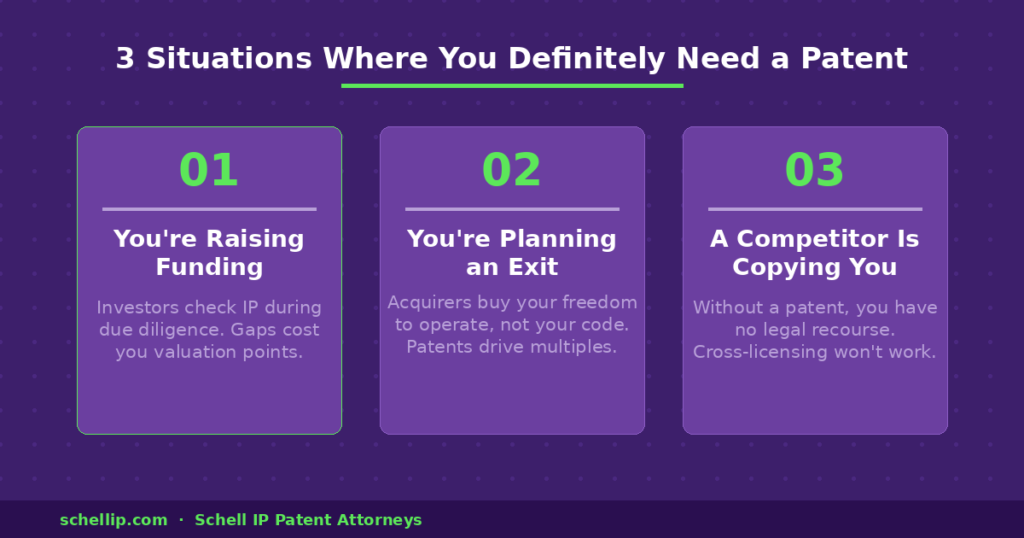
3. Think about what you are building toward. If you plan to raise venture funding or sell your company, your patent portfolio is part of what you are selling. Acquirers in tech are not just buying your code. They are buying your freedom to operate and your ability to defend market position after acquisition. Patents directly affect your valuation and negotiating leverage, often by more than founders expect.
4. Do not file without professional help. AI-drafted patent applications and DIY filings are one of the most common mistakes we see from founders. A poorly drafted patent can be worse than no patent — it creates a false sense of security and may not hold up when you actually need it. Understanding what a patent attorney actually does helps clarify why professional drafting matters.
5. Understand the cost of waiting. The cost of filing a provisional patent is a fraction of what you would spend defending a single lawsuit. And unlike legal fees, a patent is an asset that can appreciate as your company grows. Understanding what a patent costs upfront often changes the calculus for founders who assumed it was out of reach.
Jeff’s Take
I talk to founders every week who tell me they are going to worry about patents once they have more traction. I understand the instinct — there is always something more urgent when you are building a company.
But here is what I have seen happen: the founder waits, gets traction, and then discovers that a competitor filed a patent on something similar six months earlier. Or they get acquired and the acquirer’s due diligence turns up a gap in their IP that knocks seven figures off the valuation. Or they receive a cease and desist letter the week before a major product launch.
None of these situations are impossible to navigate. But they are all significantly harder and more expensive than they would have been with a provisional application filed two years earlier.
You do not need to be planning to sue anyone to need a patent. You just need to be building something worth protecting.

Frequently Asked Questions
Do I need a patent if I am just a startup?
Yes, especially as a startup. Large companies have legal teams and war chests to absorb threats. Early-stage startups do not. A single credible patent threat can derail a funding round, scare off an acquirer, or force a product pivot you never planned. Building your defensive position early is far cheaper than dealing with a threat after the fact.
What is cross-licensing?
Cross-licensing is an agreement where two parties grant each other rights to use their respective patents. In a defensive context, it often arises when one party threatens to sue and the other counters with their own patent portfolio. The mutual threat of litigation creates strong incentive for both sides to settle without going to court.
How much does it cost to get a patent?
Costs vary depending on the complexity of the invention and whether you file provisionally or non-provisionally. A provisional patent application typically costs $3,000 to $6,000 with an attorney. A full utility patent runs $10,000 to $20,000 or more. See our complete 2026 patent pricing guide for a full breakdown.
What happens if I never file and someone copies my idea?
Without a patent, you have very limited legal recourse if a competitor copies your idea. You may be able to pursue trade secret claims if the information was kept confidential, but if your product is already on the market, that protection has likely expired. A patent gives you a legally enforceable exclusive right that trade secrets and copyright do not.
Can I file a patent myself?
You can, but it is rarely a good idea. Self-filed patents are frequently rejected or granted with claims so narrow they provide little real protection. Patent claims are a specialized form of legal writing, and small drafting errors can make an otherwise strong patent unenforceable. Most founders who file themselves end up spending more money fixing the application than they would have spent working with a patent attorney from the start.
Ready to talk through your patent strategy? Book a free consultation with Schell IP.