Quick Answer: A CPG patent protects the design, function, or formulation of a consumer packaged good. Consumer product inventors can file a design patent to protect how a product looks, a utility patent to protect how it works, or both. Filing before public disclosure, manufacturing, or a crowdfunding launch is critical to preserving patent rights.
Consumer packaged goods (CPG) companies create products people use every day. Food packaging, beverage containers, personal care products, cleaning tools, fitness accessories, pet products. If you have invented something new in this space, a patent may be the most important step you take to protect it.
But most consumer product inventors are not sure where to start. They do not know what type of patent they need, when to file, or what actually qualifies for protection. This guide covers what a CPG patent is, what it protects, and how to work with a consumer product patent attorney to file the right way.
What Is a CPG Patent?
A CPG patent is a patent that protects a consumer packaged good. This can include the product itself, its packaging, a manufacturing process, a formula, or a dispensing mechanism. The term is not a formal legal category. It simply refers to patents filed in the consumer products space.
CPG patents fall into two main types: design patents and utility patents. Each protects something different, and many consumer products benefit from both.
Design Patent vs. Utility Patent for Consumer Products
Choosing the right patent type is one of the most important decisions a CPG inventor makes. The wrong choice can leave your product unprotected. Here is how each type works in the consumer products context.
Design Patents for Consumer Products
A design patent protects the ornamental appearance of a product. This includes shape, surface texture, packaging form factor, and visual design. If the way your product looks is what makes it distinctive, a design patent is the right starting point.
Common CPG design patent examples include:
- A uniquely shaped bottle or container
- Distinctive packaging with a novel form factor
- A consumer device with an original visual design
- Product accessories with a recognizable shape
Design patents are typically faster and less expensive to obtain than utility patents. They last 15 years from the date of grant and do not require maintenance fees.
Utility Patents for Consumer Products
A utility patent protects how a product works. This includes new formulations, mechanisms, dispensing systems, manufacturing methods, and functional improvements. If your product does something new or does something existing in a better way, a utility patent protects the innovation itself.
Common CPG utility patent examples include:
- A new formula for a cleaning product or cosmetic
- A dispensing mechanism that controls portion size
- A manufacturing process that reduces waste or cost
- A closure system that improves shelf life
- A wearable consumer device with a new sensor configuration
Utility patents take longer to obtain (typically 1 to 3 years) and cost more than design patents. They last 20 years from the filing date and require maintenance fees at 3.5, 7.5, and 11.5 years.
When to File Both
Many CPG products benefit from both a design patent and a utility patent. A beverage bottle, for example, may have a distinctive shape (design patent) and a novel cap mechanism (utility patent). Filing both types gives broader protection and makes it harder for competitors to copy your product.
What Parts of a Consumer Product Can Be Patented?
Inventors often think of patents as protecting the entire product. In practice, patents protect specific features or innovations. Identifying exactly what is patentable is where a patent attorney adds the most value.
Patentable elements of a consumer product may include:
- Product shape, contour, or surface pattern (design patent)
- Packaging design and form factor (design patent)
- New formulations or compositions (utility patent)
- Functional mechanisms such as closures, dispensers, or applicators (utility patent)
- Manufacturing processes that are new or improved (utility patent)
- Material combinations that improve durability, cost, or performance (utility patent)
A consumer product patent attorney can review your product and identify which elements qualify for patent protection. This prevents wasted time and money filing for features that do not meet USPTO requirements.
When to File a CPG Patent
Timing is critical for consumer product patents. Many CPG inventors lose their patent rights because they wait too long or disclose their invention publicly before filing.
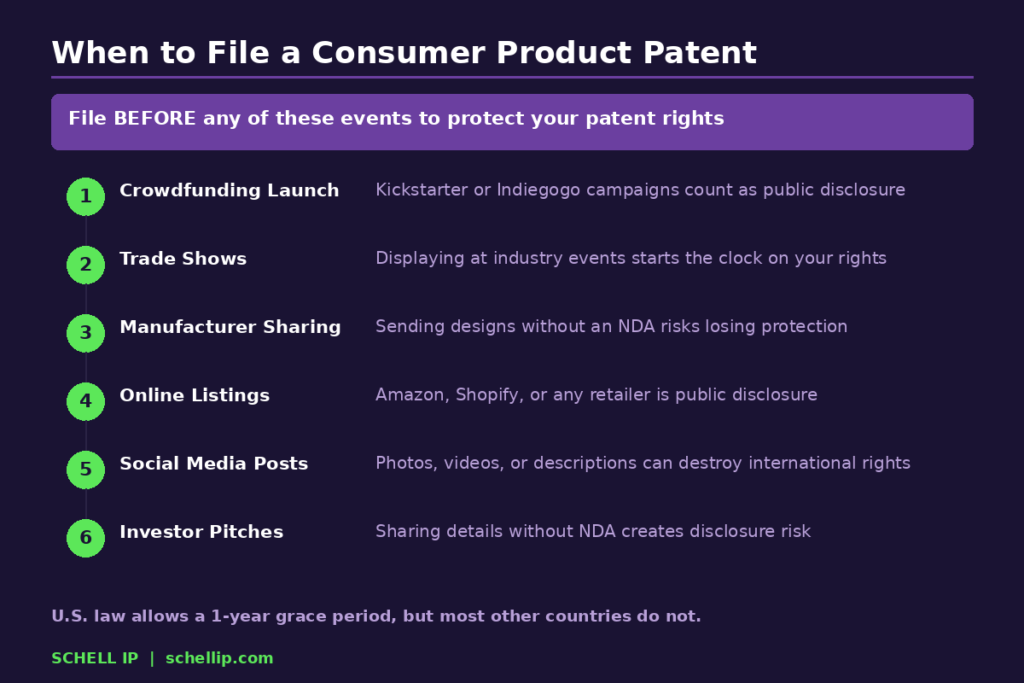
You should talk to a patent attorney before any of the following:
- Launching a crowdfunding campaign (Kickstarter, Indiegogo)
- Showing your product at a trade show or industry event
- Sharing details with a manufacturer or supplier without an NDA
- Listing the product for sale online
- Publishing photos, videos, or descriptions on social media
- Pitching to investors or retail buyers
Under U.S. patent law, you have a one-year grace period after public disclosure to file. But that grace period does not apply in most other countries. If you plan to sell internationally, file before any public disclosure.
A provisional patent application is a common first step. It establishes a filing date and gives you 12 months to file a full non-provisional application. This lets you continue developing your product and raising funds while your priority date is locked in.
How Much Does a Consumer Product Patent Cost?
Patent costs depend on the type of patent, the complexity of the product, and whether you work with a patent attorney. Here are typical ranges for consumer product patents:
- Provisional patent application: $3,000 to $6,000
- Design patent application: $2,000 to $5,000
- Utility (non-provisional) patent application: $5,000 to $8,000+
- Office Action responses: $2,000 to $5,000 per response
- Total cost through issuance: $10,000 to $25,000+
Costs vary based on invention complexity and are subject to review and quotation. For a detailed breakdown, see Schell IP’s complete patent cost guide.
Many CPG startups start with a provisional patent to secure a filing date at a lower cost, then file the full application once the product design is finalized or funding is secured.
Why You Need a Consumer Product Patent Attorney
Consumer products present specific challenges in the patent process. The line between protectable and non-protectable features is not always obvious. A consumer product patent attorney understands these challenges and knows how to write applications that survive USPTO examination.
A consumer product patent attorney helps with:
- Identifying which features of your product are patentable
- Conducting a patent search to confirm your invention is new
- Choosing between a design patent, utility patent, or both
- Drafting claims that are broad enough to block competitors but specific enough to be granted
- Handling Office Actions and USPTO correspondence
- Advising on international filing strategy
At Schell IP, Denver patent attorney Jeff Schell works with consumer product founders and inventors to file patents that protect real business value. Whether you are launching a new product on Kickstarter or scaling into retail, Schell IP helps you protect your invention the right way.
Common Mistakes CPG Inventors Make
Filing a CPG patent is not something most inventors have done before. That leads to predictable mistakes that can weaken or destroy patent protection.
Disclosing too early. Posting your product on social media, showing it at a trade show, or sharing it with a manufacturer before filing can start the clock on your grace period or eliminate international rights entirely.
Filing the wrong type of patent. Some inventors file a design patent when they should have filed a utility patent, or vice versa. This leaves the most valuable features of the product unprotected.
Writing vague or overly broad claims. Self-filed patents often fail because the claims are too broad to survive examination or too vague to be enforceable. A patent attorney writes claims that balance scope and specificity.
Skipping the patent search. Filing without a thorough search wastes money if a similar invention already exists. It also increases the risk of receiving a rejection from the USPTO.
Waiting until after launch. The best time to talk to a patent attorney is before your product is public. Waiting until after launch limits your options and may cost you rights in key markets.
How the CPG Patent Process Works
The patent application process for consumer products follows the same general steps as any patent filing, but the specifics depend on your product type and patent strategy.
Step 1: Consult a patent attorney. Discuss your product, identify patentable features, and determine whether to file a design patent, utility patent, or both.
Step 2: Conduct a patent search. Your attorney searches USPTO and international databases to confirm your invention is new and identify potential conflicts.
Step 3: File a provisional application (optional). This establishes your priority date at a lower cost and gives you 12 months to refine the product before filing a full application.
Step 4: File the non-provisional or design patent application. Your attorney drafts detailed descriptions, claims, and patent drawings, then submits the application to the USPTO.
Step 5: Respond to Office Actions. The USPTO may request changes or raise objections. Your attorney responds to these and works toward approval.
Step 6: Patent granted. Once approved, your patent gives you the legal right to stop others from making, selling, or importing your invention.
Frequently Asked Questions
What is a CPG patent?
A CPG patent is a patent that protects a consumer packaged good. It can cover the product’s appearance (design patent), function (utility patent), formulation, packaging, or manufacturing process.
Do I need a design patent or a utility patent for my consumer product?
It depends on what is new about your product. If the appearance is unique, a design patent may be the right fit. If the product works in a new way, you likely need a utility patent. Many CPG products benefit from both. A consumer product patent attorney can help you decide.
How much does a CPG patent cost?
Design patent applications typically cost $2,000 to $5,000. Utility non-provisional patent applications cost $5,000 to $8,000+ to prepare and file. Provisional patent applications cost $3,000 to $6,000. Total costs through issuance typically range from $10,000 to $25,000+ depending on complexity. Costs vary by project and are subject to review and quotation.
Can I patent a food or beverage product?
Yes. Food and beverage products can be patented if they include a novel formulation, a new manufacturing process, or unique packaging. A design patent can also protect the appearance of the container or packaging.
When should I file a CPG patent?
File before any public disclosure, including crowdfunding campaigns, trade shows, social media posts, or conversations with manufacturers without an NDA. The U.S. allows a one-year grace period after disclosure, but most other countries do not.
Can I file a CPG patent myself?
You can, but most self-filed patents are rejected or granted with weak claims that are difficult to enforce. Working with a patent attorney increases your chances of getting a strong, enforceable patent that actually protects your product.
Protect Your Consumer Product With a CPG Patent
If you are developing a consumer product with a new design, function, or formulation, patent protection is one of the smartest investments you can make. It keeps competitors from copying your work and adds real value to your business.
Book a free consultation with Schell IP today and find out how a CPG patent can protect your invention.