Quick Answer: Are you wondering how to file a patent? The patent application process generally starts with a patent search to confirm that your invention is new. Next, you will likely need to choose between a provisional patent application (to secure an early filing date) or a non-provisional patent application (to begin formal USPTO review). Your attorney will work with you to then draft the application with detailed descriptions, drawings, and legal claims, and submit it to the United States Patent and Trademark Office (USPTO). For Colorado inventors, working with a Colorado patent attorney ensures your application is drafted to maximize protection and approval chances.
Filing a patent application protects your invention from being copied, sold, or used without your permission. For inventors and startup founders in Colorado, understanding how to file a patent is one of the most important steps in turning an idea into a defensible business asset.
The patent process involves legal, technical, and strategic decisions. This guide walks through every step of how to file a patent, from determining whether your invention qualifies to filing your application with the USPTO and responding to examiner feedback.
Whether you are filing your first provisional patent application or preparing a full utility patent nonprovisional application, this guide covers what you need to know.
How to File a Patent: Is Your Invention Patentable?
Before you file a patent, your invention must meet three legal requirements set by the USPTO.
- Novelty: The invention must be new. It cannot have been publicly disclosed, published, or patented before your filing date.
- Non-obviousness: The invention must not be an obvious variation of something that already exists. It needs to represent a genuine technical advance.
- Utility: The invention must serve a practical, identifiable purpose.
If your invention meets all three criteria, it is likely eligible for patent protection. A patent attorney can help evaluate patentability before you invest in a full patent application.
What Type of Patent Application Should You File?
The type of patent you file depends on what you are protecting. The three main types of patent applications are:
- Utility patents: Protect how an invention works. This is the most common type, covering machines, processes, software systems, chemical formulas, and manufactured products.
- Design patents: Protect the ornamental appearance of a product, including shapes, patterns, and surface details. Learn more about design patents vs. utility patents.
- Plant patents: Protect new, asexually reproduced plant varieties. These are less common and primarily used in agriculture.
Most inventors and startup founders file utility patents. If your product has both a unique function and a unique appearance, you may benefit from filing both a utility and a design patent application.
How to File a Patent: Start With a Patent Search
A patent search is the first practical step when you file a patent. It identifies existing patents and published applications (called prior art) that are similar to your invention.
Skipping this step is one of the most common mistakes inventors make. If a similar invention already exists, your patent application will likely be rejected, and you will have wasted filing fees and attorney time.
A thorough patent search includes:
- Reviewing the USPTO patent database and international databases
- Comparing existing inventions in your technical field
- Identifying potential infringement risks
- Evaluating whether your invention is truly novel and non-obvious
You can start a basic search on the USPTO website, but a patent attorney provides a more detailed analysis that strengthens your patent application strategy.
How to File a Patent: Provisional Patent Application vs. Non-Provisional Patent Application
One of the first decisions when you file a patent is whether to start with a provisional or non-provisional patent application.
What Is a Provisional Patent Application?
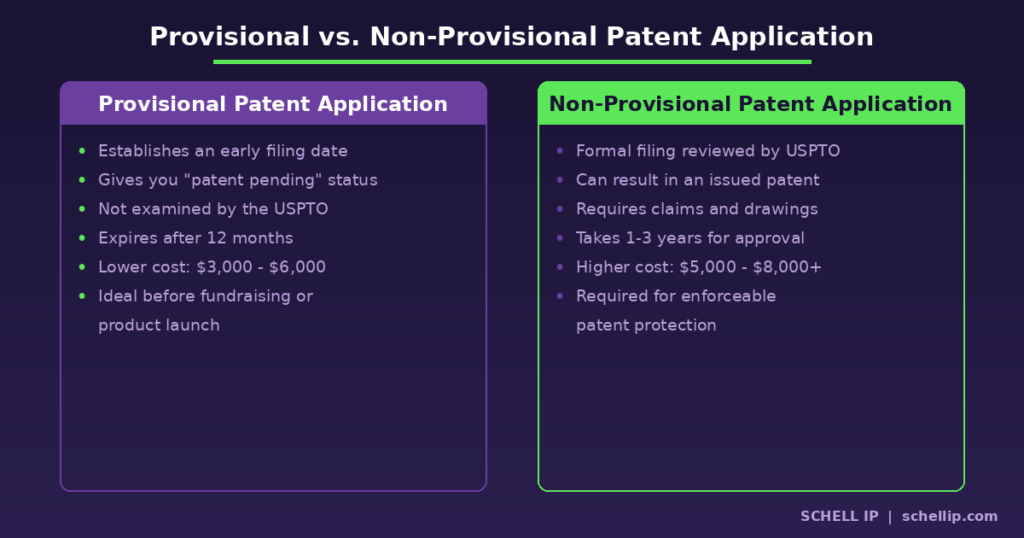
A provisional patent application establishes an early filing date and gives you “patent pending” status. It is not examined by the USPTO and expires after 12 months unless you file a non-provisional application.
A provisional patent application is useful when you:
- Need to establish a filing date quickly before a public disclosure or investor pitch
- Want to test the market before committing to a full patent application
- Are still refining the invention and need more development time
What Is a Non-Provisional Patent Application?
A non-provisional patent application is the formal filing examined by the USPTO. It must include a full specification, patent claims, and drawings. This is the patent application that, if approved, results in an issued patent.
Many founders file a provisional patent application first, then convert to a non-provisional application within 12 months. This approach balances early protection with time to develop the product and raise funding.
How to File a Patent: Step-by-Step Patent Application Process
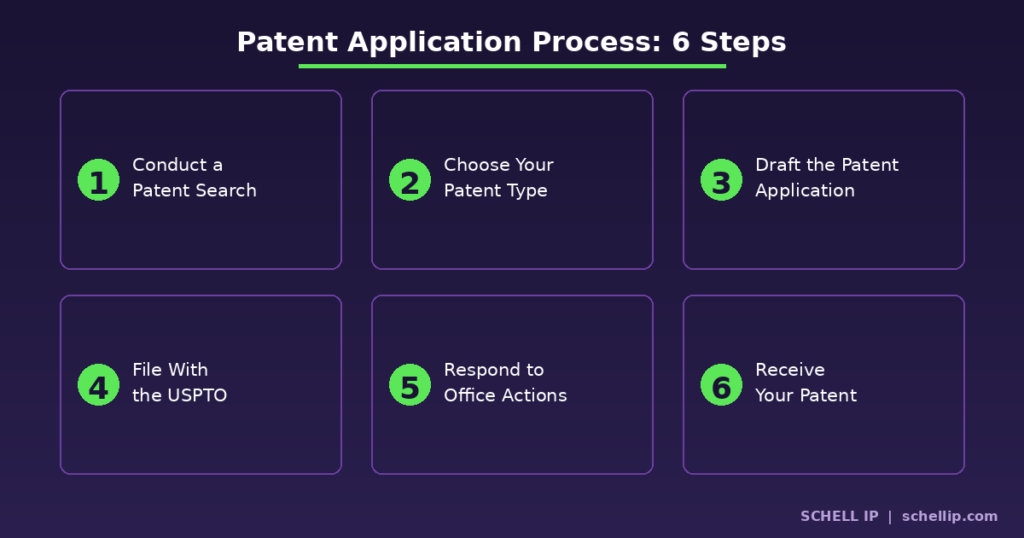
The patent application process follows a clear sequence, whether you are filing in Colorado or anywhere in the United States. Patents are filed with the federal USPTO, not with state agencies. Here is how to file a patent step by step.
Step 1: Conduct a Patent Search
Search the USPTO database and international patent databases to confirm your invention is new and has not been patented before. This step prevents wasted effort and strengthens your patent application.
Step 2: Choose Your Patent Type
Decide whether you need a utility, design, or plant patent. Most inventions and software products require a utility patent application.
Step 3: Draft the Patent Application
This is the most critical step in the patent application process. A strong patent application includes:
- Detailed description: A full explanation of how the invention works, what problem it solves, and how it differs from existing solutions
- Patent claims: Legal statements that define exactly what your patent protects. Claims that are too broad get rejected. Claims that are too narrow leave gaps for competitors. Learn more about drafting strong patent claims.
- Drawings and diagrams: Visual representations of the invention that support the written description
- Abstract: A brief summary of the invention for search and classification purposes
Step 4: File Your Patent Application With the USPTO
Submit your patent application through the USPTO’s electronic filing system. You will pay filing fees that vary based on entity size (micro, small, or large entity) and patent type.
Step 5: Respond to USPTO Office Actions
After you file a patent application, a USPTO examiner reviews it. Most applications receive at least one Office Action, which is a formal response requesting changes, clarifications, or citing reasons for rejection. Responding promptly and thoroughly is essential to keeping your patent application on track.
Step 6: Receive Your Patent
Once the examiner approves your application, you pay an issue fee and the USPTO grants your patent. You then have exclusive rights to your invention for 20 years from the filing date (for utility patents) or 15 years from the grant date (for design patents).
How Much Does It Cost to File a Patent in Colorado?
Patent costs depend on the type of application, the complexity of the invention, and whether you work with a patent attorney. Here are general ranges for 2026:
- Provisional patent application: $3,000 to $6,000 (includes attorney drafting and USPTO filing fees)
- Non-provisional utility patent application: $5,000 to $8,000+ for preparation and filing, depending on complexity
- Design patent application: $2,000 to $5,000
- Office Action responses: $2,000 to $5,000 per response
Total costs from initial filing through issuance generally range from $10,000 to $25,000+, depending on complexity and the number of Office Action responses. For a detailed breakdown, see the full patent cost guide. These costs are approximations for 2026 and may vary based on your specific project.
How Long Does It Take to File a Patent and Get Approved?
The patent process timeline depends on the type of patent application and USPTO workload:
- Provisional patent application: Provides immediate “patent pending” status. Expires after 12 months.
- Utility patent: Typically takes 1 to 3 years from non-provisional filing to issuance.
- Design patent: Typically takes 12 to 18 months from filing to issuance.
Filing a provisional patent application first is a common strategy that gives you patent pending status immediately while you develop your product and prepare for a full filing.
Why Hire a Colorado Patent Attorney to File a Patent?
Patents are filed with the federal USPTO, so a patent attorney licensed to practice before the USPTO can help you file a patent regardless of your state. However, working with a Colorado patent attorney offers several advantages for local inventors and startups.
- Local market knowledge: A Denver patent attorney who understands Colorado’s growing startup and tech ecosystem can align your patent strategy with local funding and competitive dynamics.
- Stronger patent applications: A patent attorney drafts claims and descriptions that survive USPTO scrutiny. Self-filed patent applications often fail due to vague language, weak claims, or timing mistakes.
- Strategic advice: Beyond filing paperwork, a patent attorney helps you build an IP strategy that supports fundraising, licensing, and long-term business growth.
- Office Action handling: When the USPTO pushes back on your patent application, an experienced attorney knows how to respond without weakening your claims.
At Schell IP, Denver patent attorney Jeff Schell works with inventors and startup founders to file patents that protect real business value, not just legal formalities.
Common Mistakes When Filing a Patent (and How to Avoid Them)
Many inventors lose patent rights or waste money because of avoidable errors when they file a patent. The most common patent filing mistakes include:
- Disclosing the invention publicly before filing: In the United States, you have a one-year grace period after public disclosure, but international patent rights may be lost immediately.
- Skipping the patent search: Filing a patent application without a search risks rejection and wasted fees.
- Writing vague or overly broad claims: Weak claims lead to rejections or patents that do not actually protect your invention.
- Missing deadlines: The patent process runs on strict timelines. Missing an Office Action response deadline can result in abandonment of your patent application.
- Using online filing services instead of a patent attorney: Template-based services often produce generic patent applications that are rejected or easily invalidated.
For a deeper look at these issues, read 6 Common Mistakes Inventors Make Without a Patent Lawyer.
What Happens After You File a Patent Application?
Once you file a patent application, the USPTO assigns an examiner to review it. The examiner checks whether the invention meets the requirements for novelty, non-obviousness, and utility.
Most patent applications receive at least one Office Action. This is not a rejection. It is part of the normal patent examination process. Your patent attorney reviews the examiner’s concerns and files a response that addresses each issue.
If the examiner approves your patent application, you pay an issue fee and the patent is granted. Once issued, you have exclusive rights to make, sell, and license your invention for the term of the patent.
For utility patents, you will also need to pay maintenance fees at 3.5, 7.5, and 11.5 years after issuance to keep the patent active. Learn more about how long patents last.
Frequently Asked Questions About How to File a Patent in Colorado
How do you file a patent in Colorado?
Patents are filed with the federal USPTO, not a state agency. Colorado inventors follow the same patent application process as inventors nationwide: conduct a patent search, draft the application, file electronically with the USPTO, and respond to Office Actions during examination.
How much does it cost to file a patent?
Provisional patent applications typically cost $3,000 to $6,000. Non-provisional utility patent applications cost $5,000 to $8,000+ for preparation and filing. Total costs from filing through issuance generally range from $10,000 to $25,000+, depending on complexity and Office Action responses. These costs are approximations for 2026 and may vary.
Do I need a patent attorney to file a patent?
You are not legally required to hire a patent attorney, but most self-filed patents fail due to weak claims, vague descriptions, or procedural errors. A patent attorney significantly increases your chances of approval and produces a stronger, more enforceable patent.
What is the difference between a provisional and non-provisional patent application?
A provisional patent application establishes a filing date and gives you patent pending status for 12 months. It is not examined. A non-provisional patent application is the formal filing that is reviewed by the USPTO and, if approved, becomes an issued patent.
How long does it take to get a patent?
Utility patents typically take 1 to 3 years from non-provisional filing to issuance. Design patents take 12 to 18 months. A provisional patent application gives you immediate patent pending status.
Can I file a patent for software or AI in Colorado?
Yes. Software and AI inventions are patentable when they solve a technical problem in a technical way. This requires detailed descriptions of how the technology works, not just what it does. A patent attorney for software can help draft a patent application that meets USPTO requirements.
Ready to File a Patent? Talk to a Colorado Patent Attorney
Filing a patent is one of the most important investments you can make in your invention and your business. The right patent protects your competitive position, supports funding, and prevents competitors from copying your work.
At Schell IP, we help Colorado inventors and startup founders file patents that are built for real protection, not just paperwork.
Book a free consultation with Schell IP today to discuss your invention and get a clear plan for patent protection.