Quick Answer: Can software be patented? Yes, software can be patented, but not the way most founders assume. You generally can’t patent an app idea or your raw code. What you can patent is the underlying technical method your software uses to solve a problem in a new way, meaning the algorithm, the data flow, the system architecture, or the specific technical improvement that makes it work. The old line that software patents are dead is out of date. Updated USPTO guidance issued in 2024 and clarified again in 2025 has made it much clearer how software and AI inventions qualify, so the real question is no longer whether software can be patented. It’s whether yours describes a genuine technical improvement, and whether you file before your competitors do.
“Can software be patented?” is one of the most common questions founders bring to Schell IP, and for years the answer they’d heard was discouraging. After a 2014 Supreme Court decision, much of the tech world concluded that software simply wasn’t patentable and stopped trying. That conclusion was always too broad, and in 2026 it’s genuinely outdated.
Software has generally been patentable when it does something technically new. What shifted over the last decade was how strictly patent examiners applied the eligibility rules, and what shifted recently is that the U.S. Patent and Trademark Office gave clearer guidance on how software and AI inventions can qualify. This guide walks through what patenting software actually protects, where the legal line sits, and how to think about it as a founder deciding whether a software patent is worth pursuing.
What You Are Actually Protecting When You Patent Software
The first thing to sort out is the difference between a patent and a copyright, because confusing the two is where most founders go wrong. The moment you write code, copyright protects that specific code automatically, but copyright only stops someone from copying your literal code. It does nothing if a competitor writes their own code from scratch to do the same thing your software does, and in 2026, rewriting code to copy a known function is faster and cheaper than it has ever been.
A software patent protects something more durable: the invention itself, meaning the novel technical method behind the code. Two products written in completely different programming languages can still infringe the same software patent if they implement the same underlying technical approach. For a software company, that’s usually the protection that actually holds up, because you’re not protecting the code, you’re protecting the method. If you want a deeper look at how that plays out for app builders specifically, our breakdown of patenting a mobile app covers the same principle applied end to end.
Where the Line Sits on Software Patent Eligibility
The reason software patents earned a bad reputation traces back to the Supreme Court’s decision in Alice Corp. v. CLS Bank, which established that you can’t patent an abstract idea simply by adding the words “on a computer.” Taking something people already do and automating it with generic software isn’t enough. After Alice, a wave of software patents were rejected as abstract, and a lot of founders walked away with the impression that software couldn’t be patented at all.
That impression was never quite right, and it’s especially wrong now. The Alice framework still applies, but the USPTO has issued updated guidance, effective in July 2024 and clarified further in a 2025 examiner memo, on how to evaluate software and AI inventions for eligibility. You can read the agency’s own subject matter eligibility guidance directly on the USPTO website. The throughline is straightforward: a software invention is far more likely to qualify when it describes a genuine technical improvement, a technical solution to a technical problem, rather than an abstract result.
In practice, whether a software patent issues or gets rejected usually comes down to how the claims are written. The same invention can be framed as an unpatentable abstract idea or as a specific technical improvement depending on the drafting, which is the part that rewards real expertise. It’s also why founders building software-heavy products tend to work with a patent attorney for software rather than filing on their own.
What Software Is and Isn’t Patentable
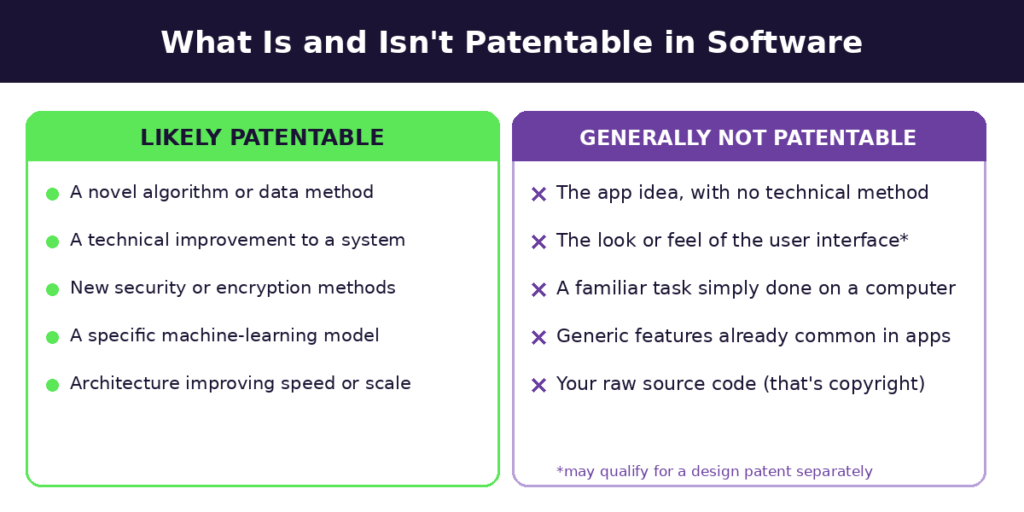
It helps to get concrete about what software is patentable and what isn’t. As a rule, the technical guts of your software are where patentable inventions live, while the idea, the look, and the code itself are protected by other means or not at all. The technical elements most likely to support a software patent include:
- Novel algorithms and data-processing methods. If your software processes, analyzes, or transforms data in a way that hasn’t been done before, that method is often the strongest candidate for a patent. This is the core of most software inventions, and it’s where claims tend to hold real competitive value.
- Technical improvements to how a system runs. Software that makes a computer or system measurably faster, more efficient, more secure, or more scalable describes exactly the kind of technical improvement the eligibility standard rewards. The improvement has to be concrete and describable, not just a better business outcome.
- Security, encryption, and authentication methods. New approaches to protecting data or verifying users are frequently patentable because they solve a clear technical problem. These claims also tend to survive examination well when the method is specific.
- Machine-learning and AI implementations. A specific, novel way of training or applying a model can be patented, provided the claims describe a real technical implementation rather than the general idea of “using AI.” More on the AI specifics below.
What you generally can’t patent is the app idea on its own, the look or feel of the user interface (which may qualify for a separate design patent), a familiar task simply performed on a computer, or your raw source code, which is the domain of copyright rather than patents. The graphic below sums up the split.
Most real products land somewhere in the middle, with a patentable technical core wrapped in features and design that aren’t patentable on their own. That’s exactly why the eligibility analysis is worth doing carefully rather than guessing whether your software is patentable.
Can You Patent AI and Machine-Learning Software?
AI is where the question of patenting software gets most urgent right now, and the rules are more favorable than many founders assume. The USPTO’s recent guidance addressed AI inventions specifically, and the core principle carries straight over from software generally: a model or AI-driven method can be patented when the claims describe a specific technical implementation and a real improvement, not just the concept of using AI to do something. One firm limit to know going in is that a patent must name a human inventor, because AI itself can’t be listed as the inventor.
If you’re building with machine learning, it’s worth understanding both the opportunity and the constraints before you file, since AI patents draw extra scrutiny on the eligibility question. Our work on whether you can patent an AI invention goes deeper on inventorship and how to frame AI claims so they survive examination.
How Schell IP Approaches a Software Patent
At Schell IP, the work on a software patent starts well before any claims get drafted. We look at what the software actually does at a technical level, identify the specific method that represents the real improvement, and think about how a competitor might try to design around it. The goal is claims broad enough to cover meaningful competitive ground, including the obvious variations someone would try, while staying specific enough to survive examination under the eligibility standard.
We also treat software IP as business strategy, not just legal paperwork. A patent that reads well in a due-diligence data room, that covers the version of the product an acquirer actually cares about, and that an investor can point to as a defensible moat is worth far more than a patent with narrow or sloppily drafted claims. That business lens is the reason founders raising capital often pair a software patent with a broader startup patent strategy rather than filing in isolation.
That perspective comes from Schell IP’s founder, patent attorney Jeff Schell, having sat on both sides of the table as a patent lawyer and as a founder who has been through funding rounds and exits. It’s what separates this work from a generic software patent filing.
What Does a Software Patent Cost, and How Long Does It Take?
Software and AI patents tend to fall in the mid-to-upper range of patent costs, because the claim drafting required to survive eligibility review is more involved. Most founders start with a provisional application to lock in a priority date for a lower upfront cost, then file the full non-provisional within twelve months. The non-provisional is the one that goes through examination and, if granted, becomes the enforceable patent.
From the non-provisional filing, the process typically runs a couple of years to grant, depending on the technology and the USPTO’s current backlog. The specific dollar figures for each stage, from provisional through issuance, are laid out in our complete 2026 patent cost guide, which breaks down what software founders should budget at each step.
Jeff’s Take
Everyone told you software patents were dead. That advice is now dangerously outdated. I’ve been a founder and an investor through the dot-com crash, the mobile boom, and now the AI revolution, and I’m also a patent lawyer, and we just entered the biggest shift in the patent market I’ve ever seen.
Here’s the shift I keep explaining to founders. Back in 2015, if you had a great app, that was enough. It was hard to build. It took six months and maybe $200,000 to build an MVP, and that barrier to entry, the app itself, was your moat. In 2026, an MVP can cost $500 in AI credits and take a weekend. AI agents can code entire platforms in minutes. So if anyone can copy your product in forty-eight hours, why would a VC give you five million dollars? The answer, increasingly, is intellectual property, and more specifically, patents. In a world where execution is cheap, protection becomes the premium asset.
I’m seeing this play out in valuations. Investors are looking for moats, including IP moats. They want to know not just whether something is easy to build, but whether it’s legal for you to build it, and whether you can stop others from building it. If you have a granted patent on the methodology underlying your system, it matters a lot less whether someone can copy your code, because they may be infringing your patent. That’s what turns a software company into an asset company, and in my experience those companies command meaningfully higher exit multiples than companies with just revenue and code.
My honest advice: if you’re building real technology and you aren’t filing patents, you’re building a house on land you don’t own. The big players, Google and Microsoft, are filing thousands of applications every year, and the land-grab on AI and software methods is already underway. Don’t be a spectator. Be an owner. If you want to know whether your code qualifies under the current rules, that’s exactly the conversation I have with founders every week.
Frequently Asked Questions About Software Patents
Can software be patented in 2026?
Yes. Software can be patented when the claims describe a specific technical method that improves how a computer or system works, rather than an abstract idea implemented on a generic computer. Updated USPTO guidance from 2024, clarified again in 2025, has made the path clearer for software and AI inventions, though the underlying Alice eligibility framework still applies.
What part of software is actually patentable?
The underlying technical method: novel algorithms, data-processing techniques, system architecture, security methods, or a machine-learning implementation that produces a real technical improvement. You can’t patent the app idea itself, the user interface look and feel (which may qualify for a design patent separately), or your raw source code, which is covered by copyright.
What is the difference between a software patent and copyright?
Copyright protects your specific code automatically and only stops literal copying. A software patent protects the invention behind the code, the technical method, so a competitor who writes entirely different code to achieve the same patented method can still infringe. For software, the patent is usually the stronger and more durable protection.
Didn’t the Alice decision make software patents impossible?
No. Alice made it impossible to patent an abstract idea just by adding “on a computer,” and it led to many rejections, but it never barred software patents that describe a genuine technical improvement. Recent USPTO guidance has made that distinction easier to navigate.
Can you patent AI software?
Yes, under the same principle: the claims must describe a specific technical implementation and improvement, not merely the idea of using AI. One key rule is that a human must be named as the inventor, because AI can’t be listed as an inventor on a patent.
How much does a software patent cost?
Software and AI patents tend toward the higher end of patent costs because of the claim drafting required to survive eligibility review. Most founders start with a lower-cost provisional application to secure a priority date, then file the non-provisional within twelve months. Our 2026 patent cost guide breaks down current figures by stage.
This isn’t legal advice. For questions specific to your software or AI product, book a free consultation to talk through what’s patentable in your case.