Quick Answer: A design patent application protects the ornamental appearance of a product, meaning its shape, surface decoration, or visual look, rather than how it works. Filing a design patent involves preparing precise drawings of your design, a short specification, and submitting it to the USPTO. A design patent is generally faster and more affordable than a utility patent, often grants within roughly 12 to 18 months, and provides 15 years of protection from the date of grant with no maintenance fees. If competitors could copy the look of your product, a design patent is often the most efficient form of protection available, and an experienced patent attorney can make sure it is filed correctly the first time.
If you have created a product with a distinctive look, a design patent application may be the most direct way to protect it. While much of the patent conversation focuses on how inventions function, the way a product appears can be just as valuable, and just as worth protecting. That is exactly what a design patent application is built for.
This guide walks through what a design patent application protects, how the filing process works, what the drawings have to look like, what it costs, and how to decide whether a design patent is right for your invention. If you are still weighing protection for function versus appearance, our breakdown of a design patent vs. utility patent is a helpful companion read.
What a Design Patent Application Protects
A design patent protects the ornamental design of a functional item, in other words what the product looks like, not what it does. This can include the shape of the product, the surface ornamentation applied to it, or a combination of both.
A design patent application can cover:
- The overall shape or configuration of a product
- A specific surface pattern, texture, or graphic
- The look of a graphical user interface (GUI), icons, or on-screen layouts
- The appearance of packaging or containers
What a design patent does not protect is the way the product functions. If your innovation lies in how something works, such as a mechanism, a process, or software logic, that belongs in a utility patent application instead. Many products are eligible for both, and filing a design patent application alongside a utility filing is a common, strategic combination.
The legal standard is that the design must be new, original, and ornamental. If a feature exists purely because it is functionally necessary, it cannot be protected through a design patent. The look has to be a design choice, not a functional requirement.
Design Patent vs. Utility Patent: A Quick Distinction
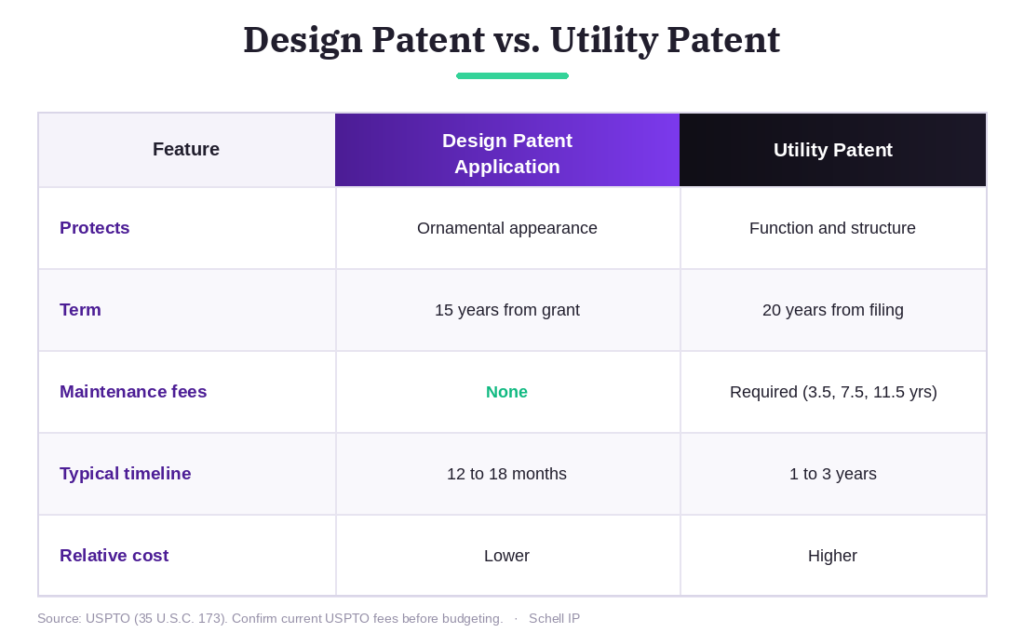
Because this trips up so many inventors, it is worth being explicit. A utility patent protects how an invention works and is used. A design patent protects how a product looks.
If you are unsure which path fits, the safest move is a quick conversation with a patent attorney. We go deeper on this decision in our design patent vs. utility patent guide.
How to File a Design Patent Application: Step by Step
Filing a design patent application is more streamlined than a utility filing, but precision matters enormously, especially in the drawings. A patent attorney is involved at nearly every stage below for a reason: small errors in a design patent can permanently narrow your protection, and they are difficult or impossible to fix after filing. Here is what the process looks like.
Step 1: Confirm Your Design Is Eligible
Before you file a design patent application, confirm the design is ornamental rather than purely functional, and that it is new. A prior art search helps you avoid filing something that already exists. A patent attorney can assess eligibility quickly and flag issues that are not obvious to an inventor, which saves time and filing fees down the line. If you would like a primer on searching, our overview of what you need to apply for a patent is a good starting point.
Step 2: Prepare the Design Patent Drawings
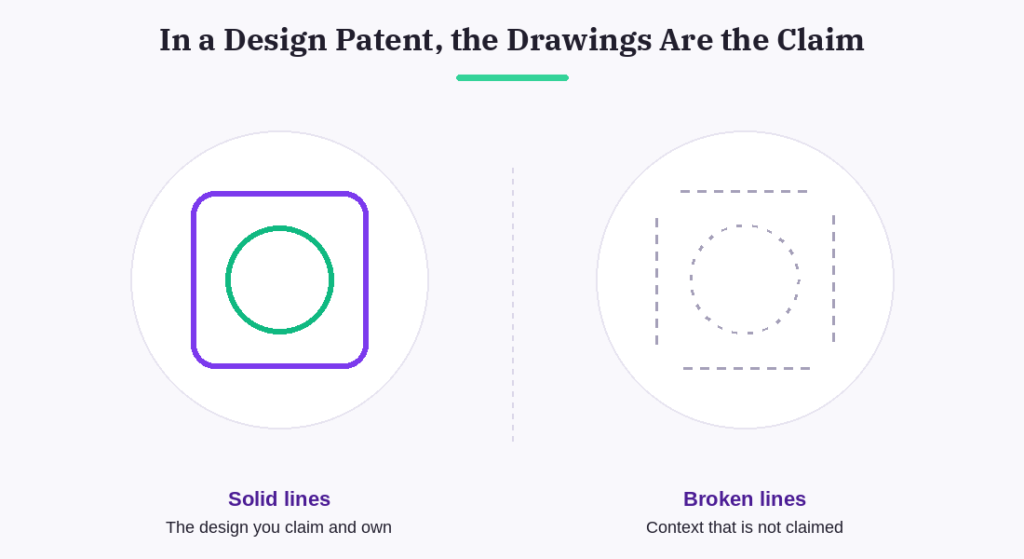
This is the heart of any design patent application. In a design patent, the drawings are the claim, meaning they define exactly what you own. Every line matters: solid lines show the claimed design, while broken (dashed) lines show context that is not being claimed.
A complete design patent application generally requires multiple views, including front, back, top, bottom, left, right, and often a perspective view. The drawings must be consistent across every view and meet USPTO formatting standards. Because so much rides on getting these right, a patent attorney will typically coordinate professional draftsmanship and review every view before it is filed. We cover this in detail in the role of patent drawings in applications.
Step 3: Draft the Specification and Claim
A design patent application has a single claim and a brief specification. The specification identifies the article the design applies to and describes the figures. Compared to a utility patent, the written portion of a design patent application is short, but the language still has to be exact, because it frames how the drawings are interpreted. This is precise legal drafting, and a patent attorney makes sure the specification and claim work together to protect the full scope of your design rather than a narrow slice of it.
Step 4: File With the USPTO
Once your drawings, specification, and claim are ready, you submit the design patent application to the USPTO along with the filing fee. You receive a filing date and, with it, patent pending status for your design. A patent attorney handles the formal filing requirements, which reduces the risk of a procedural rejection.
Step 5: Respond to Any Office Actions
The USPTO examiner reviews your design patent application and may issue an Office Action requesting clarification or raising an objection, often about the drawings. Responding effectively requires understanding what the examiner can and cannot require, which is squarely a patent attorney’s job. A well-prepared design patent application sees fewer Office Actions in the first place, which is one more reason professional preparation pays off.
Design Patent Application Drawings: Why They Are So Important
It is worth repeating: in a design patent application, the drawings define your legal protection. A utility patent leans on written claims; a design patent application leans almost entirely on its figures.
Common drawing mistakes that weaken a design patent application include inconsistent views, incorrect use of solid versus broken lines, missing surface shading, and views that do not match each other. Any of these can narrow your protection or trigger a rejection. Because the drawings carry so much weight, working with a patent attorney who coordinates proper drawings is the single most important step in a strong design patent application.
How Much Does a Design Patent Application Cost?
The cost of a design patent application depends on the entity size, the complexity of the design, and whether you handle it yourself or work with a patent attorney. It is important to separate two different things: the USPTO filing fees and the attorney fees.
USPTO filing fees for a design patent application vary by entity size and change over time, so you should confirm the current figures on the USPTO fee schedule before budgeting. Attorney fees are separate and depend on the complexity of the design and the drawings required.
A design patent application is generally more affordable than a utility patent, largely because the specification is shorter and there is a single claim. One genuine cost advantage is that a design patent has no maintenance fees, so keeping it in force does not require ongoing payments after grant. For a full breakdown of how design patent costs compare to provisional and utility filings, see our complete patent cost guide for 2026. Because every design is different, the most reliable way to get an accurate number is a consultation, where we can review your design and give you a clear estimate.
How Long Does a Design Patent Application Take?
A design patent application is generally granted within 12 to 18 months, which is faster than a utility patent, which can take one to three years. Once granted, a design patent lasts 15 years from the date of grant for applications filed under current rules, with no renewal fees required to keep it in force.
When Should You File a Design Patent Application?
A design patent application makes sense when:
- Your product has a distinctive look that competitors could copy
- The visual appearance is part of what makes your product desirable
- You want faster, lower-cost protection than a utility patent provides
- You want to layer appearance protection on top of a utility filing
Consumer products, furniture, packaging, wearables, jewelry, and software interfaces are all candidates for a design patent application. If a knock-off that looks like your product would hurt your business, a design patent application is likely worth filing, and a patent attorney can help you confirm whether it is the right tool for your specific situation.
Jeff’s Take
For a lot of consumer products, the design is the most valuable thing you have. People buy the look, and a design patent application protects exactly that. It is not a lesser form of protection or a fallback when a utility patent is not available. In many cases it is the more practical choice, because infringement of a design patent is visually obvious, which can make enforcement more straightforward than it is for a utility patent.
The part inventors tend to underestimate is the drawings. A design patent application stands or falls on its figures, and drawings that are not prepared correctly can give away protection before the examiner even reviews the application. This is the main reason working with a patent attorney matters here. Getting the drawings and the claim right at the start is the difference between a design patent that actually protects your product and one that looks good on paper but does little in practice.
How Schell IP Helps With Your Design Patent Application
At Schell IP, we help inventors and startups file design patent applications that actually hold up, starting with drawings done right. Denver patent attorney Jeff Schell brings both legal and founder experience, so we look at your design patent application not just as a filing, but as a business asset that protects market position and supports company value.
We offer:
- Strategic filing advice on whether a design patent application, a utility patent, or both fits your product
- Professional-grade drawings that protect the full scope of your design
- Transparent, often fixed or capped pricing so you know the cost up front
- Coordinated IP strategy that pairs your design patent application with broader protection
Book a free consultation to talk through your design and get a clear, personalized cost estimate.

Frequently Asked Questions
What does a design patent protect?
A design patent protects the ornamental appearance of a product, meaning its shape, surface decoration, or overall visual look. It does not protect how the product functions, which requires a utility patent.
How much does a design patent application cost?
The cost of a design patent application has two parts: USPTO filing fees, which vary by entity size and change over time, and attorney fees, which depend on the complexity of the design and drawings. Design patents have no maintenance fees after grant. Because figures vary, the most accurate way to budget is to confirm current USPTO fees and request a consultation for an attorney fee estimate.
How long does a design patent application take?
A design patent application is usually granted within 12 to 18 months, which is faster than a utility patent. Timing can vary depending on USPTO backlog and whether any Office Actions are issued.
How long does a design patent last?
A design patent granted under current rules lasts 15 years from the date of grant, with no maintenance or renewal fees required.
What is the difference between a design patent and a utility patent?
A design patent protects how a product looks, while a utility patent protects how it works. Design patents are generally faster and cheaper; utility patents last longer and cover function. Many products benefit from both.
Why are drawings so important in a design patent application?
In a design patent application, the drawings define the claimed design, so they function as the legal claim. Inconsistent or poorly prepared drawings can narrow your protection or cause a rejection, which is why working with a patent attorney on the drawings is strongly recommended.
Can I file a design patent application myself?
You can, but design patent applications are unusually sensitive to drawing quality and line conventions. Errors are common in self-filed applications and can permanently weaken protection. Working with a patent attorney significantly improves the strength of the filing.
Can a product have both a design patent and a utility patent?
Yes. Many products are protected by both, a utility patent for how the product works and a design patent application for how it looks. This layered approach provides the broadest protection.
Does a design patent application give me patent pending status?
Yes. Once you file a design patent application and receive a filing date, your product carries patent pending status, signaling to competitors that protection is in progress.
Final Thoughts
A design patent is one of the most underrated tools available to inventors, being affordable, relatively fast, and powerful for products where appearance drives value. The key to a strong design patent application is precision, especially in the drawings, since those figures define exactly what you own. That precision is also why most inventors are better served working with a patent attorney than going it alone.
At Schell IP, we help inventors and startups file design patents that protect the full value of their designs. Whether you are protecting a single product’s look or building a layered IP strategy, we provide clear pricing and experienced guidance.
Book a free consultation today to discuss your design and get a personalized cost estimate.