Quick Answer: Can you use someone else’s patent? Not without authorization. Using a patented invention without the patent holder’s permission is patent infringement, regardless of whether you knew the patent existed. There are three legitimate paths forward: obtaining a license, designing around the patent, or challenging the patent’s validity. Here is how each one works and how to figure out which applies to your situation.
If you are asking whether you can use someone else’s patent, you are probably in one of a few situations. You have received a cease and desist letter. You are building a product and discovered a patent that looks like it might cover what you are doing. Or you want to use a technology that already exists and you need to figure out whether you need permission.
All of these are legitimate reasons to ask, “Can you use someone else’s patent?”, and the stakes are higher than most people realize before they have a problem.
What “Can You Use Someone Else’s Patent” Actually Means Under the Law
A patent grants the holder the exclusive right to make, use, sell, offer for sale, and import the patented invention in the United States for the life of the patent, typically 20 years from the filing date for a utility patent. Anyone who does any of those things without authorization infringes the patent, whether or not they knew it existed.
This is one of the most counterintuitive aspects of patent law: ignorance is not a defense. You can independently develop the exact same invention, with no knowledge that someone else already patented it, and still be liable for infringement. Intent does not determine infringement. The claims do.
Patent infringement turns entirely on whether your product or process falls within the scope of the patent’s claims. If it does, you infringe. If it does not, you do not. That analysis requires reading the claims carefully and, in most situations, getting a formal legal opinion from a patent attorney before you launch or continue selling a product.
This is precisely where Schell IP gets involved early. A freedom to operate analysis, run before a product goes to market, tells you exactly where you stand relative to existing patents and what, if anything, needs to change.
Can You Use Someone Else’s Patent? Three Options When You Can’t
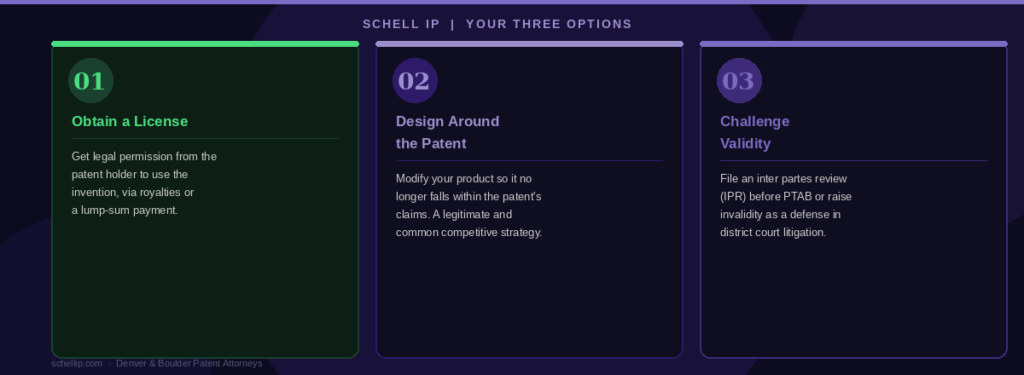
Option 1: Obtain a patent license to use the invention legally
A patent license is a legal agreement in which the patent holder grants you permission to use the patented invention, typically in exchange for royalties or a lump-sum payment. Licensing is the most direct path when you need to use a patented technology and the patent is valid and enforceable.
The two main types of licenses are:
- Exclusive license: Only you can use the technology under the terms of the agreement. The patent holder cannot license it to anyone else within the scope of your license. These command higher fees and are more common in pharmaceutical, biotech, and high-value technology deals.
- Non-exclusive license: The patent holder can license the same technology to multiple parties simultaneously. More common in software and consumer products where broad adoption benefits the licensor.
Licensing negotiations involve more than agreeing on a royalty rate. Scope of use, field of use, geographic territory, sublicensing rights, milestone payments, and termination conditions all affect the long-term value and enforceability of the agreement. Understanding patent licensing before entering a negotiation puts you in a significantly stronger position.
Not every patent holder wants to license their technology. Some hold patents specifically to exclude competitors. Others actively seek licensees as a revenue stream. Knowing which type you are dealing with shapes how you approach the conversation, and having a patent attorney negotiate or review the agreement protects you from terms that look reasonable on the surface but create problems later.
Option 2: Design around the patent
Designing around a patent means modifying your product or process so that it no longer falls within the scope of the patent’s claims. This is a legitimate and commonly used competitive strategy, and it is precisely why strong claim drafting matters so much when you are on the other side of the table.
A design-around requires a careful reading of the patent’s independent claims, the prosecution history (the record of what was argued during USPTO examination), and the relevant prior art. The goal is to identify claim elements that can be changed or eliminated while still achieving the technical result you need.
Design-arounds are not always possible. Some patents have broad, well-drafted claims that are genuinely difficult to avoid. Others have narrow claims with obvious gaps. A patent attorney can evaluate the specific patent and advise on whether a design-around is feasible, what it would require technically, and whether the modified product would be clear of infringement.
It is worth being direct about this: designing around a patent is not infringement and it is not unethical. Courts have consistently held that designing around patents is not only legal but a feature of the patent system’s purpose of promoting competition and innovation.
Option 3: Challenge the patent’s validity
Patents are granted by the USPTO but they are not guaranteed to be valid. A patent can be invalidated if it can be shown that the invention was not novel, was obvious, or was inadequately disclosed at the time of filing. The most common grounds for challenging validity are prior art (the invention was already known or patented before the filing date), obviousness (it would have been obvious to a person of ordinary skill in the relevant field), and inadequate disclosure.
There are two main formal mechanisms:
Inter partes review (IPR): A proceeding before the USPTO’s Patent Trial and Appeal Board (PTAB) in which a third party challenges a patent’s validity based on prior art. IPR is faster and significantly less expensive than district court litigation, and has become a standard tool for defendants facing infringement claims where the underlying patent is weak.
District court litigation: Invalidity can also be raised as a defense in infringement litigation. Many patents that are asserted in litigation are challenged on validity grounds simultaneously, and a meaningful percentage are found invalid or unenforceable. The standard of proof in district court is clear and convincing evidence, which is a higher bar than in an IPR proceeding.
Challenging a patent is not quick or inexpensive, but in situations where the patent is weak and the potential damages are significant, it is often the right strategic move. A patent attorney experienced in enforcement can evaluate whether a challenge is worth pursuing and which forum makes the most sense.
What to Do If You Have Already Received a Cease and Desist Letter
If you have received a cease and desist letter, or if you believe you may already be infringing a patent, the time to act is immediately. Here is what the process typically looks like, and where a patent attorney is essential at each step.
Step 1: Get a freedom to operate opinion. A freedom to operate (FTO) opinion is a legal analysis that evaluates whether your product or process infringes any valid, enforceable patents. This is the foundation of any informed response to an infringement claim and the first thing Schell IP does when a client comes in with a cease and desist. It tells you what you are actually dealing with before you respond to anything.
Step 2: Evaluate the strength of the patent. Not all patents are equal. Some are broad, well-drafted, and difficult to challenge. Others have narrow claims, significant prior art problems, or prosecution history that limits their scope in ways that are not obvious from the face of the patent. Understanding what you are actually dealing with shapes every decision that follows.
Step 3: Consider your realistic options. Based on the FTO analysis and the patent evaluation, the options typically include negotiating a license, implementing a design-around, challenging validity through IPR or litigation, or some combination. Schell IP helps clients map out the full picture before committing to any course of action, including the realistic cost and timeline of each path.
Step 4: Do not ignore the letter. A cease and desist letter is not a lawsuit, but ignoring it creates real problems. It can be used as evidence of willful infringement, which under 35 U.S.C. § 284 allows courts to award enhanced damages of up to three times the actual damages. Willfulness turns on whether you knew about the patent and continued to infringe anyway. A letter you did not respond to is evidence you knew.
How to Verify Whether a Patent Is Still in Force
Before making any decisions, it is worth confirming that the patent you are concerned about is actually active. Patents can fall out of force in two ways.
Term expiration: Utility patents expire 20 years from the earliest filing date. Design patents expire 15 years from the grant date. An expired patent cannot be enforced against you.
Lapsed maintenance fees: Utility patents require maintenance fees at 3.5, 7.5, and 11.5 years after grant. A patent that has lapsed for non-payment is unenforceable, though in some cases it can be revived. You can check the current status, maintenance fee history, and expiration date of any US patent using the USPTO Patent Center.
This is a simple check that is worth doing before spending time or money on any other analysis. Schell IP includes patent status verification as a standard part of any FTO or infringement evaluation.
Common Scenarios and Where Schell IP Can Help
You are building a product and found a patent that looks relevant. Get a freedom to operate opinion before you launch, raise money, or go to market. This is exactly what Schell IP does in the early stages of a product development engagement. The cost of an FTO analysis is almost always less than the cost of dealing with an infringement dispute after the product is live.
You received a cease and desist letter. Do not respond without legal counsel and do not ignore it. Book a consultation with Schell IP to evaluate the claim, assess the patent’s strength, and map out your options before you do anything else.
You want to license a technology for your product. Identify the patent holder, confirm the patent is in force, and approach licensing as a business negotiation. Schell IP can review or negotiate the agreement and ensure the terms are structured correctly for your use case.
You are a startup and you are not sure whether your product might infringe existing patents. A freedom to operate review at the early stage is significantly less expensive than managing an infringement claim after you have built a business around a product. This is standard IP diligence for any well-advised startup, and it is something Schell IP builds into early-stage IP strategy engagements. See how patents support startup IP strategy from the ground up.
Jeff’s Take
I heard the question, “Can you use someone else’s patent?” all the time. The most common situation I see is a founder or product team who knew there were patents in the space, assumed they were fine, and did not get a formal opinion before launch. By the time they come to me with a cease and desist letter, they are in a much tighter position than they would have been six months earlier.
What I want people to understand is that the three options, licensing, designing around, and challenging validity, do not disappear when you receive a letter. But they narrow. A license negotiation that might have been straightforward before litigation becomes more complicated once a lawsuit is filed. A design-around that would have been clean before launch now has to account for past infringement as well. The window to act cheaply is before the problem surfaces, not after.
The founders and companies who are in the best position are the ones who ran a freedom to operate analysis as part of their product development process, not as a reaction to a legal threat. It is not a complicated engagement and it gives you a clear picture of exactly where you stand before you have skin in the game.
Book a free consultation with Schell IP to talk through your situation.
Frequently Asked Questions
Can you use someone else’s patent if you invented it independently?
No. Independent invention is not a defense to patent infringement in the United States. If your product or process falls within the claims of a valid patent, you infringe it regardless of how you developed your invention. This is one of the most counterintuitive aspects of US patent law and one of the most important things to understand before launching a product.
Can you use someone else’s patent after it expires?
Yes. Once a patent expires, the invention enters the public domain and anyone can use it freely without a license. You can verify expiration dates using the USPTO Patent Center.
What is a patent license and how do I get one?
A patent license is a legal agreement granting you permission to use a patented invention under specific terms, typically including royalties, scope, territory, and duration. To obtain one you identify the patent holder, confirm the patent is in force, and negotiate the terms. A patent attorney should be involved in reviewing and drafting the agreement. Patent licensing 101 covers the basics of how these agreements are structured.
What is designing around a patent?
Designing around a patent means modifying your product or process so it no longer falls within the scope of the patent’s claims. It requires analysis of the claims, prosecution history, and prior art, and is a legitimate competitive strategy. A patent attorney can advise on whether a design-around is feasible and what it would require.
What is a freedom to operate opinion?
A freedom to operate (FTO) opinion is a legal analysis that evaluates whether your product or process infringes any valid, enforceable patents. It is typically conducted before a product launch, fundraise, or acquisition and gives you a defensible basis for moving forward. Schell IP conducts FTO analyses as part of early-stage IP strategy engagements as well as in response to infringement concerns.
What happens if I ignore a patent cease and desist letter?
Ignoring a cease and desist letter can be used as evidence of willful infringement, which under 35 U.S.C. § 284 can result in enhanced damages of up to three times the actual damages awarded. It also signals to the patent holder that litigation may be necessary. Always consult a patent attorney before responding to or ignoring a cease and desist.
Can I be sued for patent infringement even if I stop using the technology?
Yes. A patent holder can sue for damages covering the period of past infringement even after you have stopped. Stopping limits future exposure but does not eliminate past liability. This is another reason why getting ahead of a potential infringement issue early matters significantly.

Dealing with a patent concern or not sure where you stand? Book a free consultation with Jeff Schell at Schell IP. Denver and Boulder-based, serving inventors, startups, and businesses across Colorado and nationally.