Quick Answer: Patenting a mobile app comes down to protecting the right things. You cannot patent the app itself as a product, but you can patent the underlying technology: the novel algorithms, data flows, system architecture, and technical processes that make your app work in a new way. If your app solves a technical problem in a way that has not been done before, there is likely something worth protecting. This post walks through how to do it.
Patenting a mobile app is one of the most common questions founders and developers bring to Schell IP. The confusion makes sense. You have built something real, something that works, and you want to protect it before you launch, raise capital, or share it with partners. But the rules around mobile app patents are more specific than most people expect, and misunderstanding them leads to either wasted filings or missed opportunities.
This guide covers what is and is not patentable in a mobile app, why patenting a mobile app matters for fundraising and acquisitions, and the step-by-step process for doing it right in 2026.
What You Are Actually Protecting When Patenting a Mobile App
Copyright protects your specific code automatically the moment you write it. A patent does something different: it protects the invention itself, meaning the novel technical method your app uses to solve a problem. Two competing apps can be written in completely different code and still infringe each other’s patents if they implement the same underlying technical method.
The USPTO will not grant a patent for an abstract idea. It will grant a patent for a specific technical implementation of that idea. The legal standard comes from the Supreme Court’s Alice Corp. v. CLS Bank decision, which requires that software-based inventions contain an inventive concept, meaning something beyond simply performing a familiar task on a computer. This is the threshold that separates a patentable mobile app invention from one that will be rejected.
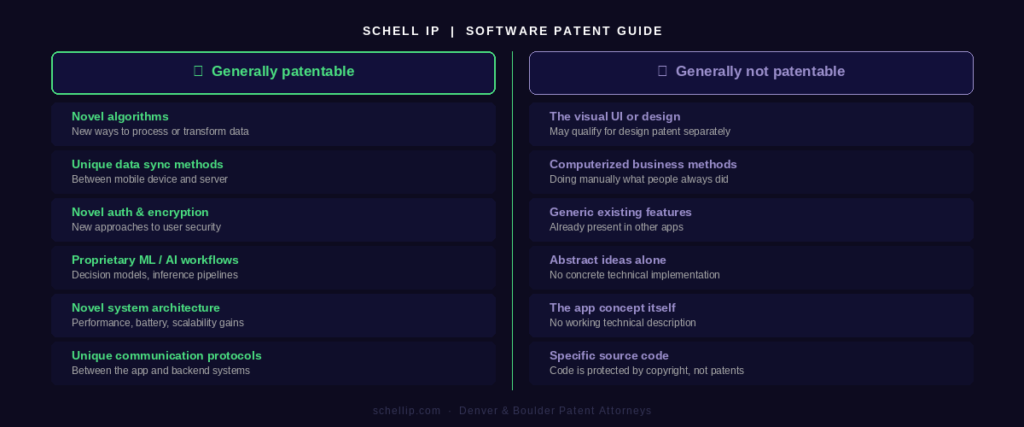
In practice, the following elements of a mobile app are commonly patentable:
- Novel algorithms that process, analyze, or transform data in a new way
- Unique methods for data synchronization between a mobile device and a server
- New approaches to user authentication, security, or encryption
- Proprietary machine learning models or AI-driven decision workflows
- Innovative ways of handling real-time data, location, or sensor inputs
- Novel system architectures that improve performance, battery life, or scalability
- Unique communication protocols between the app and backend systems
The following are generally not patentable on their own:
- The app’s visual design or user interface (these may qualify for design patent or trade dress protection separately)
- A business method that simply uses a mobile device to do what people have always done manually
- Generic features that already exist in other apps
- The concept for the app without a concrete, working technical implementation
The way claims are drafted determines whether a patent covers meaningful competitive ground or gets rejected at examination.
Why Patenting a Mobile App Matters for Fundraising and Acquisitions
For most founders, patenting a mobile app is not primarily about litigation. It is about leverage.
When you raise a seed round or Series A, investors conduct diligence on your IP position. A pending patent application signals that your technology is proprietary and defensible, meaning a well-funded competitor cannot simply replicate your core functionality and outspend you to market. Without any IP protection in place, your technology is essentially open, which is a material risk that sophisticated investors will flag.
When you approach an acquisition, the strength of your patent portfolio directly affects valuation. Acquirers pay more for businesses with defensible IP, because they are buying barriers to entry alongside the product. A well-drafted patent that covers your core technical method is worth significantly more during due diligence than a patent with narrow or poorly written claims.
Jeff Schell has been through due diligence on both sides of the table as a patent attorney and as a founder who has taken companies through successful exits. In his experience, founders who wait until they are actively fundraising or in an acquisition conversation to address their IP are consistently in a weaker negotiating position than they need to be. The time to file is before the conversation starts, not during it. See how patents support startup IP strategy and valuation for more on building IP that holds up in a deal.
Step-by-Step: Patenting a Mobile App in 2026
Step 1: Document the invention thoroughly
Before filing anything, document exactly how your app works at a technical level. This means detailed written descriptions of the algorithms and processes involved, system architecture diagrams showing how components interact, data flow diagrams showing how information moves through the app, and any technical benchmarks demonstrating improved performance or efficiency.
This documentation does two things: it gives your patent attorney the material needed to draft strong claims, and it establishes a clear record of when the invention was conceived. The more detailed and specific your documentation, the better your patent will be.
Step 2: Conduct a prior art search
A prior art search checks whether your invention, or something close to it, has already been patented. You can do a preliminary search yourself using Google Patents or the USPTO patent full-text database. This gives you a rough sense of the competitive landscape before investing in a full application.
A professional prior art search goes deeper, covering international patent databases, academic publications, and existing products that may not have been patented but still qualify as prior art. Conducting this search before filing tells you whether your claims are likely to survive examination and how to position them relative to existing patents. It also reduces the risk of spending money on a filing that will be rejected.
Step 3: File a provisional patent application
For most founders patenting a mobile app, a provisional patent application is the right first step. A provisional:
- Establishes your priority date immediately, which is the date that matters in a first-to-file patent system
- Gives you 12 months of “patent pending” status
- Costs significantly less than a full non-provisional application
- Allows you to continue developing the app before committing to a full filing
- Lets you disclose the app to investors, partners, and beta users without losing your patent rights
The critical mistake most founders make when patenting a mobile app is filing a thin, hastily drafted provisional just to have something on record. If the provisional does not adequately describe the invention as it will ultimately be built, it will not effectively protect the final version of the app. A provisional patent application needs to be drafted strategically, not just quickly. Learn more about the provisional patent application process and what a well-built provisional needs to include.
Step 4: File the non-provisional patent application
Within 12 months of the provisional filing, you need to file the full non-provisional utility patent application. This is the document that goes through USPTO examination and, if granted, becomes the enforceable patent.
The non-provisional application includes the specification (a complete written description of how the invention works), technical drawings or system diagrams, claims (the numbered statements that legally define the boundaries of protection), and an abstract.
The claims are the most important element. Independent claims need to be broad enough to cover meaningful competitive ground, including variations a competitor might try, while dependent claims add specificity and provide fallback positions if broader claims face rejection. Drafting patent claims correctly is a skill that requires both legal expertise and a genuine technical understanding of the invention. This is not a step to cut corners on.
Step 5: Respond to USPTO Office Actions
Most patent applications receive at least one Office Action, which is a formal written objection from the USPTO examiner. Office Actions for mobile app patents typically raise concerns about prior art (the examiner believes the claims are too similar to existing patents), claim scope (the claims are too broad or insufficiently described), or patentable subject matter under the Alice framework (the examiner considers the claims directed to an abstract idea).
Responding to an Office Action requires substantive legal arguments and often targeted claim amendments. The quality of that response directly determines the scope of protection you end up with. A poorly argued response either results in rejection or forces you to accept narrower claims than your invention deserves.
Step 6: Grant and maintenance
If the application survives examination, the USPTO issues a Notice of Allowance and the patent is granted after payment of the issue fee. Patenting a mobile app through the full utility patent process typically takes two to three years from the non-provisional filing date, depending on the technology area and the USPTO’s current examination backlog.
After grant, maintenance fees are due at 3.5, 7.5, and 11.5 years. Missing a maintenance deadline causes the patent to lapse and enter the public domain.
Common Mistakes When Patenting a Mobile App
Disclosing before filing. In the United States, you have a one-year grace period after publicly disclosing your app through a product launch, press coverage, app store listing, or investor pitch to file a patent application. Many founders do not realize this clock starts running at first disclosure. International patent rights are typically lost immediately upon public disclosure, with no grace period at all.
Protecting the wrong things. Many self-filed mobile app patents focus on features or user experience rather than the underlying technical methods. Features can be copied without infringing a patent; a well-drafted patent on the technical method cannot be designed around as easily. See 6 common mistakes inventors make without a patent lawyer for a full breakdown.
Filing a thin provisional to save money. A provisional that does not fully describe the invention as ultimately developed can leave you with a priority date that does not actually protect your final product. The savings on a thin provisional filing often cost far more when the non-provisional has to be rebuilt from scratch.
Overlooking design patents. If your app has a distinctive, non-obvious visual interface, a design patent may be worth pursuing alongside a utility patent. Design patents are faster to obtain and less expensive to file. See the difference between design and utility patents to understand whether both apply to your situation.
Underestimating the AI/software patentability question. If your app uses machine learning or AI-driven functionality, the patentability analysis is more nuanced. Understanding the risks of using AI tools to draft a patent application and the specific standards for patenting AI inventions is worth doing before you file.
What Does Patenting a Mobile App Cost in 2026?
Patenting a mobile app falls in the mid-to-upper range of software patent costs because of the technical complexity involved in drafting claims that survive Alice scrutiny and prior art examination. Based on the figures published in our complete 2026 patent cost guide:
Provisional patent application: $3,000 to $6,000 in attorney fees, plus USPTO filing fees. This establishes your priority date and gives you 12 months of patent pending status.
Non-provisional utility patent application (software/AI): $10,000 to $20,000 or more in attorney fees, plus USPTO fees. Software and AI patents require detailed technical descriptions and careful claim drafting to survive examination, which places them at the higher end of the utility patent cost range.
Total cost through grant: Most founders patenting a mobile app should budget $10,000 to $25,000 or more from initial filing through patent grant, depending on the complexity of the technology and how examination proceeds.
These costs reflect the reality that a well-drafted patent is a business asset with long-term value. The cost of weak IP, whether that is a filing that gets rejected, claims that are too narrow to enforce, or a gap that surfaces during due diligence, consistently exceeds the cost of doing it correctly from the start.
Jeff’s Take
Founders building mobile apps tend to think about patent protection the same way they think about legal agreements in general: something to deal with later, once the product is working and the business has momentum. That reasoning makes sense in the context of early-stage resource constraints, but it creates a specific risk that comes up over and over in due diligence.
The most common scenario is not that a founder skips patents entirely. It is that they disclose the app publicly before filing, or file a thin provisional that does not adequately describe the final product, and by the time they are in a fundraise or acquisition conversation, the IP position has gaps that are difficult or expensive to close. International rights may be gone entirely. The priority date may not cover the version of the product that investors are actually evaluating.
Patenting a mobile app does not have to be complicated or prohibitively expensive at the early stage. A well-drafted provisional can be filed relatively quickly, establishes a defensible priority date, and gives you 12 months to continue building before committing to the full non-provisional application. The key is that the provisional needs to be built to support what comes next, not just filed to have something on record.
If your app solves a real technical problem in a way that is genuinely new, that is worth a conversation before you launch or start showing it to investors. The window to protect those rights is shorter than most founders expect. Book a free consultation to talk through what is patentable in your app.

Frequently Asked Questions
What does patenting a mobile app actually protect?
Patenting a mobile app protects the novel technical methods your app uses, not the app itself as a product. This includes algorithms, data processing workflows, system architecture, and any technical process that solves a problem in a new way. Copyright protects your code automatically; a patent protects the invention behind it.
Can you patent an app idea without a working product?
Not directly. To be patentable, an invention must be reduced to practice, meaning you need a concrete technical description of how it works, not just a concept. You do not need a finished, shipping product, but you do need enough technical detail to describe the invention clearly in the application.
How long does patenting a mobile app take?
A provisional application can be filed within weeks. The full non-provisional examination process typically takes two to three years from filing to grant. Patent pending status begins as soon as either a provisional or non-provisional application is filed.
Does patent pending protect me from competitors copying my app?
Patent pending is a deterrent but not an enforceable legal shield. You cannot sue for infringement until a patent is granted. However, once granted, your patent can cover infringement that occurred after your original filing date, giving you retroactive protection back to that date.
Should I file for international patent protection?
If you plan to commercialize the app outside the United States, international protection is worth discussing. A Patent Cooperation Treaty (PCT) filing preserves your rights in more than 150 countries through a single application. You have 12 months from your first filing date to pursue international protection before those rights are permanently lost.
What is the difference between patenting a mobile app and patenting software generally?
There is no separate patent category for mobile apps. Patenting a mobile app falls under utility patent law, the same framework that covers all software inventions. What makes a mobile app distinct is the context of how the invention operates, typically on a mobile device using location, sensors, or mobile-specific data flows, but the legal standard and filing process are the same. See our full guide to software patent protection for more on how mobile and software patents overlap.
This is not intended to be legal advice. For any specific questions pertaining to your situation, Book a free consultation to explore what is patentable in your app.