Quick Answer: In 2026, an MVP costs $500 in AI credits and a weekend of work. Code is no longer a defensible moat, and investors know it. Patent valuation is now one of the most important factors VCs and acquirers use to assess software startups, with companies holding strong patent portfolios trading at 3x to 5x higher exit multiples than those with just revenue and code. If you want to build something worth acquiring, you need to stop thinking like a coder and start thinking like an asset manager.
I’ve been a founder and an investor through the dot-com crash, the mobile boom, and now the AI revolution. I’m also a patent attorney. And I want to share something most software founders are not ready to hear.
Your code is now a commodity.
I’m not saying your product is bad. I’m saying that in 2026, anyone with AI credits and a weekend can build an MVP that looks a lot like yours. The barrier to entry that used to be your moat, the six months and $200,000 it once took to build something competitive, is gone. AI agents can code entire platforms in minutes.
So the question every investor is now asking is simple: if anyone can copy your product in 48 hours, why would they give you $5,000,000?
The answer, increasingly, is patent valuation.
Why Patent Valuation Matters More Than Ever in 2026
In 2015, building a great app was enough. The app itself was the moat. It took real time, real money, and real engineering talent to ship something polished. That barrier to entry was a form of protection.
In 2026, that protection is gone. An MVP costs $500 in AI credits. A solo founder can build in a weekend what used to take a team of engineers six months. That is not a hypothetical. It is happening right now across every software category.
When execution is cheap, investors can no longer use your product as evidence that you own something defensible. They need a different signal. And increasingly, that signal is patent valuation and the strength of your IP portfolio.
The USPTO has noted that patents are among the most durable forms of competitive protection available to technology companies. Unlike a product, which can be copied, a patent gives you a legally enforceable right to exclude competitors from using your specific approach.
What Investors Are Actually Asking in 2026
There has been a massive shift in how venture capital investors evaluate software companies. The questions have changed.
It used to be: how big is the market? How fast are you growing? Who is on the team?
Now investors are also asking:
- Is it legal for you to build this?
- Can you stop others from building it?
- What does your patent valuation look like in due diligence?
- Do you own anything a competitor cannot simply replicate?
A granted patent on the methodology underlying your system changes the answer to all of these questions. It means a competitor who builds the same functionality may be infringing your patent. That is an entirely different competitive position than just having better code, and investors price that difference into their offers.
How Patent Valuation Transforms a Software Company Into an Asset Company
This is the shift every founder needs to understand.
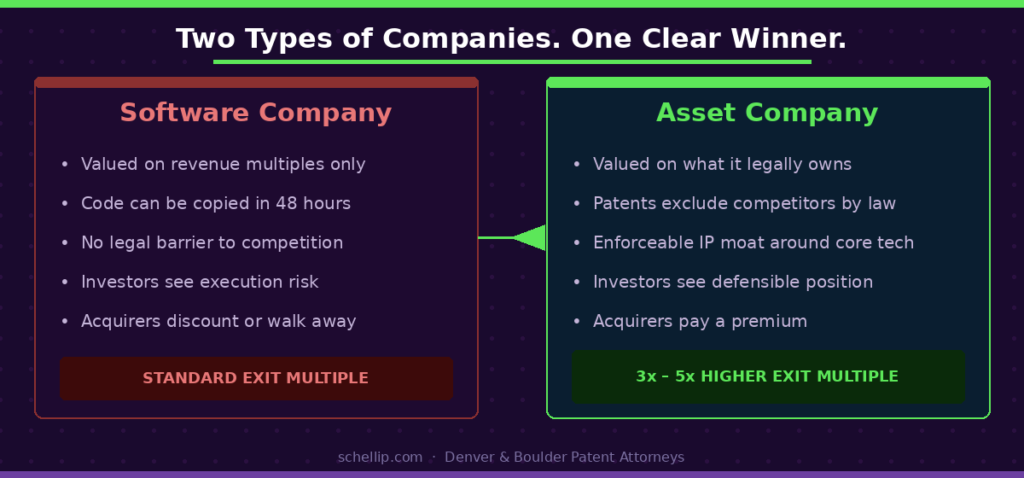
A software company is valued on revenue multiples. An asset company is valued on what it owns. When you hold a patent on the underlying methodology of your product, you transform your company from the former into the latter.
Companies with strong patent portfolios are trading at 3x to 5x higher exit multiples than companies with just revenue and code. That gap exists because acquirers are not just buying your product. They are buying the legal right to exclude competitors from using your approach. That right has value that extends far beyond the current revenue line.
This is what patent strategy for startups is actually about. Not litigation. Not blocking competitors in court. It is about building something that an acquirer or investor recognizes as a durable, defensible asset.
If you want to understand how patent valuation fits into your broader fundraising and exit planning, scheduling a free consultation with Schell IP is the fastest way to assess where your portfolio stands and where the gaps are.
Jeff’s Take
I sit on both sides of this table. As a venture partner, I’ve watched investors walk away from companies with strong revenue because the patent valuation simply wasn’t there. As a patent attorney, I’ve helped founders file patents that directly changed how their company was valued in a subsequent funding round or acquisition.
The founders who get patent valuation right are not necessarily the ones with the most technically complex products. They are the ones who documented their innovations early, filed before any public disclosure, and framed their patents around specific technical improvements rather than broad business ideas.
The founders who get it wrong usually say the same thing: they thought they’d file patents later, after they had more traction. By the time they had traction, a competitor had filed first, or an investor’s due diligence turned up gaps that were expensive to fix.
Patent valuation is not something you optimize at exit. It is something you build from the start. And the earlier you bring in a patent attorney who understands software and AI, the more options you have.
What Makes a Patent Valuable in Due Diligence
Not all patents are equal when it comes to patent valuation. Acquirers and investors assess IP portfolios carefully, and understanding what they look for helps you file strategically rather than just defensively.
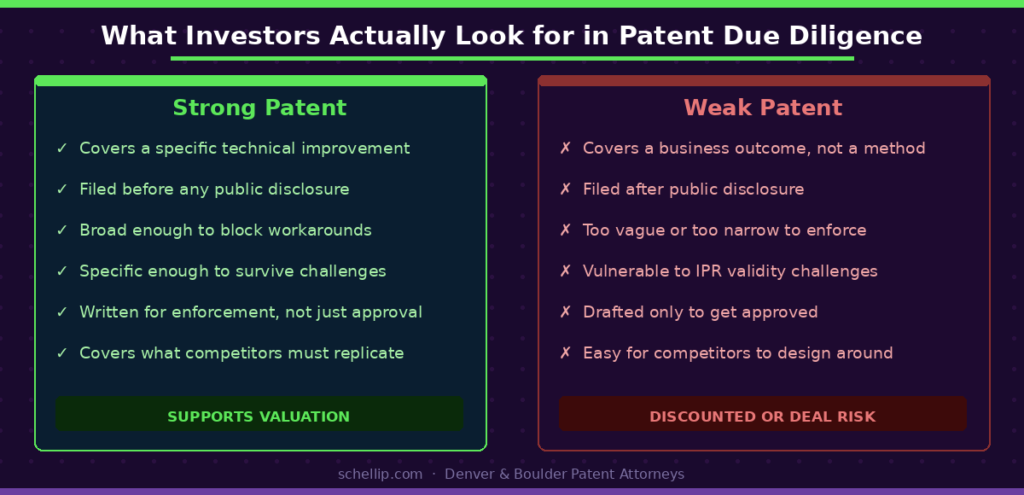
Patents that hold up in due diligence typically share these characteristics:
- They cover a specific technical improvement, not just a business outcome
- They are broad enough to block workarounds but specific enough to survive validity challenges
- They were filed before any public disclosure, including pitch decks and demo days
- They are written with enforcement in mind, not just USPTO approval
- They cover the core innovation that competitors would need to replicate to compete
Patents that fail due diligence tend to be:
- Too vague or too narrow to create real competitive protection
- Filed after public disclosure, creating prior art problems
- Focused on product features rather than the underlying technical method
- Drafted without considering how an acquirer’s IP counsel will read them
Poor patent valuation in due diligence either gets discounted or becomes a deal risk. Neither is where you want to be when you’re trying to close an acquisition or a funding round. A Denver patent attorney who understands both the technical and business dimensions of your product is the difference between a patent that supports your valuation and one that sits in a filing cabinet.
IP Moats Are Replacing Code Moats: What This Means for Patent Valuation
The venture capital community has made this shift clear. IP moats and regulatory moats are replacing code moats as the primary signals investors use to assess defensibility.
In a world where AI can build almost anything in 48 hours, legal protection is becoming the scarce resource. The founders who recognize this early are building companies that are genuinely harder to compete with and meaningfully more valuable at exit.
This is why the Silicon Valley patent strategy that has always been standard practice in hardware and biotech is now moving into software. Courts are enforcing software patents again. The USPTO is protecting patent holders from serial validity challenges. And acquirers are paying premiums for companies that own their underlying technology in a legally defensible way. For a deeper look at the enforcement shift driving this, our post on AI patent litigation in 2026 covers the legal landscape in detail.
How to Start Building Patent Valuation Into Your Company
You do not need to wait until a Series A to think about patent valuation. The best time to start is before your first public demo.
Here is a practical starting framework:
- File a provisional patent application before you pitch investors or present at demo day. It establishes your priority date quickly, typically for $3,000 to $6,000, and gives you 12 months to develop your full application.
- Focus on what your system does at a technical level, not the product features. How does your model train differently? How does your system process data more efficiently? What architectural decisions make your approach work? Those are the things worth patenting.
- Think like an acquirer. What would a competitor need to replicate to take your market? Patent that.
- Work with a patent attorney who understands your technology from the start, not after you’ve already disclosed publicly or let a competitor file first.
- Review your patent valuation regularly as your product evolves. New features and technical improvements are new filing opportunities.
For a full breakdown of what patent filing costs at each stage, the 2026 patent cost guide covers everything from provisional applications through full prosecution. And if you want to understand how patent valuation fits into your IP strategy roadmap from idea to exit, that post walks through the full arc of building a defensible IP portfolio.
The most important thing you can do right now is understand where your patent valuation stands. Book a free consultation with Schell IP and we will walk through your core innovations, identify what is patentable, and build a filing strategy that supports your funding and exit goals.
Frequently Asked Questions
What is patent valuation?
Patent valuation is the process of determining the economic value of a patent or patent portfolio. For startups, it refers to how much investors and acquirers attribute to a company’s intellectual property when assessing overall company value. Strong patents on core technical innovations can increase a startup’s exit multiple by 3x to 5x compared to companies with just revenue and code.
Why does patent valuation matter for software startups in 2026?
Because code is no longer a defensible moat. AI has collapsed the cost of building software to the point where any product can be replicated quickly. Patents on the underlying methodology create a legal barrier that code alone cannot. Investors and acquirers are increasingly pricing this defensibility directly into their valuations and term sheets.
What software innovations are worth patenting to improve patent valuation?
Innovations that demonstrate a specific technical improvement tend to carry the most weight in due diligence, including faster model training methods, reduced memory usage architectures, novel data processing or anomaly detection approaches, specific AI training methodologies, and system architecture improvements that produce measurable technical results. Broad patents on business outcomes or vague process descriptions rarely survive acquisition review.
How early should a startup file patents to maximize patent valuation?
Before any public disclosure, ideally before the first investor pitch or demo day. A provisional patent application establishes priority quickly and inexpensively. Waiting until you have traction risks a competitor filing first, or public disclosure creating prior art that invalidates your right to file at all.
What do investors look for during IP due diligence?
Investors and acquirers look for patents that cover core technical innovations rather than just product features, were filed before public disclosure, are broad enough to block workarounds, are specific enough to survive validity challenges, and have no gaps that a well-funded competitor could exploit. Weaknesses in IP coverage are one of the most common sources of valuation discount or deal friction in acquisitions.
How do I know what to patent?
Start with the specific technical decisions that make your system work, not the product features or business outcomes. Book a free consultation with Schell IP and Jeff will walk through your technology, identify your most patentable innovations, and build a patent valuation strategy that supports your funding and exit goals.