Last Updated: August 16, 2026
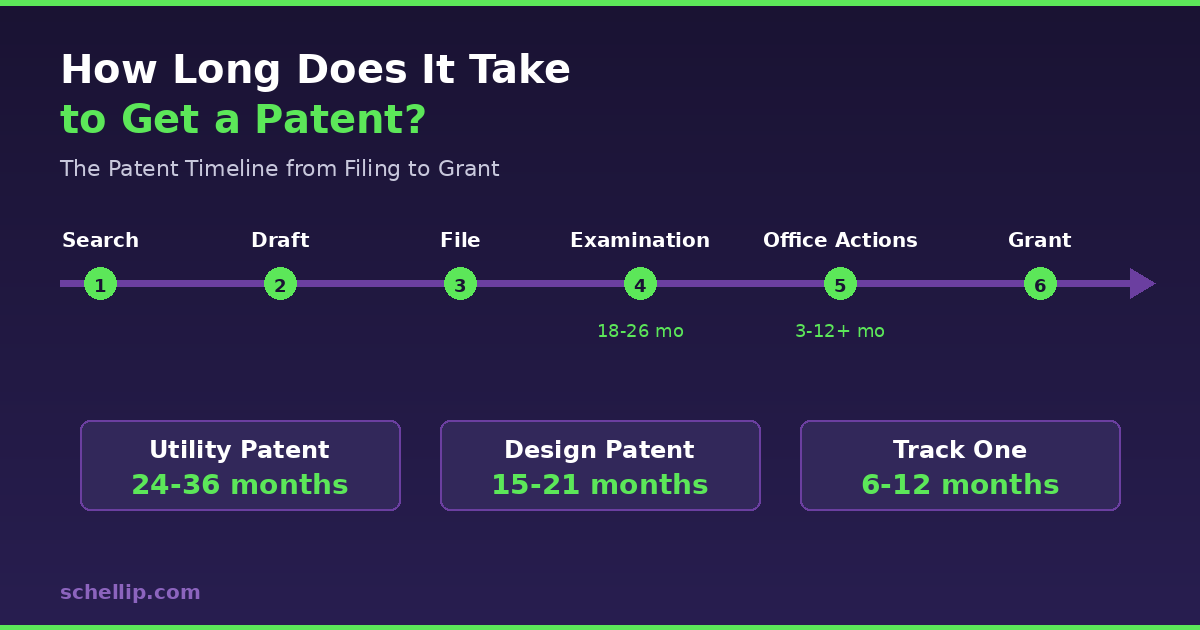
Quick Answer: How long does it take to get a patent? Most utility patents take 24 to 36 months from filing to grant. Design patents are faster, typically 15 to 21 months. A provisional patent application gives you immediate “patent pending” status and 12 months to file a full application. The total patent timeline depends on invention complexity, your technology area, USPTO backlog, and how quickly you respond to office actions.
If you are an inventor or startup founder, understanding how long it takes to get a patent is critical for planning product launches, fundraising timelines, and competitive strategy. The patent timeline affects when you can enforce your rights, how investors evaluate your company, and whether your invention is still relevant by the time full protection arrives.
This guide breaks down the patent timeline by patent type, explains what affects processing time, and covers strategies to speed up the process.
How Long Does It Take to Get a Patent by Type?
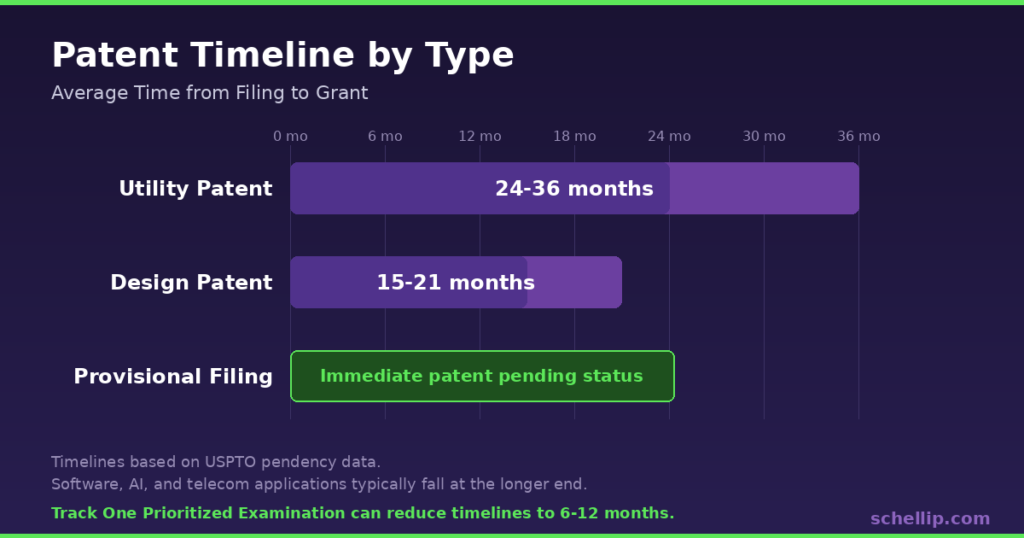
The patent timeline varies significantly depending on the type of patent you file. Each type serves a different purpose and follows a different examination process at the United States Patent and Trademark Office (USPTO). Here is a quick summary of how long it takes to get a patent by type:
- Utility patents: 24 to 36 months from filing to grant
- Design patents: 15 to 21 months from filing to grant
- Provisional patent applications: Establishes “patent pending” status immediately, with 12 months to file a full application
How Long Does It Take to Get a Patent for Utility?
Utility patents are the most common type and protect how an invention works. This includes machines, processes, software systems, chemical compositions, and manufacturing methods. Because utility patents require detailed technical examination, they take the longest to process.
Average timeline: 24 to 36 months from filing to grant.
The USPTO currently reports average first office action pendency of approximately 18 to 26 months, depending on your technology area. After receiving the first office action, most applicants need an additional 3 to 12 months for responses, amendments, and final disposition. Software, AI, and telecommunications applications tend to sit at the longer end of that range due to higher application volume and eligibility challenges.
How Long Does It Take to Get a Patent for Design?
Design patents protect the ornamental appearance of a product, its shape, pattern, or surface design. They do not protect how a product functions. Because design patents are less technically complex, examination is faster.
Average timeline: 15 to 21 months from filing to grant.
Design patents are a good option when your product has a distinctive visual appearance that competitors could copy. They are common for consumer products, packaging, and user interfaces. For a deeper comparison, see our guide on design patent vs. utility patent.
How Long Does a Provisional Patent Application Take?
A provisional patent application does not go through examination and will not become a granted patent on its own. Its purpose is to establish an early filing date and give you 12 months to prepare a full non-provisional application.
Once filed, you can immediately use “patent pending” status on your product. Many startups file provisional patents before investor pitches or product launches to establish priority without the full cost of a non-provisional filing.
A provisional patent application typically costs $3,000 to $6,000. For a full breakdown of costs, see our patent cost guide.
The Patent Application Process: Step by Step
Understanding each step of the patent application process helps you anticipate where delays happen and where you can save time.
Step 1: Patent Search
A patent search confirms that your invention is new and has not already been patented. This step involves searching USPTO databases, international patent filings, and published prior art. A thorough search can prevent rejections later and strengthen your application.
Step 2: Drafting the Patent Application
Drafting a strong patent application requires detailed technical descriptions, precise legal claims, and formal patent drawings. The claims section is the most important part, it defines the legal boundaries of your protection. A patent attorney who understands your technology can draft claims that are broad enough to block competitors but specific enough to survive USPTO examination.
Step 3: Filing with the USPTO
After the application is complete, it is filed with the USPTO. This is when your official filing date is established and your patent timeline begins. Filing can be done electronically through the USPTO’s Patent Center system.
Step 4: USPTO Examination
After filing, your application enters the USPTO’s examination queue. A patent examiner reviews the application to determine whether the invention meets the legal requirements for patentability: novelty, non-obviousness, and utility.
Wait times for a first office action vary by technology area. Mechanical inventions tend to be reviewed faster than software or AI applications. During this waiting period, your application maintains “patent pending” status. Learn more about what that status means in our post on patent pending implications.
Step 5: Office Actions and Responses
Most patent applications, roughly 85 to 90 percent, receive at least one office action before being approved. An office action is a formal communication from the examiner identifying issues with the application, such as prior art conflicts, unclear claims, or eligibility concerns.
You typically have three months to respond (with extensions available for additional fees). After you respond, the examiner reviews your arguments and amended claims, which can take another three to six months. Some applications require multiple rounds of office actions, which extends the patent timeline significantly.
Responding to office actions promptly and thoroughly is one of the most effective ways to keep your patent timeline on track. Learn more about critical patent application timing mistakes that can derail this process.
Step 6: Patent Grant
If the application satisfies all requirements, the USPTO issues a Notice of Allowance. After paying the issue fee, the patent is officially granted and published. At this point, you have enforceable, exclusive rights to your invention.
What Affects How Long It Takes to Get a Patent?
Several factors can speed up or slow down your patent timeline. Understanding these helps you plan realistically and avoid preventable delays. The most significant factors include:
- Technology area and USPTO backlog: Software and AI applications face longer wait times than mechanical inventions
- Application quality: Incomplete or vague applications trigger office actions that add months to the timeline
- Number of office action rounds: Each round adds 3 to 6 months or more
- Requests for Continued Examination (RCEs): Can add 12+ months if a final rejection requires continued prosecution
Technology Area and USPTO Backlog
The USPTO organizes patent examiners into Technology Centers based on the subject matter of the invention. Some technology centers process applications faster than others. Mechanical and consumer product applications tend to move through examination more quickly. Software, AI, and telecommunications applications often face longer backlogs.
Application Quality and Completeness
Incomplete applications, vague descriptions, or poorly drafted claims almost always result in office actions that add months to the patent timeline. Working with an experienced patent attorney from the start reduces the likelihood of preventable rejections.
Number of Office Action Rounds
Each round of office actions adds three to six months or more to the total timeline. Applications that are well prepared and clearly written are more likely to receive a first action allowance, meaning the patent is granted without any rejections. Although this is uncommon (only about 10 to 15 percent of applications), strong preparation significantly improves your chances.
Requests for Continued Examination (RCEs)
If the examiner issues a final rejection and you want to continue prosecution, you can file a Request for Continued Examination. RCEs restart the examination process and can add 12 months or more to the total patent timeline.
Jeff’s Take: The Part of the Timeline You Actually Control
After fifteen years of doing this, here is what I tell founders who ask me how long a patent takes. The part everyone worries about, the wait at the USPTO, is mostly out of your hands. The part you actually control happens before you ever file, and it is where I see people lose the most time and, sometimes, their rights altogether.
The most damaging timing mistake is not being slow. It is disclosing your invention before you file. The United States gives you a twelve-month grace period after a public disclosure to still file, but I treat that grace period as a trap, not a safety net. If you demo at a trade show, publish a paper or even a blog post, or run a crowdfunding campaign before filing, you create prior art that can be used against your own application.
I have had founders come to me after a long crowdfunding campaign, ready to patent now that they finally have the money, only to find that the campaign itself is a disclosure working against them. And the law is unforgiving here. In Helsinn Healthcare v. Teva, the Supreme Court held that even a confidential commercial sale more than a year before filing can invalidate a patent. One arrangement made before you file can cost you everything.
The second thing I watch for is the rushed provisional. There is a myth that you can quickly self-draft a provisional, and that patent pending means you are covered. A provisional only helps if it fully supports what you later claim.
In Novozymes v. DuPont, a company lost its patent, after a jury had already awarded it more than eighteen million dollars, because its provisional described a plan rather than a finished invention and failed to support the later claims. A provisional filed badly is worse than no provisional at all, because it gives you false confidence while the clock keeps running.
So when someone asks me how to make a patent go faster, my real answer is this: file before you disclose, and file something complete. The examination queue will take what it takes. The time you can actually save is the year you would otherwise lose to a preventable mistake. That is also why, at Schell IP, we spend so much of the first conversation on what you have already done in public and what you have already filed. Getting that right up front protects both your timeline and the patent itself.
How to Speed Up the Patent Process
There are several legitimate ways to reduce how long it takes to get a patent:
- Track One prioritized examination: Final disposition within 6 to 12 months of filing
- Patent Prosecution Highway (PPH): Accelerated USPTO examination based on a favorable foreign ruling
- Filing a strong application the first time: Reduces office actions, which are the biggest source of delays
Track One Prioritized Examination
The USPTO’s Track One program offers accelerated examination for utility and plant patents. Applicants who qualify can receive a final disposition within 6 to 12 months of filing. The program requires an additional fee (currently $1,000 to $4,000 depending on entity size) but delivers significantly faster results.
Patent Prosecution Highway (PPH)
If you have received a favorable patentability ruling from a foreign patent office, the Patent Prosecution Highway allows you to request accelerated examination at the USPTO. This is particularly useful for inventors pursuing international patent protection.
File a Strong Application the First Time
The most cost-effective way to speed up the patent timeline is to file a complete, well-drafted application from the start. Clear descriptions, strong claims, thorough prior art searches, and proper drawings all reduce the likelihood of office actions and revisions.
At Schell IP, Denver patent attorney Jeff Schell works with inventors and startups to draft applications that are built for approval, not just compliance.

How Long Does It Take to Get a Patent Internationally?
If you plan to sell your product outside the United States, you may need international patent protection. The Patent Cooperation Treaty (PCT) simplifies this process by allowing you to file a single international application.
A PCT application gives you up to 30 months from your priority date to decide which countries to enter. This does not result in a single “international patent,” you still need to file in each country individually, but it provides additional time to assess market opportunities and allocate budget strategically.
International patent costs typically range from $5,000 to $15,000 per country, depending on translation requirements and local filing fees. For more on managing these costs, see our patent cost guide.
What Happens After Your Patent Is Granted?
Once granted, a utility patent lasts 20 years from the filing date, provided you pay required maintenance fees. For a full explanation of patent duration, maintenance fees, and expiration, see our guide on how long patents last.
After grant, patent holders should monitor for potential infringement, consider licensing opportunities, and ensure maintenance fees are paid on schedule. Missing a maintenance deadline means your patent enters the public domain and competitors can legally use your invention.
Frequently Asked Questions About Patent Timelines
How long does it take to get a patent in the United States?
Most utility patents take 24 to 36 months from filing to grant. Design patents typically take 15 to 21 months. The exact timeline depends on technology area, application quality, and USPTO backlog.
Can I speed up the patent process?
Yes. The USPTO’s Track One prioritized examination program can deliver a final decision within 6 to 12 months. Filing a complete, well-drafted application also reduces delays by minimizing office actions.
How long does a provisional patent take?
A provisional patent application provides immediate “patent pending” status and establishes your priority date. You must file a non-provisional application within 12 months to continue the patent process.
What is the difference between a provisional and non-provisional patent application?
A provisional patent application is a temporary filing that establishes an early filing date but is not examined. A non-provisional patent application initiates formal USPTO examination and is required to obtain a granted patent. Most startups file a provisional first to secure their priority date, then follow up with a non-provisional within 12 months.
Why do patent applications take so long?
Patent applications require detailed examination by USPTO examiners who verify that the invention is novel, non-obvious, and useful. High application volumes create backlogs, and most applications require at least one round of office actions before approval. Software and AI applications face particularly long wait times.
How much does it cost to get a patent?
Provisional patent applications typically cost $3,000 to $6,000. Non-provisional utility patent applications cost $5,000 to $8,000 or more to prepare and file. Total costs through grant, including office action responses and USPTO fees, generally range from $10,000 to $20,000 or more depending on complexity.
Do I need a patent attorney to file a patent?
You are not legally required to hire a patent attorney, but most self-filed patents fail due to weak claims, incomplete descriptions, or procedural errors. A patent attorney increases approval rates, produces stronger protection, and helps you avoid costly mistakes.
Can disclosing or filing too early affect my patent timeline?
Yes, and it is one of the most overlooked risks. Publicly disclosing your invention, at a trade show, in a paper, or through a crowdfunding campaign, before you file can create prior art against your own application. The United States allows a twelve-month grace period to file after a disclosure, but many other countries allow none, so an early disclosure can permanently cost you foreign patent rights. Filing a complete application before any public disclosure is the safest way to protect both your timeline and your rights.
Protect Your Invention on the Right Timeline
The patent process takes time, but understanding the timeline helps you make better decisions about when to file, how to budget, and how to align patent protection with your business goals.
At Schell IP, we help inventors and startups navigate the patent timeline strategically, from provisional filings that support fundraising rounds to non-provisional applications built for USPTO approval.
Book a free consultation with our team to discuss your invention and get a clear timeline estimate for your patent.