Quick Answer: A startup patent attorney does more than protect your invention. The patent applications they draft create detailed technical documentation that strengthens R&D tax credit claims. Startups performing qualifying R&D can receive credits worth 6 to 14 percent of their R&D spending. Pre-revenue companies can apply credits against payroll taxes (up to $500,000 per year) or carry them forward for up to 20 years. Filing patents early creates evidence that supports both IP protection and tax credit eligibility.
Most founders know they need a startup patent attorney to protect their inventions. Fewer realize that the same patent filings can directly support another financial benefit: R&D tax credits.
The R&D tax credit has existed since the 1980s. It gives companies a dollar-for-dollar reduction in tax liability for qualifying research and development activities. But most startups and even most CPAs do not fully understand how it works, what qualifies, or how the patent application process fits into the equation.
This guide explains the connection between patent strategy and R&D tax credits. It is based on a conversation between patent attorney Jeff Schell of Schell IP and CPA Chris Peters of R&D Tax Advisors. Nothing in this article is legal or tax advice. Consult your own CPA or tax advisor about your specific situation.
What Is the R&D Tax Credit? What Every Startup Patent Attorney Wants You to Know
The R&D tax credit is a federal (and often state) incentive that rewards companies for performing research and development in the United States. The government created it to keep R&D work onshore by making it financially advantageous to hire domestic engineers, developers, and researchers.
The credit applies across industries. If your team is solving technical problems, building new products, or improving existing systems, your startup may qualify.
Industries that commonly qualify include:
- Software and AI development
- Hardware and mechanical engineering
- Biotech and pharmaceutical research
- Consumer product development
- Manufacturing process improvements
Tax Credit vs. Tax Deduction: Why Startups Should Know the Difference
A tax deduction reduces your taxable income. A tax credit reduces your actual tax bill, dollar for dollar. That is a significant difference.
If your company qualifies for a $50,000 R&D tax credit, that is $50,000 directly off your tax liability. It goes straight back to your bottom line. For startups working with a startup patent attorney to protect their innovations, understanding this distinction matters because it changes how you budget for both patent attorney fees and R&D spending.
What R&D Activities Qualify for the Tax Credit?
The IRS uses a four-part test to determine whether an activity qualifies. All four parts must be met. A startup patent attorney can help document these activities through the patent filing process.
The IRS Four-Part Test for R&D Tax Credits
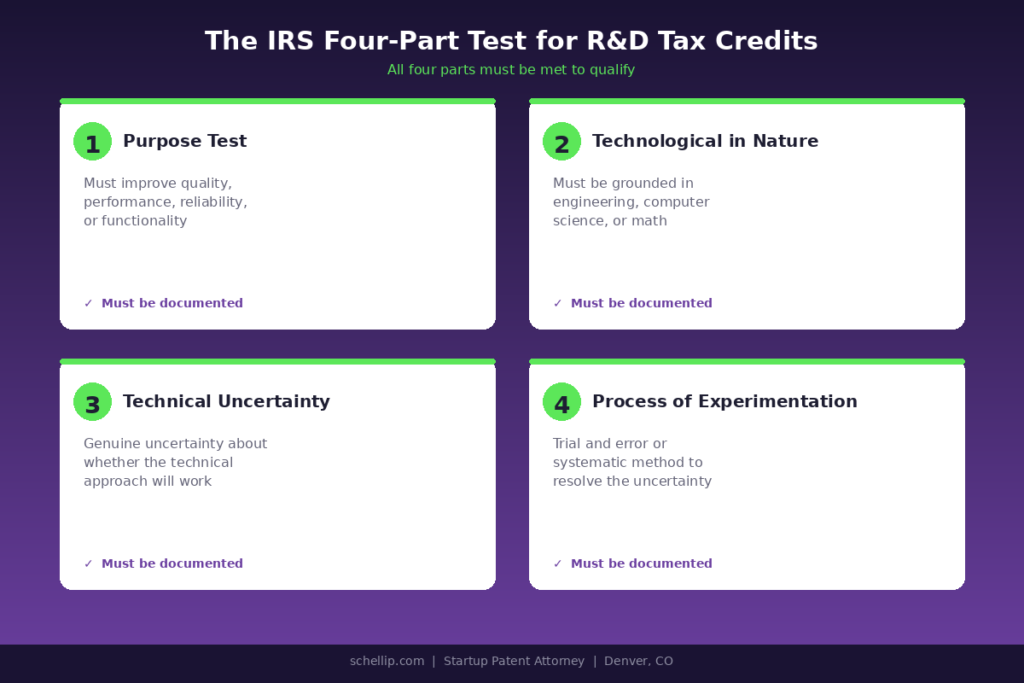
1. Purpose Test. The activity must aim to improve quality, performance, reliability, or functionality. Market research and cosmetic changes do not qualify.
2. Technological in Nature. The work must be grounded in engineering, computer science, math, or a similar hard science.
3. Technical Uncertainty. There must be genuine uncertainty about whether the approach will work. Routine or predictable work does not count.
4. Process of Experimentation. The team must use trial and error or a systematic method to resolve the uncertainty. Documentation is critical here.
Examples of Qualifying R&D Activities
Activities that typically qualify include:
- Initial conceptualization and architecture design
- Software development and iteration
- Prototyping and testing, including alpha and beta testing
- Engineering problem-solving and experimentation
- Building new features or functionality
- Developing novel algorithms, data pipelines, or system architectures
Activities that do not qualify include:
- Routine maintenance or bug fixes
- Visual or cosmetic changes (such as changing button colors)
- Market research or competitive analysis
- Routine quality assurance without technical experimentation
Benefits of Hiring a Startup Patent Attorney for R&D Tax Credits
This is where the benefits of hiring a patent attorney extend well beyond IP protection.
When a startup patent attorney drafts a patent application, they create a detailed record of the technical problem you solved, the process you used to solve it, and what makes your solution new. That documentation maps directly onto the IRS four-part test.
A startup patent attorney helps with R&D tax credits by:
- Creating detailed technical documentation that satisfies IRS requirements
- Establishing evidence of technical uncertainty and experimentation
- Triggering the patent safe harbor provision (explained below)
- Building a paper trail that holds up under IRS audit
The Patent Safe Harbor and Your Startup Patent Attorney
There is a safe harbor provision in the tax code related to patents. If you have a patent or patent application, it can satisfy the “technological in nature” requirement of the four-part test. It does not automatically qualify all your activities, but it removes one significant hurdle and strengthens your overall claim.
Patent applications are considered a gold standard of documentation by IRS auditors. They demonstrate that your company was engaged in genuine technical innovation, not routine engineering. This is one of the most overlooked benefits of hiring a patent attorney early in the development process.
How Pre-Revenue Startups Can Use R&D Tax Credits with a Startup Patent Attorney
Many founders assume tax credits only matter once a company is profitable. That is not true. A startup patent attorney and a good CPA can help you capture value from day one.
Payroll Tax Offset for Startups
Pre-revenue startups can apply R&D tax credits against payroll taxes. If you have W-2 employees such as engineers or developers, you are already paying payroll taxes. The credit can offset up to $500,000 per year in those taxes.
Carrying Credits Forward
Unused credits carry forward for up to 20 years at the federal level. Some states allow indefinite carry forward. Credits compound over time. When a company becomes profitable or gets acquired, those accumulated credits become part of the valuation.
Here is what that looks like in practice:
- Year 1: $100,000 in credits generated, applied to payroll taxes
- Year 2: $120,000 in credits generated, partially applied, remainder carried forward
- Year 3: Accumulated credits from prior years applied against tax liability
For a startup spending $1 million per year on qualifying R&D, the credit could translate to $60,000 to $140,000 annually. That is enough to hire another engineer or fund a significant growth initiative.
Why Investors Care About Startup Patent Attorneys and R&D Tax Credits
Investors evaluating startups look at capital efficiency. Companies that claim R&D tax credits and file strategic patents demonstrate they understand how to reduce costs, plan ahead, and build assets that increase company value.
From an investor perspective, R&D tax credits signal:
- The company uses capital efficiently
- Leadership plans proactively for tax obligations
- The company is building tax attributes that increase acquisition value
- R&D activities are documented and defensible
Combined with a strong patent portfolio, R&D tax credits signal a company that takes both legal and financial strategy seriously. This is why working with a startup patent attorney early matters to investors as much as it matters to founders.
How Recent Tax Law Changes Affect R&D Credits for Startups
Recent legislation changed how R&D expenses are deducted. Previously, domestic R&D costs were fully deductible in the year incurred. The rules shifted to require amortization over five years for domestic R&D and 15 years for offshore R&D.
As of the 2025 tax year, full deductibility for domestic R&D has been restored. This means:
- Companies hiring U.S.-based engineers and developers can deduct those costs immediately
- Offshore R&D expenses still must be amortized over 15 years
- Keeping your development team domestic provides both the full deduction and the R&D tax credit
How Startups Should Claim the R&D Tax Credit
Claiming the credit requires filing IRS Form 6765 with your annual tax return. The process works best when you plan for it from the start, ideally at the same time you engage a startup patent attorney.
Steps to claim the R&D tax credit:
- Identify qualifying activities as early as possible
- Start documenting the moment your team begins R&D work
- Maintain contemporaneous records of technical challenges and how they were resolved
- Work with a CPA or tax advisor who specializes in R&D tax credits
- File the credit annually to build a consistent system
- File patent applications to create supporting documentation
If you missed prior years, you can amend returns. But the IRS scrutinizes retroactive claims more closely, and going back is always harder than claiming in real time.
Why Documentation from a Startup Patent Attorney Is Critical
The IRS puts the burden of proof on the taxpayer. Your startup patent attorney creates exactly the kind of evidence that holds up under scrutiny.
Strong documentation for R&D tax credit claims includes:
- Project descriptions and technical goals
- Records of technical challenges and how they were resolved
- Time tracking for R&D employees and contractors
- Patent applications and related filings
- Engineering notebooks, design documents, and test results
The patent application process generates detailed technical descriptions, drawings, and claims that map directly to R&D tax credit requirements. Your patent filings protect your IP and support your tax credit claim at the same time.
How Schell IP Works as a Startup Patent Attorney
At Schell IP, patent attorney Jeff Schell works with startups and founders to build patent applications that protect business value and support broader company goals. That includes creating documentation that strengthens R&D tax credit claims.
Filing a provisional patent early in your development process does more than establish a filing date. It creates a record of technical innovation that serves as evidence for both patent protection and tax credit eligibility.
At Schell IP, patent attorney costs for startups typically include:
- Provisional patent applications: $3,000 to $6,000 all-in
- Non-provisional utility patent applications: $5,000 to $8,000 or more depending on complexity
- Fixed fee and capped fee cost structures to support startup budgets
If you are building something new, solving technical problems, or preparing to raise capital, the time to talk to a startup patent attorney and a tax advisor is now. The earlier you start, the more value you capture on both fronts.
Frequently Asked Questions
What is the R&D tax credit?
The R&D tax credit is a federal incentive that provides a dollar-for-dollar reduction in tax liability for companies performing qualifying research and development in the United States.
Can pre-revenue startups use R&D tax credits?
Yes. Pre-revenue startups can apply R&D tax credits against payroll taxes (up to $500,000 per year) or carry unused credits forward for up to 20 years.
How does a startup patent attorney help with R&D tax credits?
A startup patent attorney creates detailed technical documentation during the patent application process. That documentation maps directly to the IRS four-part test and strengthens R&D tax credit claims. Patents also qualify for a safe harbor that satisfies the “technological in nature” requirement.
How much can a startup save with R&D tax credits?
Most companies see a return of 6 to 14 percent on qualifying R&D expenses. A startup spending $1 million per year on R&D could receive $60,000 to $140,000 in credits annually.
When should a startup hire a startup patent attorney?
As early as possible. Ideally before public disclosure, fundraising, or product launch. Early filing protects your patent rights and begins building documentation for R&D tax credit claims.
Do state R&D tax credits exist?
Yes. Many states offer R&D tax credits in addition to the federal credit. Some states allow indefinite carry forward. Your CPA can identify which state credits apply to your company.
What is the patent safe harbor for R&D tax credits?
The patent safe harbor is a provision in the tax code that allows a patent or patent application to satisfy the “technological in nature” part of the IRS four-part test. It does not qualify all activities automatically, but it strengthens your overall R&D tax credit claim.

Talk to a Startup Patent Attorney About Your R&D Strategy
Patent strategy and tax strategy are more connected than most founders realize. The work your startup patent attorney does to protect your invention can also reduce your tax burden and extend your runway.
Book a free consultation with startup patent attorney Jeff Schell at Schell IP to discuss how patent filings can support both your IP protection and your R&D tax credit strategy.