Last Updated: 7/3/26
Quick Answer: A patent attorney secures and defends patents for your inventions and ideas. They draft and file patent applications, conduct patent searches, respond to USPTO office actions, manage patent portfolios, and advise on patent strategy, including licensing, litigation, and how your IP supports a fundraise or exit. Unlike a patent agent, a patent attorney is a licensed lawyer, so they can advise on the legal and business questions around your patent, not just the filing.
A patent attorney helps you turn an invention or idea into a legally protected asset. That means writing and filing your patent application, searching to confirm your idea is actually new, working with the USPTO when an examiner pushes back, and advising on how to use the patent once you have it. A patent attorney with extensive business experience won’t only advise on your patent application; they’ll craft your application to support business growth, attract investors, or prepare for an exit.
What Does a Patent Attorney Do Day to Day?
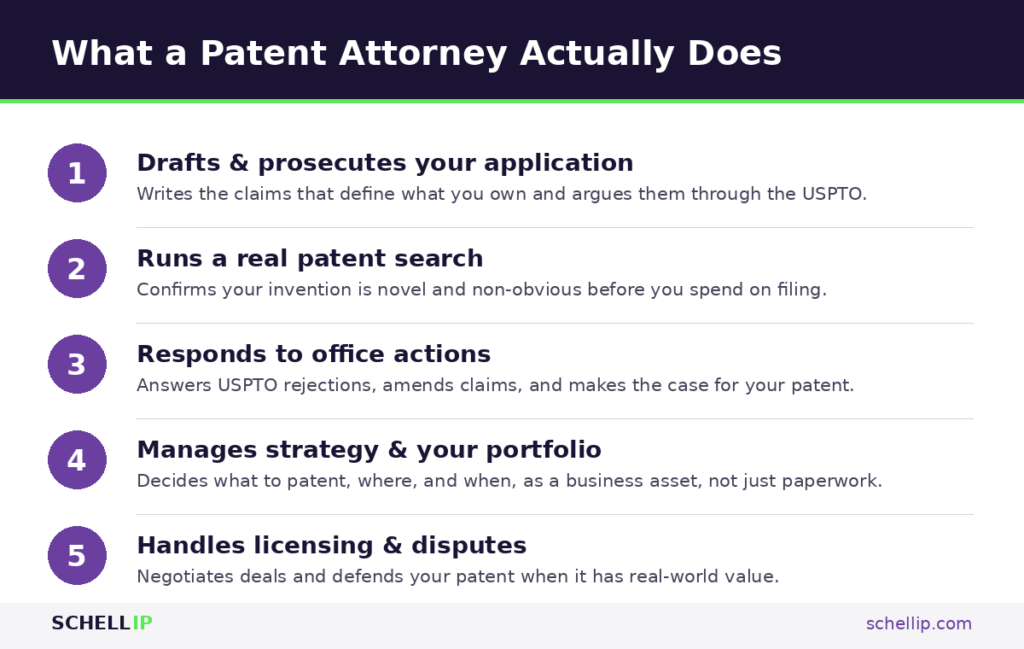
While a patent attorney’s role can vary widely day-to-day, most of the work falls into five buckets:
- Drafts and files your application. Your patent attorney will spend time learning the technical details of your invention, including how it works, what it’s for, and any other potential benefits to users. At Schell IP, we also like to think about alternative uses or future states of the invention to draft as comprehensive of an application as possible. Using all this information, your patent attorney will draft the claims that define exactly what you own and what is protected under the patent. Your attorney should be extremely thoughtful and thorough in drafting your claims – too narrow and it’s easy for a competitor to design around them, too broad and a USPTO examiner may reject them.
- Runs a real patent search. Before filing, an experienced patent attorney searches existing patents and technical literature to confirm your invention is novel and non-obvious. This checks that there are not existing patents that cover your claims and that your invention or idea isn’t an obvious update to something that already exists. This search shapes how the application is written and anticipates the rejections an examiner is likely to raise.
- Responds to office actions. Most applications will receive an office action from the examiner at least once during the patent approval process. Your attorney will answer it, amend the claims, and argue the case for patentability. Experienced attorneys answer office actions promptly, yet thoroughly to help you achieve the best outcome.
- Manages patent strategy and your portfolio. Which inventions to patent, in which countries, and when, are business decisions as much as legal ones. Attorneys track maintenance deadlines, monitor the market for infringement, and at firms like Schell IP, advise on patents as a business asset. If you are trying to build a business around your patent, you should have an attorney who can advise on leveraging IP as part of your business strategy rather than a nice-to-have.
- Handles licensing and disputes. From negotiating a patent licensing deal to defending you in an infringement fight, a patent attorney continues to manage your legal protection once the patent is granted.
How to Become a Patent Attorney (and Why It Matters to You)
Not every lawyer can practice patent law. Patent attorneys require a college degree in science or engineering to ensure they have the technical background and understanding to best represent and interpret their clients inventions.
After that comes law school, a state bar exam, and a separate USPTO registration exam known as the patent bar. Patent law is a highly specialized field; most lawyers never qualify to sit for the patent bar.
When you hire a patent attorney, you should feel confident you’re hiring someone with a technical background who can best represent your invention. Your patent application is only as strong as the attorney who drafts it, and you want the best protection for your invention.
Patent Attorney vs. Patent Agent: Which Do You Need?
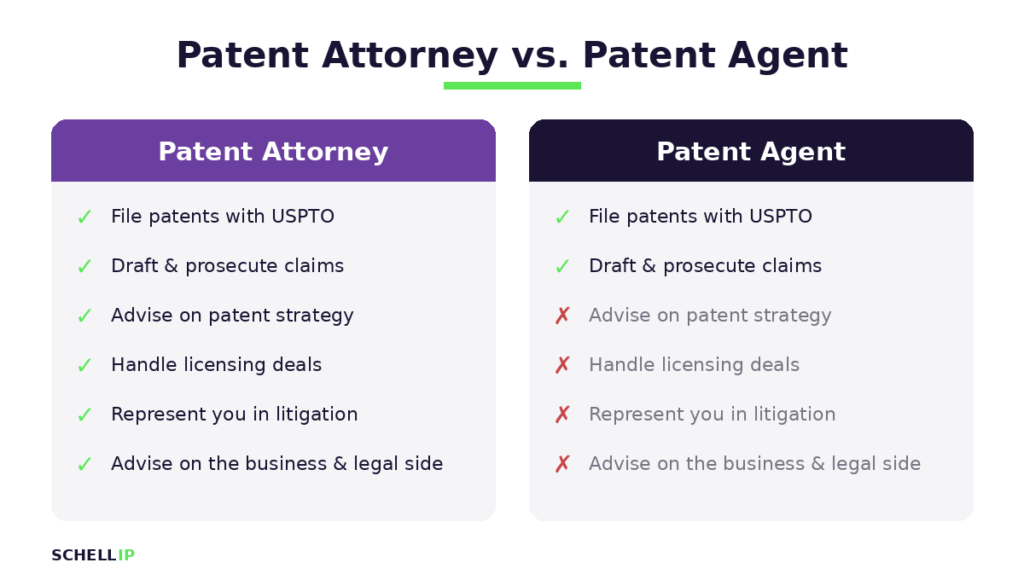
Both a patent attorney and patent agent can file patents with the USPTO. The difference between a patent attorney vs. patent agent lies in their licensing:
- A patent agent is registered to handle the patent application process, including drafting the application, communicating with examiners, and amending application based on office actions. While they must pass a rigorous exam and hold degrees in science or engineering, they are not lawyers and cannot litigate patents or provide any legal advice.
- A patent attorney is a licensed lawyer. On top of everything a patent agent can do, they can also advise on IP strategy, licensing, litigation, and the business questions that surface when your IP starts to matter to investors or acquirers.
You may be wondering if a patent agent is enough for your invention and needs. However, for a startup, entrepreneur, or any business, the attorney is usually the better option for leveraging IP as part of your business strategy.
Jeff’s Take
I’ve worked with plenty of startups – including my own – looking to leverage their IP as part of their business strategy. As they’re assessing different patent attorneys to work with, it can be difficult to find someone who deeply understands their business needs.
While yes, a patent attorney should be able to write a solid, technical patent application, an experienced patent attorney should think beyond the immediate application implications. They should consider how the claims could or could not support the company’s long term growth or which acquirers would be most interested in your technology.
Plus, so much of a patent attorney’s job happens after the patent application has been filed:
- An investor asks about your freedom to operate during diligence
- A competitor sends a cease and desist
- An acquirer wants to know whether your claims actually cover the product before they’ll close
- A licensing partner wants terms negotiated
As a patent attorney, and someone who has sat on the founder side of a few of these deals, those are exactly the conversations where the right call is worth far more than the filing fee. These are legal and business questions, and you need a trusted, experienced attorney on your side to answer them.
Litigation and Infringement
When a dispute arises, patent attorneys will handle all the communication on your behalf, as well as represent you in court, either defending your patent or challenging a patent asserted against you.
It’s important to note that a patent holder is responsible for enforcing their patent. If you discover someone infringing on your patent, your attorney should discuss the pros and cons of litigating and help you come up with the best plan of action. Your patent attorney remains part of your team; you don’t have to navigate litigation or infringement alone.
How to Choose the Right Patent Attorney
Look for an attorney who has real experience in your specific technology. An attorney who understands your field will be able to draft better claims.
You should also ask about their track record getting patents granted, not just filed. The team at Schell IP has secured hundreds of patents for clients across software, medical devices, and biotechnology.
You should also consider the attorney’s communication style. There can be a lot of back and forth while your attorney drafts claims and during the examiner review process. You want someone who can understand and articulate the technical aspects of your patent, but explain the legal process and jargon in terms you’ll understand.
For startups, the right attorney is a strategic asset. Strong, well-drafted IP signals defensibility to investors and can keep competitors out during your most vulnerable early stage.
What to Expect During Your First Meeting with Schell IP
Your very first conversation with a patent attorney is already confidential. At Schell IP, we treat the initial call as a prospective attorney-client conversation, which means the duty of confidentiality applies before you’ve signed on as a client.
The first call should stay high-level – your attorney only needs enough information to understand your project and determine if they have any potential conflicts in representation. They don’t need to know every technical detail of your invention just yet.
The call itself will also cover the patent process: how you get a patent, if you already have one, how to enforce it, or broker a sale or transaction around it.
Lastly, your attorney will be honest about whether or not they’re the right fit for your project. But, if they believe they can support you, the next step is a final conflict check and an engagement letter that spells out the terms and limits of the work.
The bottom line
A patent attorney’s value isn’t simply filing an application. It’s the judgment and strategy around it: whether to file, how to draw the boundary, how hard to fight a rejection, and how to turn a granted patent into leverage for your business. This expertise can be critical to the success of your invention and your business.
If you want advice on how to best protect your IP, book a free consultation.

Frequently Asked Questions
What does a patent attorney do?
A patent attorney secures and defends patents for inventions. The work includes drafting and filing patent applications, running patent searches, responding to USPTO office actions, managing patent portfolios, advising on patent strategy, and handling licensing or litigation when needed. In short, they protect the legal boundary around your idea.
Is my first conversation with a patent attorney confidential?
Yes. A reputable patent attorney treats the initial consultation as a prospective attorney-client conversation, so confidentiality applies before you sign an engagement letter or pay anything. It’s still smart to keep that first call high-level so the attorney can run a conflict check.
What’s the difference between a patent attorney and a patent agent?
Both can file patents with the USPTO, but a patent agent is limited to prosecution (drafting and filing). A patent attorney is a licensed lawyer who can also advise on strategy, licensing, litigation, and business decisions. For most startups, a patent attorney is the stronger choice.
Do I need a patent attorney, or can I file myself?
You can legally file on your own, but the claims are where most DIY applications fail, because they define the exact scope of your protection. An experienced attorney drafts claims that are broad enough to be valuable and narrow enough to survive examination and enforcement.
How much does a patent attorney cost?
Costs vary with the type of patent and the complexity of the invention. Our complete 2026 patent cost guide breaks down USPTO fees, attorney fees, and what to actually budget.