
Quick Answer:
Patent licensing lets you earn money from your approved patent by granting others the right to use your invention. You keep ownership. They pay royalties. The two main types are exclusive licenses (one licensee, higher fees) and non-exclusive licenses (multiple licensees, broader reach). A patent licensing attorney helps you negotiate terms, set royalty rates, and draft enforceable agreements that protect your rights.
Getting a patent approved (or in patent parlance, allowed then issued) is a major milestone. But approval alone does not generate revenue.
A patent is a legal right. It gives you the power to stop others from making, using, or selling your invention. That power has real financial value, but only if you use it.
Patent licensing is a common way to turn that value into income. It allows other companies to use your patented technology in exchange for payment. You keep ownership. They get access. Both sides benefit.
This guide explains how patent licensing works, what types of licenses exist, how to value your patent, and how to structure deals that protect your interests.
What Is Patent Licensing?
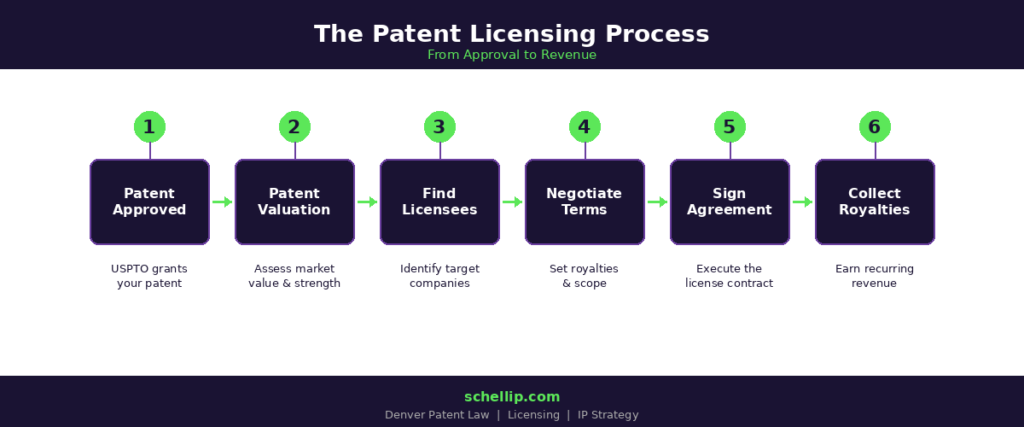
Patent licensing involves a legal agreement between a patent holder and another party. The patent holder grants permission to use the patented invention. In return, the licensee pays a fee, typically in the form of royalties.
The patent holder keeps full ownership. The license simply grants specific rights for a defined period, territory, or use case.
Licensing is different from selling a patent outright. When you license, you maintain control over how your intellectual property is used. When you sell (assign), you transfer ownership permanently.
For most inventors, startups, and technology companies, licensing is the better path. It creates recurring revenue without giving up the asset.
Why Patent Licensing Matters for Inventors and Startups
Many inventors focus on getting the patent approved and stop there. That is a missed opportunity.
A granted patent can do more than sit in a file. It can generate licensing income from companies that want access to your technology. It can increase your company valuation during fundraising or acquisition. It can create leverage in partnership negotiations. And it can block competitors from entering your market space.
For startups especially, patents are business assets that support growth. Licensing turns that asset into cash flow.
Types of Patent Licenses: Exclusive vs. Non-Exclusive
There are two main types of patent licenses. Each serves a different business goal.
Exclusive License
An exclusive license grants rights to one licensee only. Even the patent holder may be restricted from using the invention, depending on the agreement terms.
Exclusive licenses typically command higher fees because the licensee gets sole access. This works well when one company has the resources and market position to fully commercialize the technology.
Non-Exclusive License
A non-exclusive license allows the patent holder to grant rights to multiple licensees. This is common in industries where the technology has broad applications across different markets or regions.
Non-exclusive licenses generate less per deal but can produce more total revenue when multiple companies are willing to pay for access.
Choosing the Right Type
The right choice depends on your goals. If you want maximum control and a single high-value partner, an exclusive license makes sense. If you want broad market reach and diversified income, non-exclusive licensing is usually the better path.
How to Value Your Patent for Licensing
Before you negotiate a licensing deal, you need to know what your patent is worth. Overpricing drives licensees away. Underpricing leaves money on the table.
Patent valuation is not an exact science, but several factors drive the number.
- Market demand: Is there strong commercial interest in the technology your patent covers?
- Remaining patent life: A patent with 15 years left is worth more than one with 3 years remaining
- Competitive landscape: Are there alternatives, or does your patent cover the only viable solution?
- Revenue potential: How much revenue can a licensee generate using the patented technology?
- Enforcement strength: Are your patent claims broad and defensible, or narrow and easy to work around?
The strength of your original patent claims directly affects licensing value. Patents drafted with enforcement in mind are worth significantly more than patents written only to get approved.
Setting Royalty Rates and Payment Structures
Royalty rates are the core financial term in most licensing agreements. They determine how much the licensee pays for access to your patent.
Common payment structures include percentage royalties, where the licensee pays a percentage of revenue generated using the patented technology (typical rates range from 2% to 10% depending on the industry); fixed per-unit fees, where the licensee pays a set amount per product sold; upfront lump-sum payments, where a one-time fee is paid for the license, common in exclusive deals; and milestone payments, where payments are triggered when specific revenue or development goals are reached.
Most licensing deals use a combination. For example, an upfront payment plus ongoing royalties is a common structure that balances risk for both parties.
Preparing Your Patent for Licensing
A strong licensing position starts before you approach potential licensees.
First, confirm your patent is enforceable. Review your claims with a patent attorney to make sure they are clear, defensible, and cover the technology that matters to potential licensees.
Second, gather market data. Understand who is using technology similar to yours, which industries would benefit from access, and what competitors are doing in the space.
Third, make sure your patent maintenance fees are current. A lapsed patent has no licensing value. Understand the maintenance fee schedule and keep your patent active.
Fourth, build a clear value proposition. Licensees want to know what they gain. Frame your patent in terms of market advantage, cost savings, or technical capability.
Identifying and Approaching Potential Licensees
The best licensees are companies already operating in markets where your patent applies. They have the infrastructure to commercialize the technology and a financial incentive to license rather than develop alternatives.
Start by identifying companies that sell products or services related to your patent. Look at competitors, adjacent industries, and companies that have publicly discussed the problem your patent solves.
Trade shows, industry conferences, and patent databases can help identify targets. Some patent holders also work with licensing firms or brokers who specialize in connecting patent owners with licensees.
When you approach a potential licensee, lead with the business value. Explain what the technology does, how it improves their product or process, and why licensing is more efficient than building an alternative.
Drafting and Negotiating Licensing Agreements
A patent licensing agreement is a legal contract. It must be precise, enforceable, and clear about what each party can and cannot do.
Key terms to define in every licensing agreement include the scope of the license (what the licensee can do with the technology), the territory (where the license applies), the duration (how long the license lasts), financial terms (royalties, upfront payments, milestones), exclusivity (whether the license is exclusive or non-exclusive), sublicensing rights (whether the licensee can grant access to others), and termination conditions (what triggers the end of the agreement).
A patent licensing attorney is essential at this stage. Poorly drafted agreements create disputes, leave value on the table, or fail to protect the patent holder’s rights.
The Role of a Patent Licensing Attorney
Patent licensing involves legal, financial, and strategic complexity. A patent licensing attorney brings expertise in all three areas.
They help you assess your patent’s licensing potential, identify the right deal structure, draft enforceable agreements, negotiate terms that protect your interests, and resolve disputes if a licensee violates the agreement.
At Schell IP, Denver patent attorney Jeff Schell works with inventors and companies to structure licensing deals that maximize patent value and protect long-term interests.
Enforcing Your Licensing Agreement
A licensing agreement is only valuable if it is enforced. After signing, monitor the licensee’s compliance with the terms.
This includes verifying that royalty payments are accurate, confirming the licensee is operating within the agreed scope and territory, and watching for unauthorized sublicensing or use outside the agreement.
If a licensee violates the agreement, you have legal options. These may include arbitration, mediation, or patent infringement litigation. The right approach depends on the severity of the violation and the terms of your agreement.
Regular audits and clear communication help prevent disputes before they escalate.
International Patent Licensing
If your patent has international protection, licensing opportunities extend beyond U.S. borders.
Each country has different intellectual property laws. Licensing internationally requires understanding local enforcement rules, tax implications, and regulatory requirements. The Patent Cooperation Treaty (PCT) can help streamline international protection, but licensing terms must still comply with local law.
International licensing can significantly increase your patent’s revenue potential, but it adds complexity. Working with an attorney experienced in global patent strategy is important.
Other Ways to Monetize a Patent
Licensing is the most common monetization path, but it is not the only option.
Patent sale (assignment): You can sell your patent outright. This provides a lump sum but eliminates future royalties and control.
Patent pooling: Multiple patent holders contribute patents to a shared pool. Licensees pay a single fee for access to the entire pool. This is common in standards-based industries.
Enforcement and litigation: If competitors are using your patented technology without permission, you can pursue legal action to recover damages.
Strategic IP planning helps you decide which path fits your business goals.
Common Mistakes in Patent Licensing
Many patent holders make avoidable errors when licensing their patents.
- Licensing too early without understanding the patent’s full value
- Granting overly broad rights that limit future opportunities
- Failing to include audit rights in the agreement
- Not addressing sublicensing, territory, or termination clearly
- Skipping legal review and using generic templates
These mistakes are similar to the errors inventors make during the patent filing process. Working with a patent attorney at every stage helps avoid them.
Frequently Asked Questions
What is patent licensing?
Patent licensing is a legal agreement where the patent holder grants another party the right to use, make, or sell the patented invention in exchange for payment, usually royalties.
How much can I earn from patent licensing?
Revenue depends on the patent’s market value, the industry, and the deal structure. Royalty rates typically range from 2% to 10% of revenue. Some exclusive licenses include upfront payments of six figures or more.
Do I need a lawyer for patent licensing?
Yes. Patent licensing agreements are legal contracts with significant financial implications. A patent licensing attorney ensures the terms protect your rights and reflect the patent’s true value.
What is the difference between licensing and selling a patent?
Licensing grants permission to use the patent while you retain ownership. Selling (assigning) transfers ownership permanently. Licensing preserves your long-term revenue potential.
Can I license a provisional patent?
Technically, you can enter into licensing discussions while your patent is pending. However, a provisional patent does not grant enforceable rights on its own. Most serious licensees will want to see a granted patent or at least a filed non-provisional application before committing to a deal.
How long does a patent licensing deal take?
Simple non-exclusive licenses can be negotiated in weeks. Complex exclusive deals with large companies can take several months, especially if due diligence and valuation are involved.
Turn Your Patent Into Revenue
A granted patent is a powerful asset. But it only generates value if you have a strategy to use it.
At Schell IP, we help inventors and companies structure patent licensing deals that protect their rights and maximize financial return. Whether you are licensing for the first time or building a portfolio strategy, we provide clear guidance at every step.
Book a free consultation with Schell IP today to discuss your patent licensing options.