
Quick answer:
Silicon Valley patent strategy treats patents as financial and strategic assets, not just legal documents. Founders who use patents this way raise more money, negotiate better exits, and protect their companies more effectively than those who treat patents as paperwork.
If you’re building a startup (especially in software, AI, or technology) how you think about patents can determine whether investors see your company as defensible or disposable. In Silicon Valley, patents are not optional or reactive. They are built into the company’s growth and funding strategy from day one.
This article explains what Silicon Valley gets right about patents, how most founders misunderstand them, and how you can apply this mindset no matter where your company is based.
Why Silicon Valley Treats Patents as Business Assets
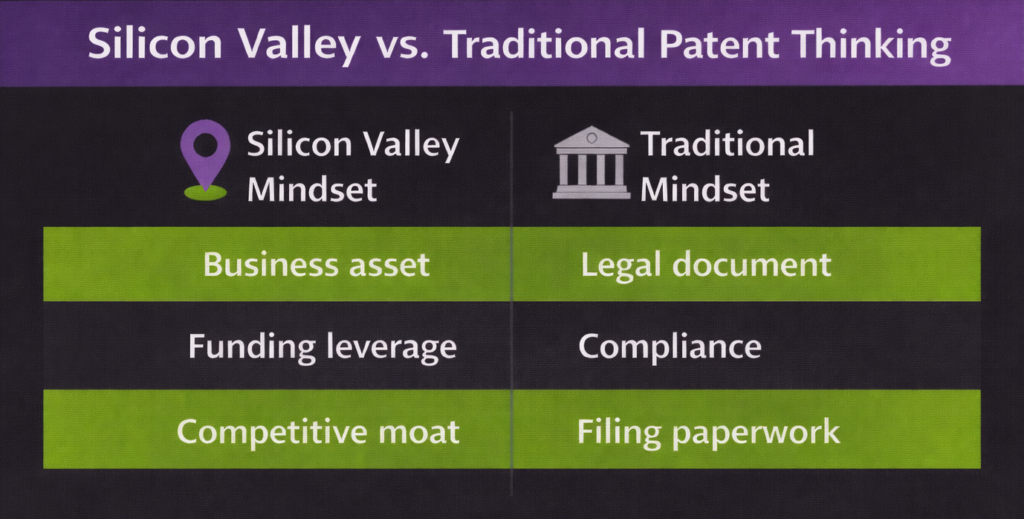
In most parts of the country, patents are viewed as legal protection. In Silicon Valley, they are viewed as financial leverage.
Investors don’t just ask whether a company has patents. They ask whether the company owns something competitors cannot copy. That distinction matters. A well-written patent does more than stop infringement – it supports valuation, protects market position, and gives leverage during acquisition or licensing negotiations.
This is why venture capital firms routinely push founders to file patents before or during early funding rounds. To them, intellectual property is part of the company’s balance sheet, even if it never shows up on a spreadsheet.
What Most Founders Get Wrong About Patents
Many founders think patents are:
- Too expensive
- Too slow
- Only for big companies
- Only useful if you plan to sue someone
That mindset leads to weak or delayed filings that do little to protect the business. By the time competitors appear or investors ask hard questions, it is often too late to fix those mistakes.
Silicon Valley startups take the opposite approach. They file early, file strategically, and file in a way that supports future growth rather than just compliance with the USPTO (United States Patent and Trademark Office).
How Venture Capital Firms Look at Patents
Investors do not read patents like lawyers. They read them like risk managers.
A venture capitalist wants to know:
- Can someone easily copy this?
- Can a larger company crush this startup with their own product?
- Does this company control something unique?
Strong patents answer all three questions. Weak patents answer none of them.
That is why patents written purely for approval, rather than for enforcement or strategic coverage, rarely impress investors. Silicon Valley companies build patents that describe systems, architectures, and technical advantages that competitors cannot simply work around.
Why Software and AI Patents Matter More in 2026
After years of uncertainty, courts and the USPTO are once again protecting real technical innovation in software and AI. This means companies that invest in strong patent strategy now are gaining a real advantage.
Software and AI companies that skip patent protection leave value on the table. In acquisitions, intellectual property often determines whether a company is bought for its technology or just its user base.
Firms like Schell IP work with founders to ensure patents are written not only to be approved, but to be valuable in funding, licensing, and acquisition scenarios.
How Smart Startups Use Patents as Leverage
In Silicon Valley, patents are used to:
- Increase company valuation
- Protect against copycat competitors
- Strengthen negotiating power in partnerships
- Improve acquisition outcomes
A startup with strong patents is harder to undercut. It also commands more respect in due diligence, even if it never plans to file a lawsuit.
This is why patent strategy should align with business strategy, not just legal formalities.
The Patent Process, Strategically

A strong patent strategy follows a clear path:
Idea Evaluation → Patent Search → Application Drafting → USPTO Submission → Office Actions & Review
More important than the steps, however, is how they’re handled. In Silicon Valley, patents are drafted with enforcement, investment, and competitive positioning in mind, not just technical compliance.
Why Location Doesn’t Matter, But Strategy Does
You do not need to be in Silicon Valley to use this approach. What matters is working with a patent attorney who understands how investors, acquirers, and competitors think.
At Schell IP, Denver patent attorney Jeff Schell helps founders and technology companies apply Silicon Valley–level patent strategy regardless of where they are based. That means writing patents that protect real business value, not just legal theory.
What This Means for Colorado and Denver Startups
Colorado’s startup ecosystem is growing fast, especially in software, biotech, and advanced technology. But many founders still use outdated patent strategies that do not reflect how companies are evaluated by investors.
A Denver patent attorney who understands venture-backed companies and technology markets can help ensure your intellectual property supports funding, growth, and exits, not just compliance.
Frequently Asked Questions
Why does Silicon Valley care so much about patents?
Because patents protect market position, support company valuation, and give leverage during fundraising and acquisition negotiations.
Do software and AI companies really need patents?
Yes. In 2026, courts and the USPTO are protecting real technical implementations, making strong software and AI patents a powerful business asset.
Is patent law different in Silicon Valley?
The law is the same, but the strategy is different. Silicon Valley treats patents as financial and competitive tools, not just legal filings.
When should a startup talk to a patent attorney?
As early as possible, ideally before public disclosure, fundraising, or product launch.
Final Thoughts
Silicon Valley looks at patents differently because it understands their true purpose: protecting business value, not just inventions. Startups that adopt this mindset gain stronger negotiating power, higher valuations, and better long-term outcomes.
Whether you are in Denver, Colorado, or anywhere else, working with a patent attorney who understands this approach can make a measurable difference in how your company grows and competes.