
Quick Answer
A provisional patent application is a temporary filing with the USPTO that establishes an early filing date and grants patent pending status for 12 months. It costs $3,000–$6,000 and does not get examined on its own. You must file a non-provisional patent application within 12 months to keep your priority date and pursue full patent protection.
Filing a patent can feel overwhelming. A provisional patent application gives inventors a faster, lower-cost way to start protecting an idea while the full application comes together. It is one of the most useful tools in an inventor’s or startup’s IP strategy.
At Schell IP, we work with founders and inventors every day who ask whether a provisional makes sense for them. The answer depends on where they are in development, whether they are pitching investors, and how much time they need before committing to a full filing. This guide covers the process, the costs, and the strategy behind provisional patents in 2026.
What Is a Provisional Patent Application?
A provisional patent application is a legal filing with the United States Patent and Trademark Office (USPTO) that secures an early filing date for your invention. It is not a full patent and it does not get examined by a patent examiner. Think of it as a placeholder that establishes your spot in line.
Once filed, you can legally label your invention as “patent pending.” You then have 12 months to develop your invention, test the market, and file a full non-provisional patent application that builds on your provisional filing date.
Key characteristics of a provisional patent application:
- Establishes a USPTO filing date and patent pending status immediately
- Does not require formal patent claims or an oath/declaration
- Expires automatically after 12 months if not converted
- Is never published or examined on its own
- Costs significantly less than a non-provisional application
Provisional vs. Non-Provisional Patent Application
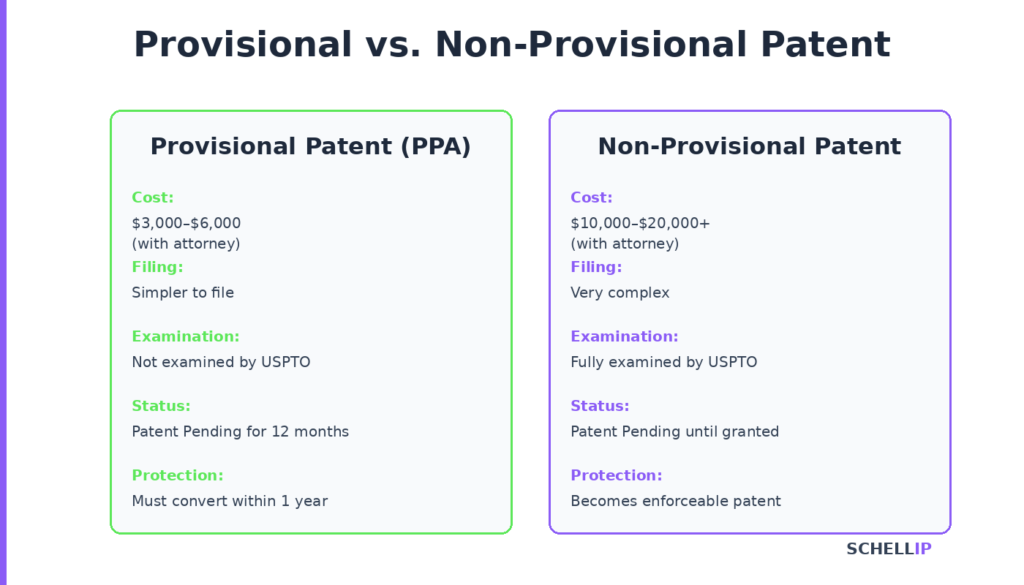
Understanding the difference between a provisional patent application and a non-provisional patent application is essential before you file.
Provisional patent application:
- Less formal, no patent claims required
- Not examined by the USPTO
- Valid for 12 months only
- Average cost: $3,000–$6,000
- Grants patent pending status immediately
Non-provisional patent application:
- Formally examined by the USPTO
- Requires detailed claims defining what you legally own
- Can result in a granted patent
- Average cost: $10,000–$20,000+ through issue, depending on complexity
- Takes approximately 1–3 years to prosecute
The two-step approach works well for most inventors. File a provisional first to lock in your priority date, then use the 12-month window to refine your invention, raise funding, or test the market before committing to the full filing cost.
Key Benefits of Filing a Provisional Patent Application
The provisional patent application is one of the most strategically useful tools in the patent process. Here is why inventors and startups use it.
1. Establishes Your Priority Date
Patent law in the U.S. operates on a first-to-file basis. The day you file your provisional patent application becomes your priority date. That date determines who has rights if two inventors file for similar inventions. Filing even a few days before a competitor can matter.
2. Grants Patent Pending Status
“Patent pending” is more than a label. It signals to competitors, investors, and partners that your invention is protected. It can deter copying and boost credibility before your full patent is granted.
3. Lower Upfront Cost
A provisional patent application costs $3,000–$6,000 on average, compared to $10,000–$20,000+ from initial filing through issue for a full utility patent. For startups managing tight budgets, this staged approach protects your invention without a large immediate commitment. For a full breakdown, see how much a patent costs in 2026.
4. Buys Time to Develop and Test
The 12-month window lets you refine your invention, run market tests, and secure funding before committing to a full non-provisional filing. Many founders Schell IP works with file provisional patents before investor pitches to show IP protection is already underway.
5. Simpler Paperwork
Unlike a non-provisional application, a provisional patent application does not require formal patent claims. You need a clear description of your invention and any drawings that help explain it. This makes the process faster to prepare.
Limitations and Risks of Provisional Patent Applications
A provisional patent application is a valuable tool, but it has real limitations. Ignoring them can cost you your patent rights.
The 12-month deadline is absolute. The USPTO does not allow extensions. If you miss the window to convert to a non-provisional application, your provisional filing expires and you lose your priority date entirely. Competitors who file after you could end up ahead in the queue.
Other risks include:
- Thin descriptions: A provisional that lacks technical detail may not support the full non-provisional application, which can weaken or invalidate your claims later
- No examination: Filing a provisional patent application does not guarantee a patent. It only reserves your date
- No international protection: A U.S. provisional does not protect your invention outside the country on its own. International filings through the Patent Cooperation Treaty (PCT) must be handled separately
- False sense of security: Inventors sometimes delay the non-provisional too long and miss the conversion deadline entirely
Working with a patent attorney from the start helps ensure your provisional is drafted with enough detail to support a strong non-provisional application down the line. At Schell IP, that review is part of how we approach every provisional filing.
How to File a Provisional Patent Application in 2026
The patent application process for a provisional filing follows five core steps.
Step 1: Prepare a Detailed Description of Your Invention
Your description is the foundation of your provisional patent application. It must clearly explain what your invention is, how it works, and what makes it different from existing solutions.
Cover these elements:
- The problem your invention solves
- How the invention works, step by step
- The components or materials involved
- Any variations or alternative versions of the invention
A vague description is one of the most common and costly mistakes with provisional patent applications. If your provisional does not fully describe your invention, the non-provisional application that follows may not be able to claim priority on undisclosed elements.
Step 2: Include Drawings and Visual Materials
Drawings are not required for a provisional patent application, but they are strongly recommended. Clear visuals help explain your invention and strengthen your description.
Patent drawings do not need to meet the strict USPTO formatting requirements that apply to non-provisional applications, but they should be labeled and clear. Include multiple views where relevant.
Step 3: Complete the USPTO Cover Sheet
The provisional patent application requires a USPTO cover sheet that identifies the invention and the inventor(s). Errors on this document can cause delays.
Required information:
- Title of the invention
- Name(s) of the inventor(s)
- Correspondence address and contact information
Step 4: Pay the Filing Fee
USPTO filing fees for a provisional patent application vary by entity size. Most individual inventors and early-stage startups qualify as micro or small entities.
- Micro entity: $320
- Small entity: $640
- Large entity: $1,280
These fees are separate from attorney fees and represent the government portion of your filing cost.
Step 5: Submit Your Application Online
The USPTO accepts provisional patent applications through its Patent Center electronic filing system. Upload your description, drawings, and cover sheet, then pay the fee. Save the confirmation with your official filing date.
Provisional Patent Application Cost in 2026
The total cost of a provisional patent application depends on invention complexity and whether you work with an attorney.
Average cost: $3,000–$6,000
What this includes:
- Detailed description of the invention
- Technical drawings or diagrams
- Attorney drafting and filing
- USPTO government filing fee
A provisional patent application does not get examined by the USPTO and does not become an enforceable patent on its own. It is a placeholder that protects your priority date while you refine your invention or raise funding. Jeff Schell at Schell IP helps founders file strategic provisional patents that support funding rounds and product development timelines.
Once you convert to a non-provisional, budget $10,000–$20,000+ through issue depending on complexity. Software and AI patents typically sit at the higher end of that range due to the technical depth required to survive USPTO scrutiny.
Provisional Patent Application Strategy for Inventors and Startups
A provisional patent application is most powerful when it fits into a broader IP strategy. Here is how to use it effectively.
File Before Public Disclosure
Any public disclosure of your invention before filing a provisional patent application can permanently destroy your patent rights in many countries. That includes pitching at events, publishing articles, or posting on social media. File your provisional before you disclose anything publicly.
Align Your Provisional Patent Application With Fundraising
Investors ask whether your company owns something competitors cannot copy. A provisional patent application shows IP protection is underway without the full cost of a non-provisional. Filing before a funding round signals commitment and can strengthen your position in due diligence. Schell IP regularly works with Colorado founders who need patent filings in place before seed rounds.
Use the 12 Months Strategically
The 12-month window is not just a deadline. It is time to refine your invention, conduct market tests, file additional provisionals if new features emerge, and prepare a stronger non-provisional application. Do not let the window close without a concrete plan for conversion.
Software and AI Provisional Patent Applications
Software and AI inventions require more detailed provisional descriptions. The application must show how the technology solves a technical problem in a technical way. A vague description of a software system is one of the most common reasons non-provisional applications fail to claim priority from a provisional. Jeff Schell works specifically with software and AI patent filings and understands what the USPTO needs to see.
Common Mistakes to Avoid With Provisional Patent Applications
Most provisional patent problems come from the same avoidable errors. Inventors who skip working with a patent attorney run into these most often.
- Vague descriptions: A provisional patent application that does not fully describe the invention cannot support strong non-provisional claims on that priority date
- Missing the 12-month deadline: There are no extensions. Missing the conversion window means losing your priority date entirely
- Disclosing before filing: Public disclosure before filing destroys international rights and can jeopardize U.S. rights
- Filing without attorney review: DIY provisional patent applications often lack the technical detail needed to support a non-provisional. A weak provisional can undermine your entire patent strategy
- Ignoring critical timing mistakes around the conversion deadline
Next Steps After Filing: Converting Your Provisional Patent Application
Once your provisional patent application is filed, the 12-month clock starts. Here is how to use that time well.
- Set a conversion deadline reminder for month 10 to give yourself buffer time
- Continue developing your invention and document any new features or improvements
- Conduct or update your patent search to confirm your invention is still novel
- Work with a patent attorney to draft the non-provisional application, including formal claims that define your legal rights
- Consider international filing through the Patent Cooperation Treaty (PCT) if global protection is relevant to your business
The non-provisional application will reference your provisional filing date, preserving the priority you established on day one. Schell IP helps manage this conversion process so no deadlines are missed and the non-provisional builds correctly on the provisional description.
Frequently Asked Questions About Provisional Patent Applications
What is a provisional patent application?
A provisional patent application is a temporary USPTO filing that establishes a priority date and grants patent pending status for 12 months. It is simpler and less expensive than a full patent application but does not result in a granted patent on its own.
How much does a provisional patent application cost?
A provisional patent application costs $3,000–$6,000 on average, including attorney fees and USPTO filing fees. This varies based on invention complexity.
How long does a provisional patent application last?
A provisional patent application is valid for exactly 12 months from the filing date. It cannot be extended. You must file a non-provisional patent application within that window to retain your original priority date.
Does a provisional patent application guarantee protection?
No. A provisional patent application is not examined by the USPTO and does not become a patent on its own. It only reserves your filing date. Full patent protection requires a non-provisional application that is examined and approved.
Can I file a provisional patent application myself?
You can file without an attorney, but it carries real risk. A provisional patent application with vague or incomplete descriptions may not support the claims you need in your non-provisional application. Most inventors benefit from working with a patent attorney to draft the description properly from the start.
Does a provisional patent application provide international protection?
No. A U.S. provisional patent application only establishes a U.S. priority date. For international protection, you must file through the Patent Cooperation Treaty (PCT) or directly in other countries within the applicable deadlines.
What is the difference between a provisional and non-provisional patent application?
A provisional is a temporary placeholder that grants patent pending status and establishes a priority date. A non-provisional is the full patent application that gets examined by the USPTO and can lead to a granted patent. Both are important parts of a complete patent filing strategy.
File Your Provisional Patent Application With Schell IP
A provisional patent application is one of the most cost-effective steps you can take to protect your invention. It secures your priority date, buys you 12 months, and signals to investors and partners that you are serious about protecting your IP.
Denver patent attorney Jeff Schell works with inventors and founders to file provisional patent applications that are detailed enough to support strong non-provisional patents. Schell IP offers transparent pricing and patent filings written to support funding, growth, and exits.
Book a free consultation with Schell IP today.