
Quick Answer:
What’s the difference between a patent attorney vs patent agent? A patent attorney is a licensed lawyer who can draft patents, provide legal advice, represent you in court, and handle patent litigation. A patent agent can draft and file patents but cannot provide legal advice in association with assignments, fundraising, or contracts, and cannot represent you in court. Choose a patent attorney for complex legal issues or litigation; choose a patent agent for straightforward technical patent filings without the need for assistance with other legal needs.
Filing a patent requires specialized expertise. Many inventors wonder whether they need a patent attorney or a patent agent.
Both patent attorneys and patent agents are registered with the United States Patent and Trademark Office (USPTO). Both can prepare and file patent applications. However, their qualifications, scope of services, and legal authority differ significantly.
Understanding these differences helps you choose the right professional for your invention. The wrong choice can lead to weak patent protection, higher costs, support for needed contracts or missed legal opportunities.
This guide explains what patent attorneys and patent agents do, when to use each, and how to decide which is right for your intellectual property needs.
What is a Patent Attorney?
A patent attorney is a licensed lawyer with specialized training in patent law. Patent attorneys must:
- Hold a law degree (J.D.)
- Pass a state bar exam
- Pass the USPTO patent bar exam (officially called the Patent Bar or Registration Examination)
- Be registered to practice before the USPTO
Because patent attorneys are licensed lawyers, they can provide legal advice and represent clients in court. This makes them essential for patent litigation, licensing negotiations, and complex intellectual property strategy.
What Patent Attorneys Can Do
Patent attorneys offer comprehensive legal and technical services, including:
- Drafting and filing patent applications (utility patents, design patents, provisional patents)
- Conducting patent searches and patentability assessments
- Prosecuting patents before the USPTO (responding to office actions)
- Providing legal opinions on patent infringement, validity, and freedom to operate
- Representing clients in patent litigation and disputes
- Negotiating patent licensing agreements
- Advising on intellectual property strategy
- Handling trademark and copyright matters
Patent attorneys combine technical knowledge with legal expertise. This dual capability makes them valuable for inventors and companies with complex IP needs.
What is a Patent Agent?
A patent agent is a technical expert authorized to practice before the USPTO but is not a licensed attorney. Patent agents must:
- Hold a technical or scientific degree (typically in engineering, computer science, chemistry, biology, or physics)
- Pass the USPTO patent bar exam
- Be registered to practice before the USPTO
Patent agents focus exclusively on the technical aspects of patent preparation and prosecution. They cannot provide legal advice or represent clients in court.
What Patent Agents Can Do
Patent agents specialize in the technical side of patenting, including:
- Drafting and filing patent applications
- Conducting prior art searches
- Prosecuting patents before the USPTO (responding to office actions)
- Providing technical guidance on patentability
- Communicating with inventors to understand technical details
Patent agents excel at translating complex technical concepts into precise patent language. Their technical background makes them particularly effective for inventions in specialized fields like software, biotechnology, or engineering.
Patent Attorney vs Patent Agent: Key Differences
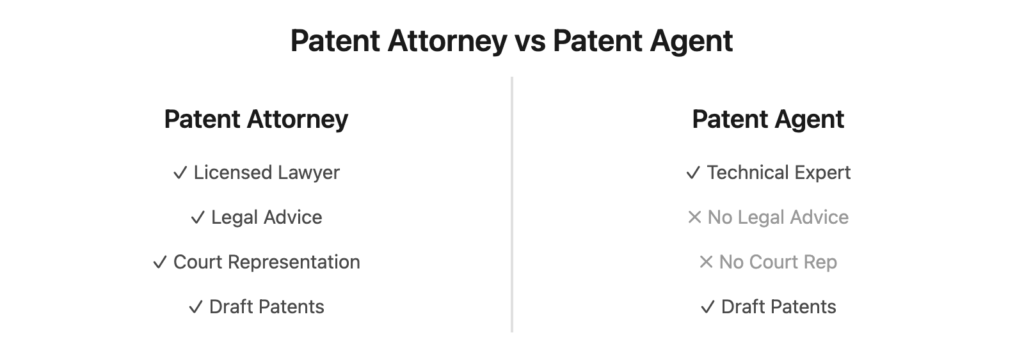
The main differences between a patent attorney vs patent agent relates to their qualifications, legal authority, and scope of services.
Education and Qualifications
Patent Attorney:
- Law degree (J.D.)
- State bar membership
- USPTO patent bar exam
- Can practice law
Patent Agent:
- Technical or scientific degree
- USPTO patent bar exam
- Cannot practice law
Legal Authority
Patent Attorney:
- Can provide legal advice
- Can represent clients in court
- Can handle patent litigation
- Can negotiate contracts and licenses
- Can advise on IP strategy
Patent Agent:
- Cannot provide legal advice
- Cannot represent clients in court
- Cannot handle litigation
- Cannot negotiate contracts
- Limited to USPTO patent matters
Services Provided
Both patent attorneys and patent agents can draft and file patent applications. Both can respond to USPTO office actions during patent prosecution.
The critical difference is that patent attorneys can handle legal matters beyond the patent application itself. This includes litigation, licensing, contracts, and comprehensive IP strategy.
Patent Attorney Cost vs Patent Agent Cost
Patent attorney fees are typically higher than patent agent fees. This reflects their broader legal training and ability to provide legal representation.
Average Cost Ranges
Patent Attorney Costs:
- Provisional patent application: $3,000 – $6,000
- Non-provisional utility patent: $10,000 – $20,000+
- Design patent: $2,000 – $5,000
Patent Agent Costs:
- Provisional patent application: $2,000 – $5,000
- Non-provisional utility patent: $8,000 – $15,000+
- Design patent: $1,500 – $4,000
Costs vary based on:
- Complexity of the invention
- Technical field
- Number of patent claims
- Geographic location
- Professional’s experience
When Lower Cost Means Higher Risk
While patent agents typically charge less, choosing based solely on price can be costly. A poorly drafted patent may be:
- Rejected by the USPTO
- Easy for competitors to work around
- Difficult or impossible to enforce
- Worthless during acquisition or licensing
Working with a qualified patent attorney ensures your patent is drafted to maximize protection and business value.
When to Choose a Patent Agent
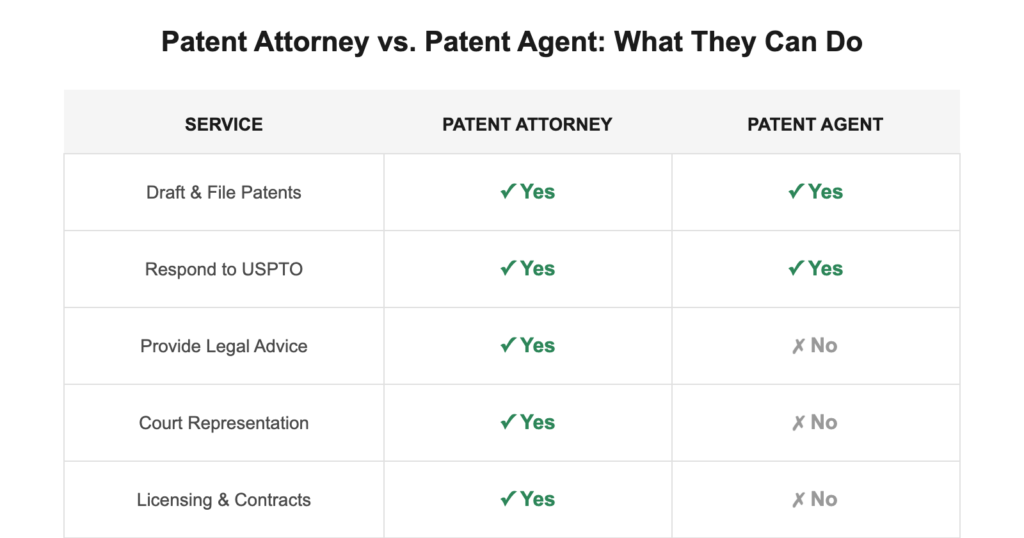
Patent agents are appropriate when your needs are primarily technical and only focused on drafting the actual patent application.
Choose a Patent Agent If:
- Your invention has clear, well-defined technical features
- You need patent drafting and filing services only
- Legal issues are unlikely
- Budget is a primary concern
- Your invention is relatively simple
- You do not anticipate litigation or licensing negotiations
Patent agents work well for inventors with:
- Straightforward mechanical inventions
- Simple technical innovations
- Clear prior art landscapes
- No anticipated legal disputes
When to Choose a Patent Attorney vs Patent Agent
Patent attorneys are essential when legal complexity, strategic planning, or potential litigation is involved.
Choose a Patent Attorney If:
- Your invention involves potential legal challenges
- You need strategic IP advice for business growth
- Patent infringement or litigation is possible
- You are planning to license or sell your patent
- International patent protection is needed
- Your invention is in a crowded technical field
- You need comprehensive IP portfolio management
- Investors or acquirers will review your IP
Patent attorneys are critical for:
- Startups seeking venture capital
- Software and AI patents (subject to complex legal standards)
- Companies with competitive markets
- Inventors planning to commercialize products
- Any situation requiring legal representation
Do You Need a Patent Attorney?
Most inventors and companies benefit from working with a patent attorney rather than a patent agent, especially if:
- The invention has significant commercial value
- Competitors exist in your market
- You plan to raise funding
- Litigation risk exists
- You need legal protection beyond basic filing
At Schell IP, we help inventors, startups, and companies throughout Colorado and nationwide protect innovations with patents that are both technically sound and legally enforceable.
A patent attorney provides comprehensive protection that a patent agent cannot offer. This includes anticipating legal challenges, drafting defensible claims, and positioning your IP for maximum business value.
How to Verify Credentials
Before hiring a patent attorney or patent agent, verify their credentials through the USPTO.
USPTO Verification Steps:
- Visit the USPTO Patent Attorney/Agent Search
- Enter the professional’s name or registration number
- Confirm active registration status
- Check for any disciplinary actions
You can also verify a patent attorney’s state bar membership through their state bar association website.
Questions to Ask Before Hiring
Whether you choose a patent attorney or patent agent, ask these questions:
- Are you registered with the USPTO? (Verify their registration number)
- What is your technical background?
- How many patents have you drafted in my technology field?
- What is your success rate with the USPTO?
- What are your fees and billing structure?
- Will you handle my case personally or delegate to junior staff?
- Can you provide references from past clients?
For patent attorneys, also ask:
- Are you licensed to practice law in my state?
- Have you handled patent litigation?
- Can you assist with licensing and contracts?
The Patent Process: What to Expect
Whether you work with a patent attorney or patent agent, the patent application process follows these steps:
- Initial Consultation – Discuss your invention and assess patentability
- Patent Search – Identify prior art and similar patents
- Application Drafting – Prepare detailed description, claims, and drawings
- USPTO Filing – Submit application and pay filing fees
- Patent Prosecution – Respond to USPTO office actions
- Patent Grant – Receive your patent once approved
A patent attorney can assist with additional steps like:
- Filing international patents through the Patent Cooperation Treaty (PCT)
- Defending against patent challenges
- Enforcing your patent rights
- Licensing negotiations
Common Mistakes When Choosing
Many inventors make these mistakes when deciding between a patent attorney and patent agent:
Mistake #1: Choosing Based Only on Price
The cheapest option often results in weak patents that are easy to challenge or work around. Quality patent drafting protects your innovation and increases its value.
Mistake #2: Not Considering Future Needs
Even if you only need filing services now, you may need litigation support, licensing help, or strategic advice later. Starting with a patent attorney ensures continuity.
Mistake #3: Failing to Verify Credentials
Some individuals claim to be patent professionals without proper USPTO registration. Always verify credentials before hiring.
Mistake #4: Not Understanding the Scope of Services
Patent agents cannot provide legal advice or represent you in disputes. If you hire a patent agent and later need legal services, you will need to hire a patent attorney separately.
Mistake #5: Skipping the Consultation
Most patent attorneys offer free consultations. This helps you assess whether they understand your invention and can provide the services you need.
Benefits of Working with a Patent Attorney vs Patent Agent
Patent attorneys provide comprehensive protection that goes beyond patent filing:
- Legal Strategy – Align IP protection with business goals
- Risk Management – Identify and address potential legal challenges
- Enforcement – Defend your patents against infringement
- Licensing – Negotiate agreements to generate revenue
- Due Diligence – Support fundraising and acquisition processes
For startups and companies, these capabilities directly impact valuation and competitive positioning.
Colorado Patent Attorney Services
At Schell IP, Denver patent attorney Jeff Schell provides comprehensive patent services for inventors and companies throughout Colorado, including:
- Patent drafting and filing
- Software and AI patent protection
- Patent prosecution and USPTO communications
- Patent litigation and enforcement
- Licensing and IP strategy
- Startup patent services
We focus on patents that protect real business value and withstand scrutiny from investors, competitors, and courts.
Frequently Asked Questions
Can a patent agent represent me in court?
No. Patent agents cannot represent clients in court or provide legal advice. Only licensed patent attorneys can handle litigation.
Are patent agents cheaper than patent attorneys?
Yes, patent agents typically charge lower fees because they cannot provide legal services. However, you may ultimately pay more if you need to hire a patent attorney later for legal matters.
How much does a patent attorney cost for a simple invention?
It depends. Even simple inventions benefit from strong legal protection. A patent attorney ensures your patent is drafted to withstand challenges and maximize value. For a provisional patent application, expect to pay $3,000-$6,000. For a non-provisional utility patent application, costs typically range from $10,000-$20,000+.
Can a patent agent become a patent attorney?
Yes. Patent agents who complete law school, pass a state bar exam, and maintain USPTO registration can become patent attorneys.
How do I find a patent attorney near me?
Search for “patent attorney near me” or “patent attorney Colorado” to find local professionals. Verify credentials through the USPTO before hiring.
What does a patent attorney do vs patent agent?
Patent attorneys can provide legal advice, represent clients in court, handle litigation, negotiate contracts, and advise on comprehensive IP strategy. Patent agents can only draft and file patents.
Is a patent lawyer the same as a patent attorney?
Yes. “Patent lawyer” and “patent attorney” refer to the same professional – a licensed attorney who specializes in patent law.
Conclusion: Patent Attorney vs Patent Agent
Choosing between a patent attorney and a patent agent depends on your specific needs, budget, and long-term goals.
For straightforward technical filings with no anticipated legal issues, a patent agent may be appropriate. However, most inventors and companies benefit from working with a patent attorney who can provide comprehensive legal protection.
Patent attorneys offer:
- Legal expertise and strategic advice
- Protection against future legal challenges
- Support for licensing and commercialization
- Representation in disputes and litigation
At Schell IP, we help inventors and companies protect innovations with patents that create real business value. Book a free consultation to discuss your patent needs and determine the best path forward.