
Quick Answer
What does a Colorado patent attorney do for first-time inventors? A Colorado patent attorney helps protect your invention by conducting patent searches, filing provisional and non-provisional patent applications, drafting enforceable claims, and ensuring USPTO compliance.
You have a brilliant idea. Maybe it’s a sketch on a napkin, a solution you built in your garage, or a thought that struck you in the shower. It’s new, it’s yours, and it could be big. But what’s the very first step to protect that spark of genius from being copied?
Many inventors mistakenly believe a patent gives them the right to sell their invention. In reality, it grants something more valuable: the legal authority to stop others from making, using, or selling your unique creation. This exclusive right is what turns a concept into a tangible business asset.
This Colorado patent attorney guide walks you through the immediate steps for safeguarding your work, from proper documentation to understanding when professional legal help becomes necessary. Whether you’re in Denver, Boulder, or Fort Collins, these principles apply to protecting your invention in Colorado.
Before You Tell Anyone: Two Crucial First Steps to Safeguard Your Invention
That brilliant idea is yours, but how do you prove it? Before sharing your invention with friends or posting online, take two crucial steps for protecting your invention idea.
The first rule is simple: keep it confidential. Revealing your invention publicly, even in casual conversation, is called a Public Disclosure. Under patent law, this can start a one-year countdown to file for a patent or prevent you from getting one at all.
While maintaining confidentiality, start your second crucial step: documentation. You need a clear, dated record that proves you are the inventor. The best way to do this is by creating an Invention Disclosure Document. Think of it as a detailed, private diary for your idea.
Create Your Invention Disclosure Document
Make sure your document answers these questions. Date and sign every page:
- What problem does your invention solve?
- How does it work? (Include sketches and drawings)
- What makes it different from existing solutions?
This documentation prepares you for working with a patent attorney in Colorado when you’re ready to file.
Is It a Patent, Trademark, or Copyright? Choosing the Right Protection
Now that you’ve documented your idea, what kind of legal protection do you need? Getting this right from the start saves time and money.
Think of these three tools as protecting different parts of a single product:
- Patent: Protects how your invention works or looks (the function/design)
- Trademark: Protects your brand name and logo (the source identifier)
- Copyright: Protects creative works like instruction manuals or website text
Real-World Example: The Spill-Proof Dog Bowl
Imagine you invented a new spill-proof dog bowl. The unique valve mechanism that prevents spills could be protected by a utility patent, while its distinctive ornamental shape could be covered by a design patent. If you call your product “PuddleProof” and create a logo for it, you protect that brand identity with a trademark. The marketing copy on your website is covered by copyright.
For most new products and processes, the patent is the key protection mechanism. But before filing, you must first determine what qualifies as a patentable invention.
What Qualifies as a Patentable Invention? The 3 Tests Every Idea Must Pass
The U.S. Patent and Trademark Office (USPTO) has a specific checklist for patent eligibility. To earn a utility patent (the most common type for new machines, processes, or compositions), your invention must pass three fundamental tests.
Test #1: Utility
Your invention must have a practical, real-world use. It has to do something. This is the most straightforward test to pass for most inventions.
Test #2: Novelty
Your invention must be brand new. It cannot have been sold, used in public, or described in a printed publication anywhere in the world before you file for a patent. If prior art already exists, the invention lacks novelty.
Test #3: Non-Obviousness
The change you made can’t be a logical next step that someone with average skill in your field would have easily thought of.
Example: Making a hiking backpack out of new, stronger fabric might be considered obvious. But designing a backpack with a built-in, weight-distributing frame that adjusts automatically to your posture represents a creative leap. This makes it potentially novel and non-obvious.
A patent attorney in Colorado can help evaluate whether your invention meets these three tests and advise on the best filing strategy.
How to Find Out if Your Idea Already Exists: The Prior Art Search
The question of “is it new?” leads to your first mission: finding prior art. Prior art is the global library of public knowledge. It includes every existing patent, product, and publication. Discovering your invention in this library before filing saves time and money on non-refundable USPTO filing fees.
Free Patent Search: Your Starting Point
Your best starting point is Google Patents. Don’t just search for your product’s name; think like an examiner and brainstorm keywords describing its function.
Search Strategy Example: If you invented a “self-stirring coffee mug,” also search for:
- “automated mixing cup”
- “motorized beverage container”
- “electric drink stirrer”
While this search provides a starting point, a comprehensive patent search conducted by a Colorado patent attorney examines USPTO databases, international patents, and technical literature that free tools may miss. This professional search identifies potential obstacles before you invest in filing.
The ‘One-Year Placeholder’ Strategy: Provisional vs. Non-Provisional Patents
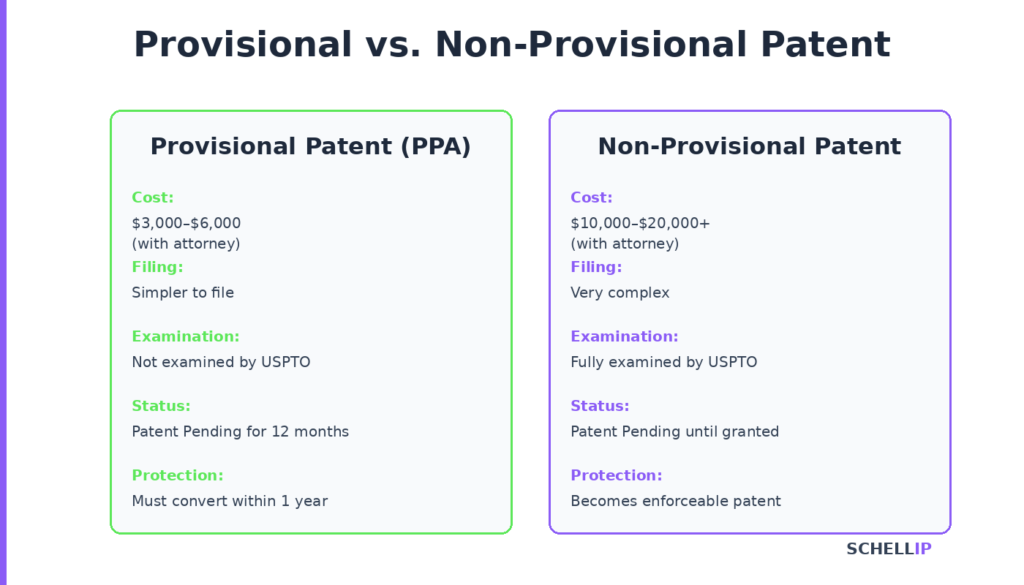
After your initial search, the most strategic way to secure your invention date is with a Provisional Patent Application (PPA). A PPA is a one-year placeholder that officially secures your priority date. This is the date the USPTO recognizes as your invention date.
Benefits of a Provisional Patent Application
A PPA allows you to legally label your invention as “Patent Pending.” This status deters potential copycats and adds credibility when talking to partners, investors, or manufacturers. You get this protection for 12 months, giving you time to refine your design, test the market, or seek funding.
The One-Year Deadline
This one-year window is critical. You must file a formal Non-Provisional Patent Application that references your PPA within 12 months to keep your original priority date. Missing this deadline means losing your priority date entirely.
At this stage, most Colorado inventors decide whether to work with a patent attorney or attempt the non-provisional filing themselves.
Should You Hire a Colorado Patent Attorney?
The decision to work with a patent attorney comes down to understanding what’s actually being protected. A patent is not just paperwork. It is the legal definition of your intellectual property rights.
The Critical Importance of Patent Claims
The legal power of a patent lives in a section called the claims. The claims define the exact boundaries of your invention. They specify what you legally own and can prevent others from making.
If claims are drafted incorrectly (too narrow, too broad, or ambiguous), competitors can easily design around your patent. Professional patent attorneys in Colorado specialize in drafting claims that provide meaningful protection while surviving USPTO examination.
What a Colorado Patent Attorney Provides
A patent attorney offers:
- Comprehensive patent searches beyond free online tools
- Professionally drafted claims that define enforceable boundaries
- Strategic prosecution responding to USPTO office actions
- Industry expertise in software, mechanical, biotech, and consumer products
- Local knowledge of Colorado’s innovation ecosystem
At Schell IP, Denver patent attorney Jeff Schell works with Colorado inventors and startups to file patents that protect market position and support business growth.
What Is the Real Cost of Working with a Patent Attorney in Colorado?
Patent costs include USPTO filing fees and attorney fees. Understanding these costs helps you budget appropriately.
Patent Attorney Fees in Colorado (2026)
Based on invention complexity:
- Provisional Patent Application: $3,000 – $6,000
- Utility Non-Provisional Patent Application: $5,000 – $20,000+
- Design Patent Application: $2,000 – $5,000
- Office Action Responses: $2,000 – $5,000 per response
USPTO Filing Fee Discounts
The USPTO offers Micro-Entity Status that reduces filing fees by up to 80% for qualifying inventors. To qualify, you must have modest income and limited prior patent filings.
Maintenance Fees for Granted Patents
Once your patent is granted, maintenance fees are required:
- 3.5 years: $800 (micro), $1,600 (small), $3,200 (large)
- 7.5 years: $1,800 (micro), $3,600 (small), $7,200 (large)
- 11.5 years: $3,700 (micro), $7,400 (small), $14,800 (large)
Design patents do not require maintenance fees.
At Schell IP, we offer transparent pricing with no surprise fees.
Why Location Matters: Colorado Patent Attorney Advantages
Working with a Colorado patent attorney offers specific advantages:
USPTO Rocky Mountain Regional Office
Denver is home to the USPTO Rocky Mountain Regional Office, one of only a few physical USPTO locations nationwide. This proximity provides:
- Direct access to USPTO resources
- Local patent examiner relationships
- Faster responses to procedural questions
Understanding Colorado’s Innovation Ecosystem
A patent attorney in Colorado understands the state’s key industries:
- Software and AI (Denver Tech Center, Boulder)
- Aerospace and Defense (Colorado Springs, Denver)
- Outdoor and Recreation Products (Boulder, Fort Collins)
- Renewable Energy (throughout Colorado)
- Cannabis and Hemp Technology (statewide)
This local expertise means your patent attorney understands the competitive landscape and can draft claims that address industry-specific challenges.
Colorado Startup and Investor Network
Colorado patent attorneys work directly with the state’s venture capital and startup communities. When investors conduct due diligence, professionally drafted patents from recognized Colorado patent law firms carry credibility.
Jeff Schell at Schell IP brings both patent law expertise and entrepreneurial experience, having founded companies and completed successful exits. This combination provides strategic guidance beyond just filing paperwork.
The Patent Application Process with a Colorado Patent Attorney: What to Expect
Working with a Colorado patent attorney typically follows this process:
1. Initial Consultation (Free at Schell IP)
Discuss your invention, review documentation, and determine patent strategy. The attorney evaluates patentability and provides a cost estimate.
2. Comprehensive Patent Search
The attorney conducts a thorough patent search examining USPTO databases, international patents, and prior art. This search identifies potential obstacles.
3. Application Drafting
For provisional applications, the attorney prepares a detailed technical description with drawings. For non-provisional applications, the attorney drafts formal claims, detailed specifications, and required drawings.
4. USPTO Filing
The attorney files the application electronically with the USPTO, ensuring all formalities are met and fees are paid correctly.
5. USPTO Examination (Non-Provisional Only)
The USPTO assigns a patent examiner who reviews the application. Most applications receive at least one Office Action. This is a formal request for changes or clarifications.
6. Office Action Response
Your patent attorney responds to Office Actions, addressing examiner concerns while maintaining broad claim coverage. This negotiation process is where attorney expertise provides the most value.
7. Patent Grant
Once all USPTO requirements are satisfied, your patent is granted and published.
Throughout this process, a Colorado patent attorney manages deadlines, responds to USPTO correspondence, and keeps you informed of progress.
Common Mistakes First-Time Inventors Make (And How a Colorado Patent Attorney Prevents Them)
Mistake #1: Public Disclosure Before Filing
Talking about your invention publicly (at trade shows, on social media, or in sales meetings) starts the one-year filing deadline. A Colorado patent attorney helps you maintain confidentiality and file before this deadline expires.
Mistake #2: Inadequate Patent Searches
Free online searches miss patents filed but not yet published, international patents, and technical literature. A patent attorney conducts comprehensive searches.
Mistake #3: Poorly Drafted Claims
Self-filed patents often have claims that are too narrow (easy to design around) or too broad (likely to be rejected). A patent attorney in Colorado drafts claims that balance protection with enforceability.
Mistake #4: Missing Critical USPTO Deadlines
The USPTO has strict deadlines for responses. Missing a deadline can abandon your application. A patent attorney manages all deadlines professionally.
Mistake #5: Inadequate Technical Descriptions
USPTO examiners require detailed technical descriptions that enable someone skilled in the field to recreate your invention. A patent attorney ensures specifications meet this requirement.
Your Action Plan: Next Steps with a Colorado Patent Attorney
You’re now equipped with foundational knowledge about patent protection in Colorado. Here’s your immediate action plan:
Week 1 Action Steps
- Document Your Invention
- Create an invention disclosure document
- Include sketches, how it works, and what makes it unique
- Date and sign every page
- Maintain Confidentiality
- Identify who needs to know about your invention
- Use Non-Disclosure Agreements (NDAs) when necessary
- Avoid public disclosure until filing
- Conduct Preliminary Patent Search
- Spend time on Google Patents
- Search multiple keyword variations
- Document what you find
- Consult with a Colorado Patent Attorney
- Schedule a free consultation with Schell IP
- Bring your invention documentation
- Get professional evaluation and cost estimate
- Develop Your Filing Strategy
- Decide if provisional or non-provisional filing is appropriate
- Understand the costs involved
- Create a timeline for filing
Frequently Asked Questions
How much does a Colorado patent attorney charge?
Patent attorney fees in Colorado typically range from $3,000-$6,000 for provisional patent applications and $10,000-$20,000+ for full utility non-provisional patent applications. Design patents cost $2,000-$5,000. Fees vary based on invention complexity.
Do I need a Colorado patent attorney or can I file myself?
While self-filing is possible, most self-filed patents are rejected or provide inadequate protection due to weak claims or improper formatting. A patent attorney increases approval rates and ensures your patent is enforceable.
What is the difference between a provisional and non-provisional patent?
A provisional patent application is a one-year placeholder that secures your filing date and grants “patent pending” status. A non-provisional patent application is the formal application that gets examined by the USPTO and can become an enforceable patent.
How long does it take to get a patent in Colorado?
Patent timelines are the same nationwide. Non-provisional utility patents typically take 1-3 years from filing to approval. Design patents are faster, usually 12-18 months. Provisional applications provide immediate “patent pending” status.
What is micro-entity status for USPTO fees?
Micro-entity status is a USPTO discount program that reduces filing fees by up to 80% for qualifying inventors. To qualify, you must have modest income, limited prior patent filings, and meet other USPTO requirements.
When should I talk to a Colorado patent attorney?
Contact a patent attorney as soon as you have a documented invention and before any public disclosure. Early consultation prevents mistakes that could destroy your patent rights, especially regarding the one-year deadline after public disclosure.
Why should I choose a Colorado patent attorney specifically?
Colorado patent attorneys understand the state’s key industries, have relationships with local USPTO offices, and work within Colorado’s startup and investor ecosystem. This local expertise provides strategic advantages for Colorado-based inventors.
What makes Schell IP different from other Colorado patent law firms?
Schell IP, led by Denver patent attorney Jeff Schell, combines deep patent law expertise with entrepreneurial experience. Jeff has founded companies and completed successful exits, providing strategic guidance that goes beyond legal paperwork. Schell IP offers transparent pricing, flexible payment structures, and a focus on protecting innovations that drive business growth.
Protect Your Invention with a Colorado Patent Attorney
Working with an experienced Colorado patent attorney ensures your innovation is protected correctly from the start. At Schell IP, we help inventors and startups throughout Colorado navigate the patent process with transparent pricing, strategic guidance, and deep understanding of Colorado’s innovation ecosystem.
Whether you’re in Denver, Boulder, Fort Collins, Colorado Springs, or anywhere in Colorado, our team provides the expertise you need to turn your idea into a protected asset.
Book a free consultation with Schell IP today to discuss your invention and get a clear path forward.
Colorado Patent Attorney: Related Articles
- What Does a Patent Attorney Do?
- How to Choose a Top Denver Patent Lawyer
- Patent Attorney for Software: How to Protect Your Product
- How Much Does a Patent Cost in 2026? Complete Pricing Guide
- Understanding the Provisional Patent Application
- Design Patent vs. Utility Patent: Which is Right for Your Invention?
- 6 Common Mistakes Inventors Make Without a Patent Lawyer