Quick Answer: Yes, AI-generated inventions can be patented in 2026, but only when a human inventor conceived the invention. The USPTO requires a natural person as the named inventor. Under the agency’s November 2025 revised guidance, AI systems are treated as tools — like lab equipment or software — not as co-inventors. An AI patent attorney helps founders and companies structure their development process and patent applications so that AI-assisted inventions qualify for full patent protection.
AI is no longer just a tool for automating tasks. It is generating new inventions, solving technical problems, and producing novel solutions across industries. For founders, engineers, and technology companies, this raises a critical legal question: can you actually patent something an AI helped create?
The answer depends on how the invention was developed, who conceived the solution, and how the patent application is written. Getting this right is the difference between owning defensible intellectual property and losing protection entirely.
This article breaks down the current legal rules, recent court decisions, and practical strategies that an AI patent attorney uses to protect AI-driven inventions in 2026.
What Counts as an AI-Generated Invention?
An AI-generated invention is any new product, process, system, or method where artificial intelligence plays a significant role in creating the solution. This includes inventions where:
- AI identified a novel compound or material
- AI designed a new system architecture
- AI optimized a process beyond what human engineers proposed
- AI generated code, algorithms, or data workflows that solve a technical problem
The key distinction is between AI as a tool and AI as the sole inventor. When a human uses AI to assist in the inventive process, the result is patentable. When AI operates entirely on its own with no meaningful human conception, patent protection becomes much more difficult under current law.
Understanding this distinction is where an AI patent attorney adds the most value. They help identify and document the human contributions that make an AI-assisted invention patentable.
The USPTO’s Current Position: What an AI Patent Attorney Needs You to Know
The USPTO has made its position clear through two rounds of formal guidance. Only natural persons can be named as inventors on a patent application. This rule was reinforced by the Thaler v. Vidal decision in 2022, where the Federal Circuit ruled that an AI system called DABUS could not be listed as an inventor. The Supreme Court declined to hear the case in April 2023, leaving this as settled law.
The USPTO first issued guidance in February 2024 under Director Kathi Vidal, clarifying that AI-assisted inventions are not categorically unpatentable and applying joint-inventorship factors (the Pannu test) to evaluate human contributions.
Then, in November 2025, Director John Squires rescinded the 2024 guidance entirely and replaced it with a revised framework. The key changes in the 2025 guidance:
- AI systems are explicitly classified as tools, comparable to lab equipment, software, or research databases
- The Pannu joint-inventorship factors no longer apply when a single human works with AI
- The traditional “conception” standard governs all inventorship determinations
- A human inventor must have formed a “definite and permanent idea of the complete and operative invention” in their mind
- Any application listing an AI system as an inventor will be rejected
This is a critical distinction for any AI patent attorney advising clients in 2026. The legal standard is now simpler but the documentation burden is higher. Human inventors must be able to demonstrate they conceived the invention, not just that they used AI as part of the process.
Why an AI Patent Attorney Says Inventorship Affects Your Business Value
Getting inventorship wrong on a patent application is not just a technicality. It can invalidate the entire patent.
If a patent names the wrong inventor, or fails to properly account for how an AI contributed to the invention, competitors can challenge the patent’s validity. This means the protection you thought you had disappears.
For startups raising capital, this is especially dangerous. Investors conduct IP due diligence. If your patents have inventorship problems tied to undisclosed AI involvement, it raises red flags that can derail funding rounds or acquisition deals.
An AI patent attorney ensures that inventorship is properly documented from the start. This protects both the patent and the business value it supports.
How Courts Have Handled AI Inventorship: What Every AI Patent Attorney Is Watching
Court decisions in the U.S. and internationally have shaped the current landscape. Understanding these cases is essential for anyone filing patents on AI-assisted inventions.
United States: Thaler v. Vidal (2022) The Federal Circuit held that the Patent Act requires inventors to be “individuals,” which the court confirmed means natural persons. Dr. Stephen Thaler had filed two patent applications naming his AI system DABUS as the sole inventor. The court rejected all policy arguments for expanding the definition, finding the statutory text unambiguous. The Supreme Court denied certiorari in April 2023.
European Patent Office: The EPO’s Legal Board of Appeal refused Thaler’s applications, holding that the European Patent Convention requires the inventor to be a natural person. The Board noted that nothing prevents the owner or user of an AI system from designating themselves as the inventor if they meet the legal requirements.
United Kingdom: The UK Supreme Court heard the case in March 2023 and upheld the position that patents require a human inventor under UK law.
Australia: Australia’s Federal Court initially ruled in 2021 that DABUS could be named as an inventor — making it the only court worldwide to do so. However, a five-judge panel of the Full Federal Court unanimously overturned that decision in April 2022, finding that an inventor must be a natural person. The High Court of Australia denied leave to appeal in November 2022, ending the case.
South Africa: South Africa granted a patent listing DABUS as the inventor, but this was an administrative outcome. South African law does not define “inventor” or require substantive examination of patent applications, so the decision carries little precedential weight.
The global trend is consistent: major patent offices worldwide require human inventors. But they increasingly accept that AI can be part of the inventive process, as long as humans conceive the invention. An experienced AI patent attorney helps clients navigate these jurisdictional differences when filing internationally.
What an AI Patent Attorney Looks for in a Patentable AI Invention
AI-assisted inventions must still meet the same three core requirements as any patent: novelty, non-obviousness, and utility.
Novelty means the invention must be new. It cannot already exist in prior art. AI systems can generate solutions quickly, which means the window between creation and public disclosure can be short. Filing early is critical. An AI patent attorney helps ensure provisional patents are filed before any public exposure.
Non-obviousness means the invention must not be an obvious step for someone skilled in the field. AI can blur this line because it processes information differently than humans. A skilled AI patent attorney frames the invention in a way that highlights its non-obvious elements.
Utility means the invention must serve a practical purpose. Abstract AI concepts or raw algorithmic outputs without a clear application will not qualify. The patent application must describe a specific, useful implementation.
Beyond these core requirements, software and AI patents must also survive the Alice test, which prevents patenting abstract ideas implemented on a computer. An AI patent attorney drafts claims that focus on technical implementations rather than abstract concepts, which is the key to surviving USPTO examination.
AI Patent Attorney Strategies for Protecting AI-Assisted Inventions
Protecting AI-driven innovation requires a deliberate approach. Here is what an AI patent attorney at Schell IP recommends for founders working with AI.
Document human conception throughout development. Under the November 2025 guidance, the touchstone is whether the human inventor had a “definite and permanent idea” of the complete invention. Keep records of:
- Who identified the problem the AI was directed to solve
- What parameters, training data, or prompts were selected and why
- How AI output was evaluated, selected, or rejected
- What modifications or refinements the human inventor made
- When the human inventor recognized the inventive solution in the AI’s output
This documentation becomes essential if inventorship is ever challenged during prosecution, litigation, or acquisition due diligence.
File provisional patents early. AI development moves fast. A provisional patent application establishes your priority date and gives you 12 months to refine the full application. This is especially important when AI is generating solutions that could be independently discovered by competitors.
Focus patent claims on the technical system, not the AI output. The strongest AI patents describe:
- How data is processed and transformed
- How systems interact and communicate
- How decisions are made at a technical level
- How performance, accuracy, or security is improved
They do not just claim the result. They claim the method and architecture that produces the result.
Use NDAs before disclosing AI methods. If you share how your AI works with investors, partners, or collaborators before filing, you risk losing patent rights. A non-disclosure agreement protects your ability to file.
Consider international filing strategies. Different countries handle AI inventorship differently. An AI patent attorney helps you prioritize filings in jurisdictions where your product will be manufactured, sold, or face competition.
AI as a Tool vs. AI as an Inventor: Where an AI Patent Attorney Draws the Line
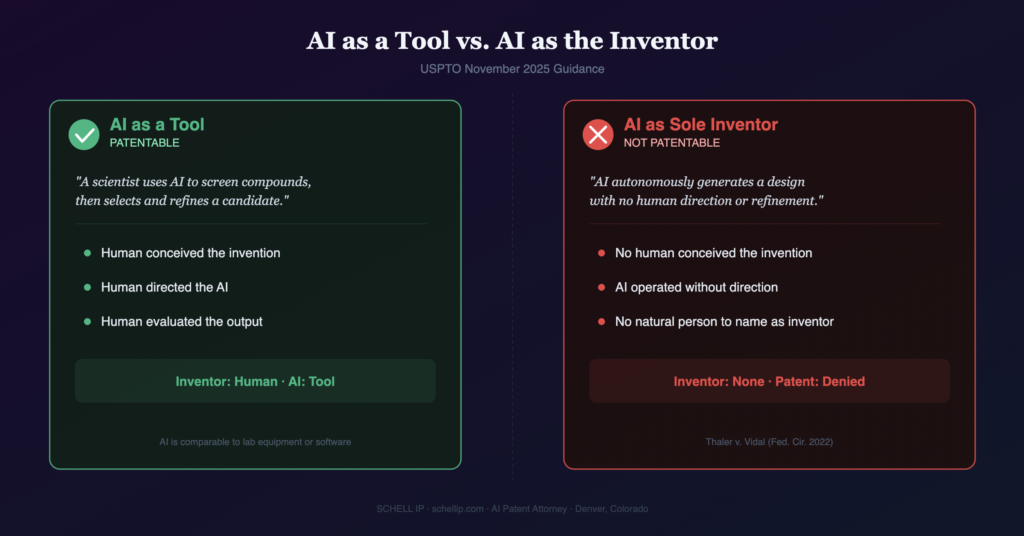
The legal distinction between AI as a tool and AI as an inventor is the most important concept in this area of patent law. The November 2025 USPTO guidance makes this explicit: AI is a tool, like a microscope or a computer simulation.
When a scientist uses AI to screen thousands of compounds and then selects, tests, and refines a promising candidate, the scientist is the inventor. The AI was an instrument that assisted the process.
When an AI system autonomously generates a new design with no human direction, evaluation, or refinement, there is no human inventor. Under current law, that invention cannot be patented.
Most real-world AI inventions fall somewhere in between. Humans set the problem, configure the AI, and evaluate its output. The AI contributes computational power and pattern recognition. This collaborative model is patentable, but only if the patent application clearly describes the human’s role in conceiving the invention.
An AI patent attorney ensures that the application tells the right story — one where human ingenuity drives the invention and AI accelerates the process.
How Schell IP’s AI Patent Attorneys Protect Your Innovation
At Schell IP, Denver patent attorney Jeff Schell works with founders and technology companies to draft AI patents that are built for enforcement, investment, and long-term competitive advantage.
Our AI patent attorney services include:
- Evaluating whether your AI-assisted invention meets patentability requirements under the current USPTO framework
- Structuring inventorship documentation to comply with the November 2025 guidance
- Drafting claims that survive both the Alice test and examiner scrutiny
- Advising on international patent strategy for AI inventions
- Building an IP portfolio that supports fundraising and acquisition goals
Schell IP also helps clients understand how AI patent law intersects with broader intellectual property strategy, including trade secrets, copyrights, and licensing, to build comprehensive protection around AI-driven products.
The companies that protect their AI innovations now will have a significant advantage as the technology and legal landscape continue to evolve.
What to Expect From AI Patent Law in 2026 and Beyond
AI patent law is still developing. Several trends are shaping what comes next.
The November 2025 USPTO guidance simplified the inventorship standard, but questions remain about how examiners will apply the traditional conception test to increasingly autonomous AI systems. Congress has held hearings on whether the Patent Act should be updated to address AI inventorship more directly. Internationally, patent offices are working toward more consistent standards, though significant differences remain.
For founders and companies, the best strategy is to file now under the current rules while building documentation practices that will hold up under whatever standards emerge. Waiting for the law to “settle” means competitors file first.
Working with an AI patent attorney who stays current on these developments ensures your IP strategy adapts as the rules evolve.
Frequently Asked Questions
Can AI be listed as an inventor on a patent?
No. Under current U.S. law, only natural persons can be named as inventors. The Federal Circuit confirmed this in Thaler v. Vidal (2022), and the Supreme Court declined to review the decision. The USPTO’s November 2025 revised guidance further clarifies that AI systems are tools, not inventors. However, inventions created with AI assistance are patentable when a human conceived the invention.
What is the difference between an AI-generated and an AI-assisted invention?
An AI-generated invention is created entirely by AI with no meaningful human conception. An AI-assisted invention involves human direction, evaluation, or refinement of AI output, with the human forming the inventive concept. Only AI-assisted inventions are currently patentable.
Why should I hire an AI patent attorney for an AI-related patent?
An AI patent attorney understands both the technical and legal requirements specific to AI inventions. They help structure inventorship documentation under the current USPTO framework, draft claims that survive the Alice test, and ensure your application meets the traditional conception standard. Filing without this expertise significantly increases the risk of rejection or future invalidation.
Can software and AI algorithms be patented?
Yes. Software and AI patents are granted when they describe technical implementations that solve real problems. Abstract ideas or generic algorithms cannot be patented, but specific methods, systems, and architectures can.
How does AI inventorship affect startup valuations?
Investors evaluate IP during due diligence. Patents with clear, defensible inventorship increase company valuation. Patents with inventorship problems tied to undisclosed AI involvement create legal risk that can reduce valuation or block deals entirely.
What countries allow AI to be named as an inventor?
No major patent jurisdiction currently allows AI to be listed as the sole inventor. The U.S., UK, EU, and Australia all require human inventorship. South Africa granted a DABUS patent administratively, but this did not involve substantive legal review. The global trend supports human-centered inventorship requirements.
How much does it cost to patent an AI invention?
AI and software patents are more complex than traditional mechanical patents. Most founders should expect provisional applications to cost $3,000-$6,000 and non-provisional applications to cost $10,000-$20,000+, depending on technical complexity and number of claims.
Protect Your AI Innovation Today
AI-generated and AI-assisted inventions represent some of the most valuable intellectual property being created today. But that value only exists if it is properly protected.
Book a free consultation with the AI patent attorneys at Schell IP to discuss your invention and build a patent strategy that protects your innovation, supports your business goals, and holds up under legal scrutiny.