Quick Answer: A patent office action is an official letter from the USPTO examiner reviewing your application, and in most cases it means one or more of your claims have been rejected or objected to. It is not a denial of your patent. You typically have three months to respond (extendable to six months with fees), and the response, which should be prepared by your patent attorney, can argue against the rejection, amend your claims, or both. Most issued patents received at least one office action along the way. The worst thing you can do is nothing: miss the deadline and your application goes abandoned.
You filed your patent application, waited over a year, and the letter that finally arrived from the USPTO says “rejected.” Take a breath. An office action is a normal part of patent examination, not the end of it. The examiner is starting a negotiation, and how the response is handled determines whether your application becomes a granted patent or an expensive dead end.
At Schell IP, responding to office actions is a core part of what we do, and we can tell you that the applications that make it through are rarely the ones that were perfect on day one. They’re the ones where the response was handled strategically.
What Is a Patent Office Action?
An office action is the examiner’s formal written position on your application. After you file your patent application, a USPTO examiner searches existing patents and publications (called prior art) and measures your claims against the legal requirements for patentability. The office action lays out, claim by claim, what the examiner thinks passes and what doesn’t, with citations to the prior art or statutes behind each rejection. You can read more about the examination process itself on the USPTO’s website.
There are two main types, and the difference matters:
- Non-final office action. This is usually the first one you receive, and it’s the opening move in the conversation. Your attorney can respond with arguments, claim amendments, or both, and the examiner must consider the response. Most of the negotiating room lives here.
- Final office action. Despite the name, this isn’t the end either. It means the examiner is closing this round of examination. The options narrow: limited amendments, a Request for Continued Examination (RCE) to reopen prosecution, or an appeal to the Patent Trial and Appeal Board. “Final” really means “final for this round.”
Why Was Your Application Rejected? The Four Rejections Examiners Actually Use
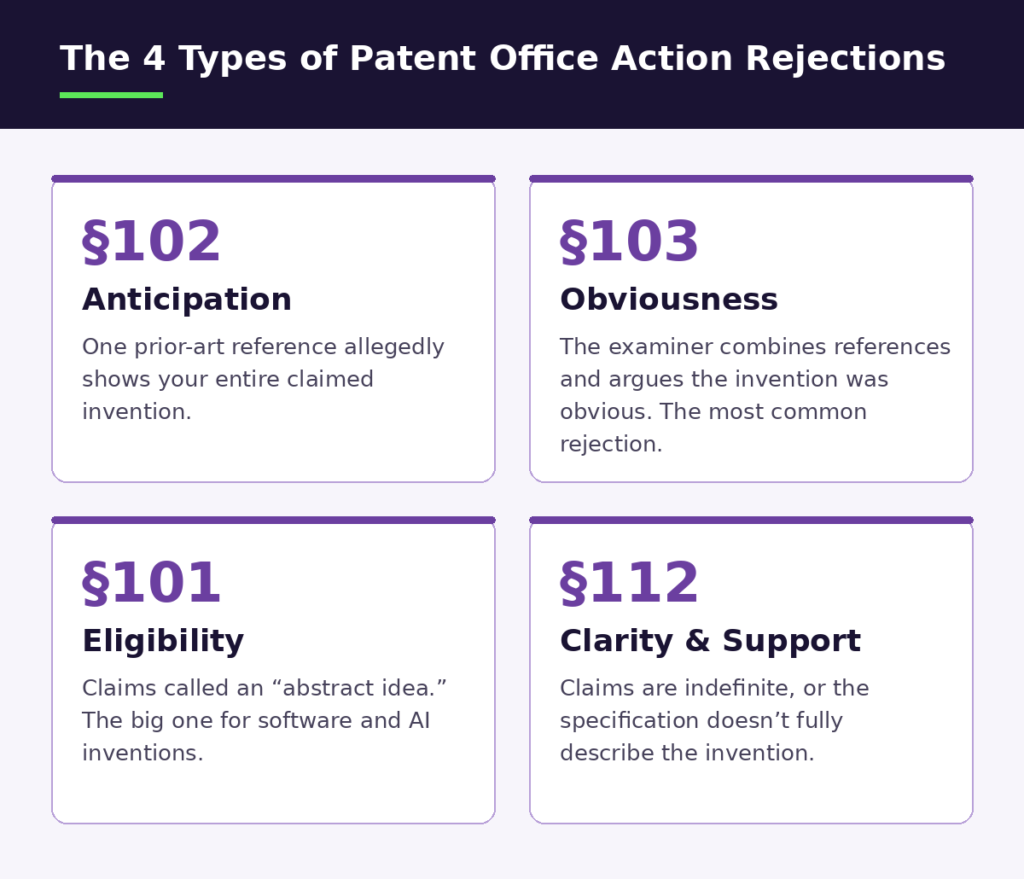
Nearly every rejection falls into one of four buckets, each named for the section of the Patent Act (Title 35 of the U.S. Code) it comes from; that’s what the § symbol refers to. Knowing which one you’re facing tells you what kind of response your attorney will need to build.
- §102: Anticipation (lack of novelty). The examiner found a single piece of prior art that they believe shows your entire claimed invention. The response usually involves showing what your claims include that the reference doesn’t, or amending the claims to draw that line more sharply.
- §103: Obviousness. The most common rejection. The examiner combines two or more references and argues a person skilled in your field would have found it obvious to put them together. These rejections often look intimidating but are frequently the most beatable, because the examiner’s proposed combination has to actually make sense, and often it doesn’t.
- §101: Subject matter eligibility. The rejection that haunts software and AI inventions. The examiner argues your claims cover an “abstract idea” rather than a patentable invention. If you’re building in AI, this is the one to understand deeply, and it’s where the law has moved dramatically in your favor.
- §112: Clarity and support. The examiner says your claims are indefinite or your specification doesn’t adequately describe or enable what you’re claiming. These are often the most fixable, but they can also expose a real drafting problem that limits how much protection you can ultimately get.
Patent Office Action Deadlines: The Clock Is Already Running
The standard response window is three months from the mailing date of the office action, and it can be extended up to six months total by paying escalating extension fees to the USPTO. Miss the six-month mark and your application is abandoned. Revival is sometimes possible, but it’s expensive and not guaranteed, and it’s an entirely avoidable problem.
Extension fees are real money that buys you nothing except time, so treat the three-month date as the real deadline and get the office action to your attorney as soon as it arrives. Rushed responses are weaker responses, and the difference between a response drafted over weeks and one drafted in a panic can follow your patent for its entire life. If timing pressure is a recurring theme in your filing life, it’s worth reading about the patent timing mistakes that cost inventors the most.
How an Office Action Response Works
Every response has two levers, and most good responses pull both. Understanding them helps you have a smarter conversation with your attorney about strategy, even though the drafting itself is their job.
- Arguing. Your attorney explains, on the record, why the examiner’s rejection is wrong: why the cited prior art doesn’t show what the examiner says it shows, or why the proposed combination of references wouldn’t have been obvious. Winning on argument alone is the best outcome, because your claims stay as broad as you filed them.
- Amending. Your attorney revises the claims to steer around the prior art while still covering your actual product and, just as important, what a competitor would build to copy you. This is where strategy matters most. Amending too narrowly gets you an allowance and a patent that’s easy to design around. At Schell IP, we draft amendments with the future infringer in mind, not just the current examiner.
Many cases also benefit from an examiner interview, a phone call where your attorney and the examiner talk through the rejection directly. These conversations can accomplish in thirty minutes what two rounds of written responses can’t, because they reveal what the examiner actually needs to see to allow the case.
Should You Ever Respond to an Office Action Yourself?
No. If you filed through an attorney, the response is their job. An office action is best left for a patent attorney to handle. This is the single stage of the patent process where professional handling pays for itself most directly, and here’s the part most inventors don’t know: the danger isn’t just losing the argument, it’s winning it badly. Everything said in a response becomes part of the permanent record (called the prosecution history), and statements or amendments made to get past the examiner can be used later to shrink your patent’s scope in court, a doctrine known as prosecution history estoppel. We routinely see self-drafted responses that got a patent allowed but gave away the protection that made the patent worth having.
Responding to an office action may involve an additional fee beyond your original filing costs, depending on how your engagement with your attorney is structured, so ask your attorney how office action responses are handled in your agreement. Weigh that against what the patent is supposed to protect, and against the cost of an RCE or appeal if the first response misses. For the bigger picture on what patent protection costs end to end, see our complete patent pricing guide.
Jeff’s Take: The Rejection That Scares Founders Most Is the One That Just Got Easier to Beat
I’m a patent attorney, a venture partner, and a serial entrepreneur with multiple exits, and I help founders build patent assets that survive due diligence. For years, investors were scared of software patents. They thought they were too expensive to get and would simply be unenforceable, and honestly, the §101 rejection was a big part of why. Examiners were throwing the “abstract idea” flag at nearly everything software-related, and a lot of founders gave up right there.
The standard has changed, and many founders and even investors don’t know the new rules. It comes down to one key phrase: technological improvement. If you use AI just to organize data, that’s probably not patentable, and no response is going to fix it. But if your AI makes the computer itself run better, if it reduces memory usage, trains a model faster, or detects anomalies with less data, that can be a patentable asset. When I see a §101 rejection on an AI application now, my first question isn’t “is this dead?” It’s “did the application show the technological improvement, and did the claims capture it?” Often the invention was always eligible; the response just needs to reframe the claims around what the technology actually improves.
And unlike five years ago, courts are now enforcing these patents against infringers. That’s a massive opportunity for deep tech startups, and a real problem for founders who ignore the patent system at their own peril. An office action is where you find out which side of that line you’re on.
What to Expect When Schell IP Handles Your Office Action
When you bring us an office action, the first thing we do is read it the way the examiner wrote it, not the way it feels. We map each rejection to its statutory basis, pull and read every cited reference, and then look at your claims next to your actual product and roadmap. Then we walk you through the options: what we can win on argument, what we’d recommend amending, and what each path does to the strength of the eventual patent.
If your invention touches software or AI, we also assess the claims against the current eligibility standard, because a claim set drafted for the 2019 rules is often leaving protection on the table under the current framework. You’ll feel confident in the strategy before a single word is drafted.

FAQ
How long do I have to respond to a patent office action?
Three months from the mailing date in most cases, extendable to six months total by paying USPTO extension fees. After six months the application goes abandoned. Check your specific office action, because some deadlines differ.
Is an office action a rejection of my patent?
It’s a rejection of one or more claims as currently written, not a final denial of your patent. Most applications receive at least one office action, and most issued patents were rejected at least once along the way.
What’s the difference between a final and non-final office action?
A non-final office action opens examination and gives your attorney full freedom to argue and amend. A final office action closes the current round; your attorney can still respond in limited ways, file an RCE to continue examination, or appeal.
Can my application be revived if I miss the deadline?
Sometimes, through a petition to revive for unintentional delay, with a significant USPTO fee. It’s a safety net that is only sometimes available, not a plan.
The Bottom Line
An office action isn’t your patent dying. It’s the moment your application gets a lawyer’s problem instead of an inventor’s problem, and the quality of the response determines what your patent will actually be worth. If there’s an office action sitting in your inbox right now, the deadline is already running. Book a free consultation and we’ll read it with you and lay out your options before you owe us anything.