Quick Answer: A consumer product patent attorney helps inventors and founders protect physical products by drafting patents that define how the product works, what it looks like, or both. Without proper patent protection, competitors can legally copy your product and sell it themselves. Working with a consumer product patent attorney early in the development process reduces risk and strengthens your position with investors, retailers, and manufacturers.
If you have invented a new consumer product, whether it is a kitchen tool, a fitness device, a piece of outdoor gear, or a children’s product, patent protection is one of the most important steps you can take before going to market.
But consumer product patents are not simple. They require specific legal knowledge, technical writing, and an understanding of how products are manufactured, marketed, and copied. A general business attorney is not equipped to handle this work. You need a consumer product patent attorney who understands both patent law and the product development process.
This article explains what a consumer product patent attorney does, when you need one, what types of patents apply to physical products, and how to avoid the most common mistakes inventors make.
What Does a Consumer Product Patent Attorney Do?
A consumer product patent attorney protects your product by securing legal rights that prevent others from making, selling, or importing copies of your invention.
This includes conducting a patent search to confirm your product is new, drafting a patent application that clearly describes how the product works, and writing legal claims that define the boundaries of your protection.
A consumer product patent attorney also advises on which type of patent best fits your product. Some products need protection for how they function. Others need protection for how they look. Many need both.
At Schell IP, Denver patent attorney Jeff Schell works with inventors and product companies to build patent strategies that protect real business value, not just ideas on paper.
Why Consumer Products Need Patent Protection
Consumer products are easy to copy. Once a product appears on a retail shelf or an online marketplace, competitors can reverse-engineer it, manufacture a knockoff, and undercut your price.
Without a patent, there is no legal way to stop this.
A patent gives you the right to prevent others from making, using, or selling your invention. It also increases your product’s value in the eyes of investors, licensees, and potential acquirers.
Many successful consumer product companies treat patents as business assets. They use them to negotiate licensing deals, secure retail partnerships, and create barriers that keep competitors out of their market.
Types of Patents for Consumer Products
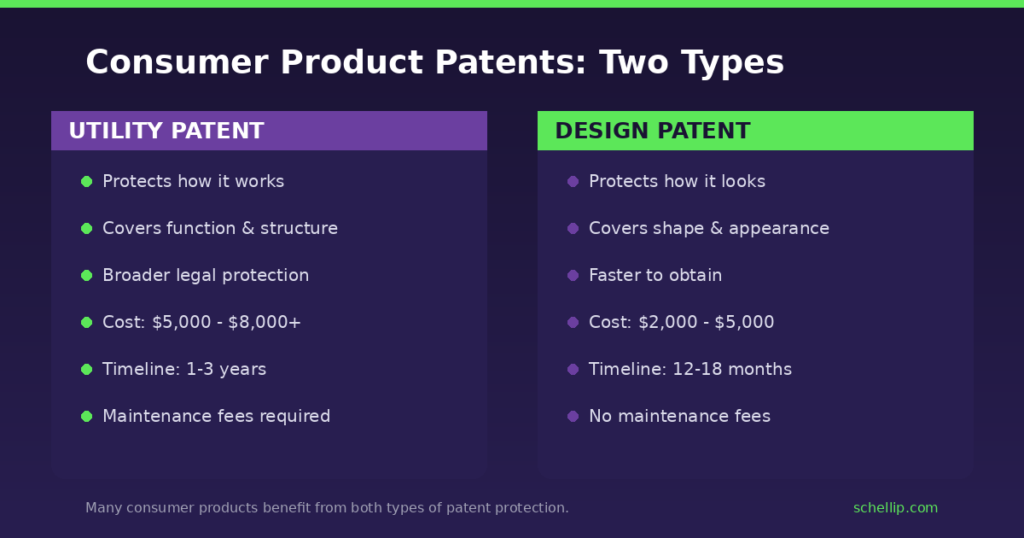
Consumer products can be protected by two main types of patents: utility patents and design patents. Understanding the difference is critical to building the right protection.
Utility Patents for Consumer Products
A utility patent protects how a product works. It covers the function, structure, or method of use.
If your consumer product solves a problem in a new way, a utility patent is typically the strongest form of protection. It prevents competitors from copying the way your product operates, even if they change how it looks.
Utility patents are more expensive and take longer to obtain, but they provide broader and stronger protection than design patents.
Design Patents for Consumer Products
A design patent protects the ornamental appearance of a product. This includes the shape, surface pattern, and overall visual design.
If your product has a distinctive look that sets it apart in the market, a design patent can prevent competitors from copying that appearance. Design patents are faster and less expensive to obtain than utility patents, making them a practical option for products where visual identity is a key selling point.
Many consumer product companies file both a utility patent and a design patent to protect both the function and the appearance of their product.
How Much Does a Consumer Product Patent Cost?
Patent costs depend on the type of patent, the complexity of the product, and the level of protection needed.
General cost ranges for consumer product patents are:
- Provisional patent application: $3,000–$6,000
- Non-provisional utility patent application: $5,000–$8,000+
- Design patent application: $2,000–$5,000
These costs include attorney drafting and filing fees. Additional costs may apply for USPTO office action responses, which typically run $2,000–$5,000 per response.
Filing a provisional patent first is a common strategy. It establishes an early filing date at a lower cost and gives you 12 months to refine the product, test the market, or raise funding before committing to a full non-provisional filing.
For a detailed breakdown, see the complete patent cost guide.
When Should You Hire a Consumer Product Patent Attorney?
You should speak with a consumer product patent attorney as early as possible in the product development process. Ideally, before any of the following:
- Showing the product to potential investors or partners
- Sharing details with a manufacturer or supplier
- Launching a crowdfunding campaign
- Listing the product for sale online or in retail
Public disclosure of your invention before filing a patent application can permanently destroy your patent rights. In the United States, you have a one-year grace period after public disclosure, but in most other countries, there is no grace period at all.
A consumer product patent attorney helps you file before these deadlines and ensures that your protection is in place before your product is exposed to the market.
Common Mistakes Inventors Make Without a Consumer Product Patent Attorney
Many inventors try to patent consumer products on their own. This usually leads to problems that are expensive or impossible to fix later. The most common mistakes include:
Filing without a proper patent search. A quick internet search is not the same as a professional prior art search. Missing a similar existing patent can lead to rejection, wasted fees, or future infringement claims.
Writing vague or overly narrow claims. Patent claims define what you legally own. If they are too broad, the patent will be rejected. If they are too narrow, competitors can work around them. A consumer product patent attorney writes claims that are balanced and enforceable.
Choosing the wrong type of patent. Some inventors file only a design patent when they need a utility patent, or vice versa. This leaves gaps in protection that competitors can exploit.
Disclosing too early. Sharing product details publicly or with manufacturers without a patent filing or NDA in place can eliminate your ability to obtain a patent.
Using online filing services instead of a patent attorney. Template-based services produce generic applications that are frequently rejected or easily invalidated. A consumer product patent attorney drafts applications tailored to your specific product and market.
For more on this topic, see 6 Common Mistakes Inventors Make Without a Patent Lawyer.
Benefits of Hiring a Consumer Product Patent Attorney
Working with a consumer product patent attorney offers advantages that go beyond filing paperwork.
Stronger protection. A patent attorney writes claims that are harder for competitors to design around, giving your product broader legal coverage.
Higher approval rates. Professionally drafted applications are more likely to be approved by the USPTO without costly revisions or appeals.
Strategic guidance. A patent attorney helps you decide what to patent, when to file, and how to build an IP portfolio that supports your business goals.
Investor confidence. Patents drafted by a qualified attorney carry more weight in due diligence. Investors want to see that your product is legally protected before they commit capital.
Long-term value. A well-written patent increases your company’s valuation, supports licensing opportunities, and strengthens your position in acquisition negotiations.
How to Choose the Right Consumer Product Patent Attorney
Not all patent attorneys handle consumer products. When evaluating attorneys, look for experience with physical product inventions, a background in the relevant technical field, and a track record of working with inventors and startups.
Ask whether the attorney has experience with both utility and design patents, and whether they understand manufacturing, product development, and go-to-market strategy, not just legal compliance.
For guidance on selecting the right attorney, see Top Denver Patent Law Firm: Your Guide to Choosing the Best.
At Schell IP, patent attorney Jeff Schell combines deep patent law experience with a background in venture capital and technology entrepreneurship. This means your patents are written to protect business value, not just meet legal requirements.
Frequently Asked Questions
What does a consumer product patent attorney do?
A consumer product patent attorney helps inventors protect physical products by conducting patent searches, drafting patent applications, and writing legal claims that prevent competitors from copying the product’s function or appearance.
How much does it cost to patent a consumer product?
Consumer product patent costs typically range from $3,000–$6,000 for a provisional patent application and $5,000–$8,000+ for a non-provisional utility patent application. Design patents generally cost $2,000–$5,000.
Do I need a utility patent or a design patent for my product?
It depends on what makes your product unique. If the innovation is in how the product works, you need a utility patent. If the innovation is in how it looks, you need a design patent. Many consumer products benefit from both.
Can I patent a consumer product myself?
You can file a patent application yourself, but most self-filed patents are rejected or produce weak protection. A consumer product patent attorney drafts stronger claims and increases the likelihood of approval.
When should I talk to a patent attorney about my product?
As early as possible, ideally before sharing the product with investors, manufacturers, or the public. Public disclosure before filing can permanently destroy your patent rights.
What is the difference between a patent attorney and a regular attorney?
A patent attorney is registered with the USPTO and has a technical background. Regular attorneys are not qualified to file patent applications. Only a patent attorney or patent agent can represent you before the USPTO.
Protect Your Consumer Product With the Right Patent Attorney
If you have invented a consumer product, the right patent protection can mean the difference between building a successful business and watching competitors copy your idea.
A consumer product patent attorney gives you the legal foundation to protect your product, attract investors, and grow with confidence.
Book a free consultation with Schell IP today to discuss your invention and learn how to protect it.