Quick Answer: AI patent litigation has shifted in favor of inventors. Courts are now enforcing AI patents that demonstrate a clear technological improvement, such as reducing memory usage, training models faster, or detecting anomalies with less data. This is a major opportunity for deep tech startups and a serious risk for founders who ignore patents. If your AI improves how a computer system actually functions, it may qualify for enforceable patent protection.
For years, investors and founders avoided software patents. They were expensive to file and seemed impossible to enforce. Courts regularly threw out AI and software patents under the Alice Corp. v. CLS Bank standard, and many entrepreneurs concluded that patents were not worth the investment.
That era is over. Recent court decisions have created a clearer, more favorable standard for AI patent litigation. Founders who understand the new rules can build patent portfolios that attract funding, protect market position, and hold up in court.
Patent attorney, venture partner, and serial entrepreneur Jeff Schell explains what changed, what qualifies, and why this matters for every AI startup.
Why AI Patent Litigation Failed in the Past
The Alice decision made it illegal to patent abstract ideas implemented on a computer. In practice, this meant courts routinely invalidated software patents that were too vague, too broad, or that simply described a business process automated by technology.
For investors conducting due diligence, weak software patents were a red flag. They signaled wasted capital and poor patent strategy. Many venture capitalists told founders not to bother with patents at all.
That advice made sense at the time. It no longer does.
What Changed: The Technological Improvement Standard in AI Patent Litigation
Recent court cases have clarified what separates a patentable AI invention from an abstract idea. The key phrase is technological improvement. If your AI system improves how the underlying technology works, not just the business outcome it produces, it can qualify for enforceable patent protection.
This standard applies directly to AI patent litigation. Courts are now asking a specific question: does this invention make the computer itself work better?
What Qualifies as a Patentable AI Invention
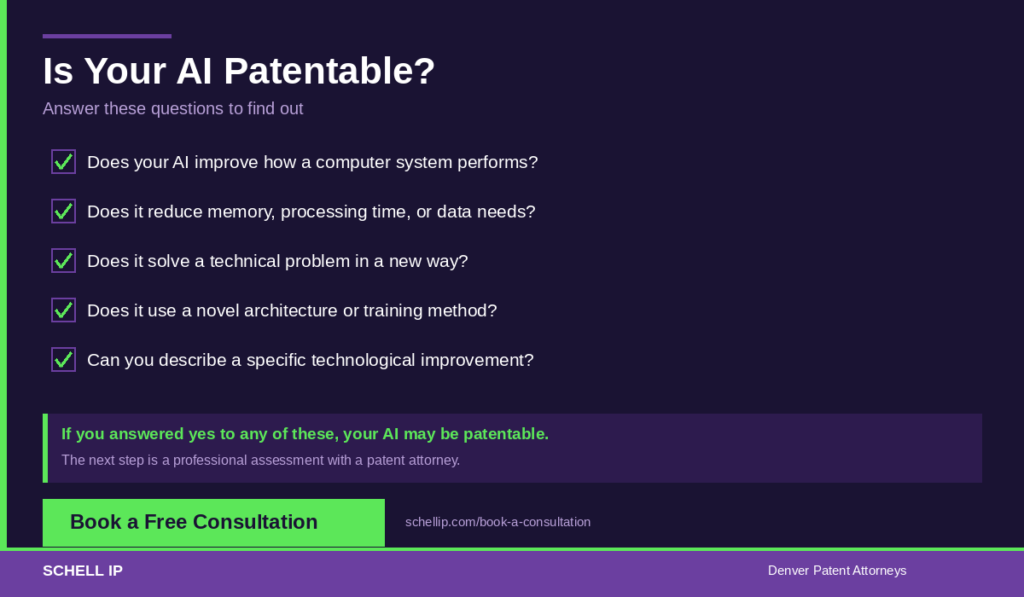
Your AI may qualify for patent protection, and survive AI patent litigation, if it delivers a concrete technological improvement. Examples include:
- Reducing memory usage during inference or training
- Training a model faster with fewer computational resources
- Detecting anomalies or making predictions using significantly less data
- Improving the accuracy, speed, or efficiency of a computer system in a measurable way
- Novel architectures for how software systems coordinate, communicate, or process data
These are improvements to how the computer functions. That distinction is what determines software patent eligibility and what holds up in AI patent litigation.
What Does Not Qualify for AI Patent Protection
Using AI to organize, sort, or categorize data, even if it does so faster than a human, typically does not meet the bar. Courts view this as automating a conventional process, not improving the technology itself.
This is a critical distinction for founders asking can software be patented. The answer is yes, but only when the software delivers a real technical advancement. AI that simply wraps an existing model with a new interface or workflow is unlikely to produce enforceable patents.
Why AI Patent Litigation Is a Bigger Problem for Wrapper Startups
The new enforcement landscape creates two very different outcomes depending on the type of company you are building.
For deep tech startups with genuine AI innovation, this shift is a massive opportunity. A strong patent portfolio becomes a competitive moat, a bargaining chip in licensing negotiations, and a value driver in acquisition due diligence.
For wrapper startups, companies that build a layer of UI or workflow on top of existing AI models without meaningful technical innovation, this is a warning. Without patentable technology, your competitive position is fragile. A larger company can replicate what you have built without legal consequence.
Can AI Be Named as an Inventor in AI Patent Litigation?
One question that keeps surfacing in AI patent litigation is inventorship: when an AI system contributes to an invention, who gets credit? Current U.S. law requires a human inventor. The USPTO has consistently held that only natural persons can be named on a patent application. Courts have upheld this position in multiple rulings.
For founders, this means the human team directing the AI, defining the problem, selecting the training approach, and interpreting the output, are the named inventors. But the question is not purely academic. If your patent application does not clearly identify the human inventive contribution, it can be challenged in litigation on inventorship grounds.
An experienced AI patent attorney structures applications to clearly document human involvement at each inventive step. This protects the patent from inventorship challenges that could otherwise invalidate it during AI patent litigation.
International AI Patent Litigation: What Founders Should Know
AI patent litigation does not stop at U.S. borders. If you sell, license, or deploy your technology internationally, foreign patent laws apply, and they differ significantly from U.S. standards.
The European Patent Office, for example, applies a stricter standard for software patent eligibility than the USPTO. What is patentable in the United States may not qualify for protection in Europe or Asia. Conversely, some jurisdictions are more receptive to certain types of AI inventions.
For startups with global ambitions, international patent strategy needs to be part of the plan from the beginning. Filing through the Patent Cooperation Treaty (PCT) provides a streamlined path to protection in over 150 countries, but each national phase requires careful handling. Working with an artificial intelligence patent attorney who understands cross-border enforcement helps avoid costly gaps in your portfolio.
How AI Patent Litigation Impacts Fundraising and Acquisition
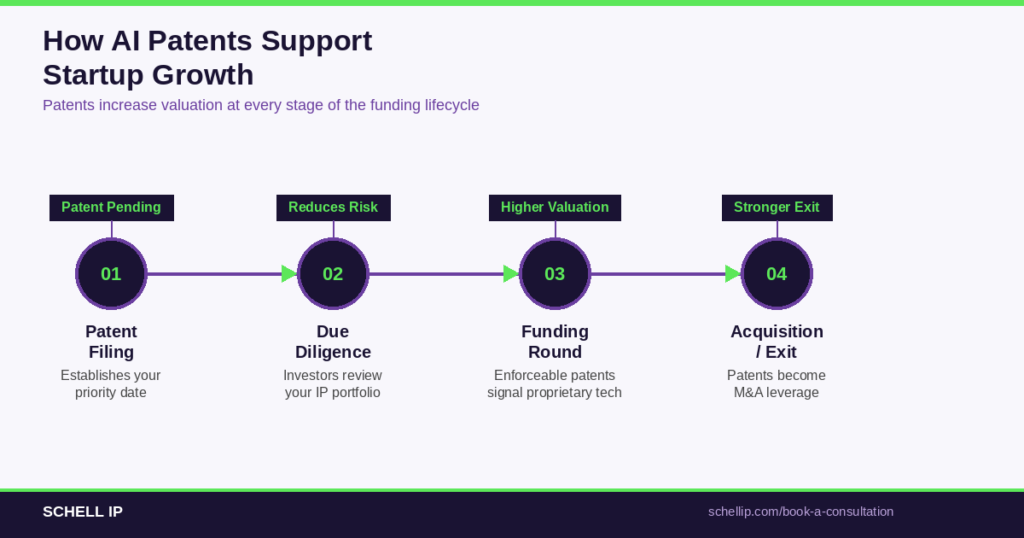
Investors and acquirers are paying closer attention to patent assets than ever. A defensible patent portfolio signals that a startup owns proprietary technology worth protecting. During due diligence, enforceable patents reduce risk for the buyer and increase the startup’s valuation.
Founders who skip patenting software entirely may find themselves at a disadvantage when raising their next round or negotiating an exit. Investors increasingly expect to see defensible IP, particularly in the AI space.
How AI Is Changing the Patent Litigation Process Itself
AI is not only the subject of patent disputes. It is also transforming how those disputes are handled. Patent attorneys and litigation teams increasingly use AI tools to search prior art, analyze claim language, predict case outcomes, and identify potential infringement.
For startups preparing for or defending against AI patent litigation, this has practical implications. AI-powered prior art searches are faster and more thorough than manual searches, which means opposing counsel is more likely to find relevant references. That raises the bar for patent quality. Weak or vague patents that might have survived a decade ago are more likely to be challenged today.
This is another reason to work with a patent attorney who drafts for enforcement, not just approval. At Schell IP, every patent is written with the assumption that it will be scrutinized, both by the USPTO and by opposing counsel using sophisticated search tools.
How to Build an AI Patent Portfolio That Survives AI Patent Litigation
Strong AI patents start with understanding your technology at a system level. An experienced AI patent attorney will interview your technical team, map how your system processes information, identify the inventive steps, and draft patent claims that are broad enough to block competitors but specific enough to survive the USPTO and the courtroom.
Patents written purely for approval, rather than for enforcement or strategic coverage, rarely hold up in AI patent litigation. The goal is to describe systems, architectures, and technical advantages that competitors cannot simply work around.
At Schell IP, we help founders build patent assets that survive due diligence, support funding rounds, and stand up to enforcement challenges. That means writing patents with litigation, licensing, and acquisition in mind from day one.
Frequently Asked Questions
What is AI patent litigation?
AI patent litigation is the legal process of enforcing or defending patents related to artificial intelligence technology. It includes lawsuits over patent infringement, challenges to patent validity, and disputes over the scope of AI-related patent claims.
Are AI patents enforceable in 2026?
Yes. Recent court rulings have strengthened the enforceability of AI patents that meet the technological improvement standard. Courts are now actively upholding patents that demonstrate real improvements to how computer systems function.
Can software be patented?
Software can be patented when it delivers a specific technological improvement, such as faster processing, lower resource usage, or novel data handling methods. Software that simply automates a business process without improving the underlying technology typically does not qualify. Learn more about software patent eligibility.
What makes an AI invention patentable vs. an abstract idea?
The dividing line is whether your AI delivers a concrete improvement to the technology itself. Using AI to organize data is likely an abstract idea. Using AI to make a computer system run more efficiently, reduce resources, or improve accuracy is a technological improvement and likely patentable.
Can AI be listed as an inventor on a patent?
No. Under current U.S. law, only natural persons can be named as inventors on a patent application. The USPTO and federal courts have consistently upheld this requirement. For AI-assisted inventions, the human team members who directed the inventive process are named as inventors.
When should an AI startup talk to a patent attorney?
As early as possible, ideally before public disclosure, fundraising, or product launch. Public disclosure before filing can permanently destroy your patent rights. An AI patent attorney can help you assess what is patentable and build a filing strategy that aligns with your business timeline.
Do AI patent laws differ across countries?
Yes. Patent eligibility standards for AI and software vary significantly between the United States, Europe, and Asia. What qualifies for patent protection in one jurisdiction may not qualify in another. Founders with international markets should work with a patent attorney who understands cross-border filing and enforcement.
Who are the best attorneys for AI patent litigation?
The best attorneys for AI patent litigation combine deep technical knowledge of artificial intelligence with experience navigating the USPTO and federal courts. Look for a patent attorney who understands how investors, acquirers, and competitors evaluate AI patents, not just how to file them. At Schell IP, Denver patent attorney Jeff Schell works with AI startups to build patent portfolios designed for enforcement, funding, and acquisition.
Protect Your AI Technology With Enforceable Patents
If you are building AI technology and are not sure whether your invention qualifies for patent protection, the time to find out is before your next funding round or acquisition conversation.
Book a free consultation with Schell IP to assess your technology and learn how enforceable AI patents can strengthen your company’s position.