
Quick Answer: Patents for physical products and software follow different rules. Physical products are typically protected through utility patents (how it works) and design patents (how it looks). Software patents must clear a higher legal bar by proving the invention solves a technical problem in a technical way. A consumer product patent attorney helps you choose the right strategy based on what you are building.
If you are developing a consumer product, whether it is a physical device, a software application, or a product that combines both, understanding how patent protection works for each type is a critical first step. The rules, requirements, and strategies are different, and filing the wrong way can leave your invention unprotected.
This guide breaks down the key differences between patenting physical products and software, explains what each process involves, and helps you understand when to work with a specialized patent attorney.
What Is a Patent and Why Does It Matter?
A patent is a legal document that gives the holder exclusive rights to an invention. It prevents others from making, using, or selling the invention without permission. For inventors and startups, patents serve as both legal protection and business assets that can attract investors and increase company valuation.
There are three main types of patents:
- Utility patents protect how an invention works, including new processes, machines, and systems.
- Design patents protect the ornamental appearance of a product, such as its shape, pattern, or surface design.
- Plant patents protect new plant varieties (less common and not covered in this guide).
Understanding which type of patent applies to your invention is the first step in building a real intellectual property strategy.
How a Consumer Product Patent Attorney Protects Physical Products
For tangible goods, the patent process is generally more straightforward than for software. Physical products have visible components, mechanical functions, and measurable features that are easier to describe in a patent application.
Design Patents for Physical Products
If your product has a unique visual appearance, a design patent may be the right protection. Design patents cover the ornamental look of a product, not how it functions. This is common in industries like consumer electronics, furniture, fashion, and packaging.
To qualify for a design patent, the design must be novel, non-obvious, and not dictated solely by function. A consumer product patent attorney can help identify which visual elements of your product are protectable and craft an application that highlights those features.
Design patents are typically faster and less expensive to obtain than utility patents, often taking 12 to 18 months for approval. At Schell IP, we help consumer product inventors identify which visual elements qualify for design patent protection and build applications that hold up against competitors.
Utility Patents for Physical Products
If your product introduces a new function, mechanism, or improvement over existing technology, you will likely need a utility patent. Utility patents protect how a product works, not how it looks.
A strong utility patent application includes a detailed description of the invention, technical drawings, and precisely written claims that define the scope of protection.
Utility patents are strategic business assets. They prevent competitors from copying your invention and open opportunities for licensing agreements, partnerships, and increased company valuation during fundraising or acquisition. At Schell IP, we draft utility patent applications that are written not just for approval, but for enforcement and long-term business value.
When Physical Products Need Both
Many consumer products benefit from both design and utility patent protection. For example, a kitchen appliance with a unique ergonomic shape (design patent) that also uses a new heating mechanism (utility patent) could be protected on both fronts.
A consumer product patent attorney can help you evaluate whether one type of patent is sufficient or whether a combined strategy provides stronger protection.
How Software Patents Differ from Physical Product Patents
Software patents present unique challenges that physical product patents do not. The core difficulty is that software often involves abstract concepts, algorithms, and data processing, all of which face stricter scrutiny under patent law.
The Alice Standard and Software Patentability
After the Supreme Court’s Alice Corp. v. CLS Bank decision, the USPTO applies a two-part test to software patent applications. First, examiners determine whether the claims are directed to an abstract idea. If so, the application must demonstrate that the software provides something significantly more than just automating a known process on a computer.
This means vague or broadly written software patents are routinely rejected. A software patent attorney must show that the invention solves a specific technical problem in a technical way.
What Makes Software Patentable?
Software may qualify for a patent if it includes:
- New methods of processing or transforming data
- Novel AI training, inference, or decision workflows
- Unique system architecture or backend automation
- Improvements to performance, security, or scalability
- New ways for software systems to coordinate or communicate
Courts and the USPTO are increasingly protecting real technical innovation in software and AI, making 2026 a strong time for founders to invest in software patent strategy.
Documentation Requirements for Software Patents
Software patent applications require more detailed technical documentation than physical product patents. This includes flowcharts, algorithm descriptions, system architecture diagrams, and explanations of how the software interacts with hardware or improves performance.
The claims section must emphasize the technical aspects of the software rather than just the outcome. Writing claims that are specific enough to survive USPTO examination but broad enough to prevent competitors from designing around them requires significant legal and technical expertise.
Key Differences Between Physical Product and Software Patents
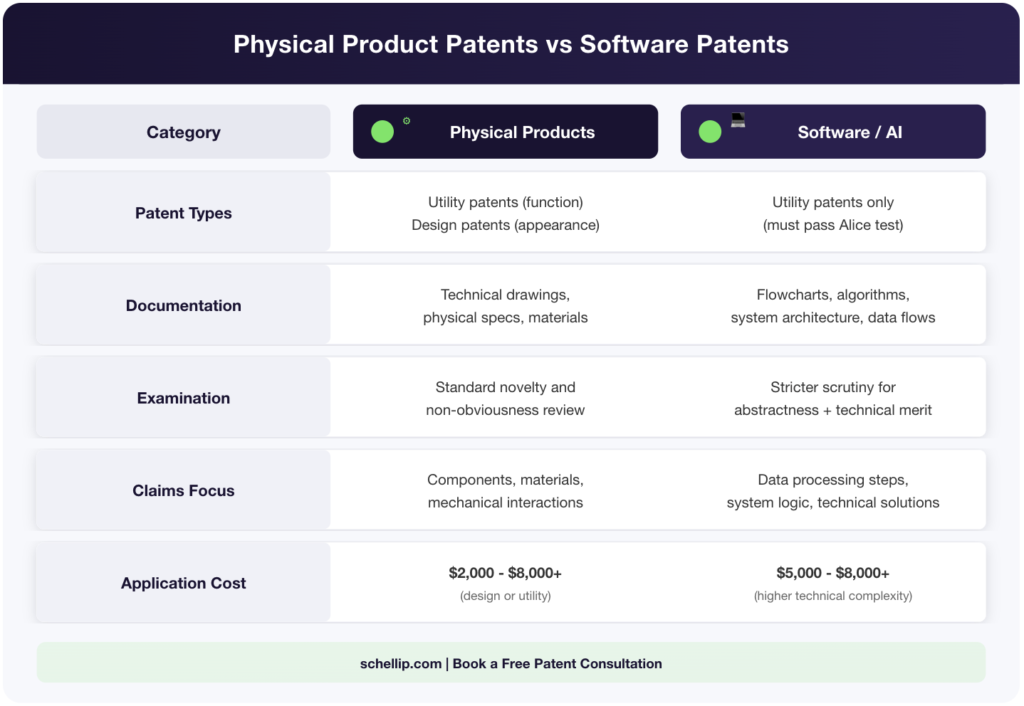
Application and Documentation
Physical product patent applications focus on tangible attributes, mechanical functions, and visual features. Documentation includes detailed descriptions and technical drawings that illustrate how the invention works.
Software patent applications require a more complex technical narrative. Algorithms, data flows, system specifications, and code-level explanations are often necessary to establish patentability and meet the Alice standard.
Examination Process
The patent examination process for software is typically more rigorous. Examiners scrutinize software patents closely for abstractness and technical merit. Physical product patents, while still subject to examination, generally face fewer challenges in proving novelty and utility.
For both types, applicants should expect to receive at least one Office Action from the USPTO. Responding effectively to these formal examiner concerns is a critical part of the process.
Claims Strategy
For physical products, claims focus on specific components, materials, and their interactions. For software, claims must clearly articulate how the technology achieves a technical solution, including data processing steps, system interactions, and performance improvements.
Weak claims in either category can result in a patent that is easy for competitors to work around. A specialized patent attorney drafts claims that balance breadth and specificity for maximum protection.
Cost Differences
Patent costs vary between physical products and software. Provisional patent applications typically cost $3,000 to $6,000. Non-provisional utility patent applications cost $5,000 to $8,000 or more depending on complexity. Software and AI patents often fall on the higher end because they require both legal and deep technical expertise.
Why You Need a Consumer Product Patent Attorney
Whether you are patenting a physical product or a software system, working with an attorney who understands your specific technology is critical.
Industry-Specific Expertise
A consumer product patent attorney understands the mechanical, material, and design challenges specific to physical products. A software patent attorney understands how to navigate the Alice standard and write claims that emphasize technical contribution.
If your product combines hardware and software, which is increasingly common in IoT, healthtech, and consumer electronics, you need an attorney who can handle both.
Streamlined Process
A specialized attorney ensures all documentation is prepared correctly the first time. This reduces the risk of rejection, speeds up the path to approval, and minimizes costly Office Action responses.
Strategic Protection Beyond Filing
Beyond obtaining a patent, a specialized attorney advises on enforcement strategy, potential infringement risks, licensing opportunities, and how to leverage patents for business growth. Strong patent protection is not just a legal formality. It is a competitive advantage.
At Schell IP, Denver patent attorney Jeff Schell works with inventors and startups to build patent strategies that protect real business value, whether the innovation is a physical product, a software system, or a combination of both.

Ready to protect your consumer product or software invention? Book a free consultation with Schell IP to discuss your patent strategy.
Frequently Asked Questions
What is a consumer product patent attorney?
A consumer product patent attorney helps inventors protect physical products through utility patents, design patents, or both. They specialize in the specific documentation, claims, and strategy needed for tangible consumer goods.
Can software really be patented?
Yes. Software is patentable when it solves a technical problem in a technical way. This includes novel algorithms, data processing methods, AI workflows, and system architectures. A software patent attorney helps navigate the stricter legal requirements.
Do I need a design patent or a utility patent for my product?
It depends on what you are protecting. If the innovation is in how the product looks, a design patent applies. If the innovation is in how it works, a utility patent is the right choice. Many products benefit from both.
When should I talk to a consumer product patent attorney?
As early as possible. Public disclosure before filing can permanently destroy your patent rights. Ideally, speak with a patent attorney before sharing your invention with investors, partners, or the public.
How much does it cost to patent a consumer product?
Costs vary by complexity. Provisional patents typically cost $3,000 to $6,000. Non-provisional utility patents cost $5,000 to $8,000 or more. Design patents typically cost $2,000 to $5,000. Software patents tend to be on the higher end due to technical complexity.
Protect Your Innovation with a Consumer Product Patent Attorney
Whether you are building a physical device, a software platform, or a product that combines both, the right patent strategy protects your business and your competitive position.
Book a free consultation with the patent attorneys at Schell IP today.